- SS. Crispin and Crispinian, Brothers of Soissons (October 25) [Black Letter Day]
- St. Martin of Tours, Bishop and Confessor (November 11)
- St. Machutus, Bishop and Confessor (November 15)
- St. Hugh of Lincoln, Bishop and Confessor (November 17)
- St. Edmund, King and Martyr (November 20)
- St. Clement of Rome, Bishop and Martyr (November 23)
- St. Catherine of Alexandria, Virgin and Martyr (November 25)
St. Clement.
Of Rome.
November 23.
(Martyred, according to general tradition, A.D. 100. Sarum Epistle and Gospel: Phil. iv. 1–3; St. Luke xix. 12–28.)
It is remarkable that while of Nicomede not one spoken or written word has come down to us, but only the memory of his acts and sufferings, of Clement’s life we scarcely know anything except through his writings. Every circumstance recorded of him seems to have been made a subject of contradiction and debate.
By one account he was of pagan descent, from a Roman patrician family. By some he is identified with Clement the fellow-labourer of St. Paul, whose name is in the Epistle to the Philippians, and, as the Apostle says, ‘in the Book of Life.’ By others he is spoken of as the devoted companion and disciple of St. Peter.
By many it is questioned if he suffered martyrdom at all. In our own Calendar he is not reckoned among the martyrs, nor is anything said of his martyrdom by Eusebius or any earlier writer.
But in the canon of the Roman Mass he is ranked among the martyrs, and in the eighth century a church stood at Rome dedicated in his name, at a time when it is said none but martyrs were thus honoured.
Besides these historical debates about him there is a religious romance, or rather a whole ‘Clementine’ literature, founded on his life, and there is also a legend recorded in the sixth century by Gregory of Tours describing his death in the Tauric Chersonese (the Crimea), with the subsequent miracles attending it.
But the very gathering of this literature around him proves the reality and importance of his personality and the weight attached to his name, for at the heart of it are those unquestioned and characteristic writings of his own — the fact that they are included in many ancient MSS. of the New Testament, and were certainly read of old in the Church services — and the fact that the author lived and died at Rome at the close of the first century in a position of honour and responsibility.
Bishop Lightfoot, after weighing the traditions, chiefly from the internal evidence of the epistle, arrives at the conclusion that St. Clement was a man of Jewish parentage, a Hellenistic Jew brought up not on the classics but on the Septuagint Bible, a freedman of Flavius Clemens1 (the cousin of Domitian, who was undoubtedly martyred for his Christian faith on the charge of atheism and neglect of social and political duties) and Flavia Domitilla, his wife, also a cousin of the Emperor, who after her husband’s death was banished to an island in the Mediterranean, to whom belonged the Cœmeterium Domitillæ, in the Tor Marancia, near the Ardeatine Way, unquestionably a Christian catacomb in the second century.
‘Is it possible to consider this letter as written by one who had received the education and who occupied the position of Flavius Clemens, who had grown up to manhood, perhaps to middle life, as a heathen, who was imbued with the thoughts and feelings of the Roman noble; who about this very time held the most ancient and honourable office in the State (Roman Consul) in conjunction with the Emperor; who lived in an age of literary dilettanteism and Greek culture; who must have mixed in the same circles with Martial and Statius and Juvenal, with Tacitus and the younger Pliny, in whose house Quintilian lived as the tutor of his sons, then designated by the Emperor as the future rulers of the world? Would not the style and diction and thoughts, the whole complexion of the letter, have been very different? It might not, perhaps, have been less Christian; but it would certainly have been more classical — at once more Roman and more Greek — and less Jewish than it is.
‘The writer, indeed, like the author of the Book of Wisdom, is not without a certain amount of classical culture; but this is more or less superficial. The thoughts and diction are alike moulded on ‘the Law and the Prophets.’ He is a Hellenist indeed, for he betrays no acquaintance with the Scriptures in the original tongue; but of the Septuagint version his knowledge is very thorough and intimate. It is not confined to any one part, but ranges freely over the whole. He quotes profusely, and sometimes his quotations are obviously made from memory. He is acquainted with traditional interpretations of his text. He teems with words and phrases borrowed from the Greek Bible. His style has caught a strong Hebraistic type. All this points to an author of Jewish or proselyte parentage, who from a child had been reared in the knowledge of this one book.
‘Jews were found in large numbers at this time among the slaves and freedmen of the great houses, even of the Imperial palace.
‘I venture, therefore, to conjecture that Clement the bishop was a man of Jewish parentage, a freedman or the son of a freedman, belonging to the house of Flavius Clemens, the Emperor’s cousin. It is easy to imagine how, under these circumstances, the leaven of Christianity would move upwards from beneath, as it has done in so many other cases; and from their domestics and dependents the master and mistress would learn their perilous lesson in the Gospel. Even a much greater degree of culture than is exhibited in the epistle would be quite consistent with such an origin; for among these freedmen were frequently found the most intelligent and cultivated men of their day. Nor is this social status inconsistent with the position of the chief ruler of the most important Church in Christendom. More than a century after Clement the Papal chair was occupied by Callixtus, who had been a slave.’2
We may, therefore, picture to ourselves the Rome in which St. Clement lived and wrote as the Rome of the Flavian emperors, Domitian, Vespasian, Titus, and Trajan.
The ruins of Nero’s conflagration must have left traces, though, as the great Rebuilder, he had filled up many of the waste spaces. His Golden House by the Palatine, the beautiful Greek statues of which he had ruthlessly rifled the cities of conquered Greece, were adorning Rome. The Palatine, with its stately palaces, thronged with soldiers, with the Imperial Court and with slaves, looked down on the Forum, girt round with temples and basilicas, and across to the Capitol with its diadem of temples.
It was an era of great conflagrations. Five years after the fire of Nero, in the civil war between Vitellius and Vespasian, the great Temple of the Capitoline Jove had caught fire, and blazed up like a sacrificial Ara Cœli to the December sky; and seven months afterwards the rumour came to the colony of Jews at Rome that the sacred shrine of their law, of which they had deemed the destinies eternal, had been burned to ashes amidst the death agonies of fallen Jerusalem, captured by Vespasian; to the Jewish colony at Rome a bewildering destruction of sacred hopes, to the Christians a terrible fulfilment.
Along that Sacred Way to the Capitol the Jewish captives had been driven, bound and laden with the sacred vessels of their own desecrated temple, afterwards as captives forced to build the triumphal arch in which their defeat was commemorated, and the Coliseum, where the Christian martyrs suffered.
Emperor after emperor had been slavishly obeyed, more slavishly worshipped, and afterwards ignominiously slain. Twice within ten years the dreadful solitude of despotic power had ended in the madness, and then in the murder, of the despot.
Yet through all these tragedies the hundred thousand citizens of crowded Rome, leaving work to the foreign slaves, feasted, and bathed, and criticised, and debated in the stately corridors of the Baths and on the seats of the Amphitheatre.
There was no malaria then on those peopled hills; and instead of the desolate Campagna a fertile undulating plain, gay with cities and villages and country houses, spread on all sides of the City. Caravans of merchandise came from Ostia, and trains of captives along the great northern roads. Centre of empire and commerce and of conquest, from which all power went forth, to which all wealth flowed back, in the midst of all this activity and idleness and corruption the little Christian community lived and grew; a little germ of imperishable hope in the midst of this despairing and crumbling world. To this new living youthful society the things that betokened death to others were promises of a new life and dawns of a new era. The burning of the temple on the Capitol3 might be to them as a beacon of promise, prophetic of a true Ara Cœli to be erected over its ruins; the burning of the Temple of Jerusalem but the scattering of the sacred light and fire, the diffusion of the Shechinah throughout the world.
A little community, scarcely now to be ignored, least of all at Rome, since a husband and wife of the Imperial Family — Flavius Clemens and Domitilla — had been among its martyrs; in which all ranks and stations were fused into one by the fire of Divine love, since while Domitian’s cousin german died for Christ in the palace, Alexamenos, the slave, was being mocked for Him in the slaves' quarters of the Palatine, caricatured gazing up at the Cross, ‘Alexamenos is worshipping his God.'
For the most part Greek, many of them of Jewish extraction, their language in their liturgy and in their funeral inscriptions was Greek; the names inscribed in the catacombs are often Hebrew. Yet this little community appears also to have been endued with the ruling faculty of the imperial Roman race and with the world-wide sympathies of the Central City of the world, sending out her words of wise and dignified guidance to the earlier Church of Corinth, not as a daughter to a mother, but rather as a wise mother to a refractory and unwise child, in answer to counsel asked by the child.
All this shines through this epistle ‘from the Church of God sojourning at Rome to the Church of God sojourning at Corinth,’ which is called in the title added at the close (though never in the text) the First Epistle of Clement to the Corinthians. For the autobiographical interest of the epistle is twofold: it is not only the unconscious autobiography of St. Clement, but of the Church of which he was the leader and representative.
The fact of the persistent recognition of his personality from age to age in spite of the effacement of it in the circular heading of the epistle, combined with the vagueness as to his personal history, seems to imply that this personality was representative rather than exceptional; gathering into itself and giving out the characteristics of the society around him rather than towering above them on some solitary height.
In reading the epistle we see St. Clement. In seeing St. Clement we see the Roman Church for which he lived. We hear its language, the Greek language of its prayers and hymns; we see its literature. The classical fable of the phoenix rising from its funeral pyre of frankincense and myrrh, and flying to the City and Altar of the Sun, is alluded to as a type of the Resurrection; but not a name of Greek poet or hero occurs throughout, whilst scarcely one of the great names of the Old Testament is absent. Abraham and David are its heroes, the psalms and prophets its poems. The master-key of classical culture is in the hands of the writer, in the language he lisped in infancy. But the sacred stories of his infancy are those of Abraham, Job, David, and Daniel.
As we listen we seem to stand by the twin fountains of
Christian thought. But it is the moral ideal of St. Clement and of that early Roman Church revealed in the epistle which is more than all else to us.
In the first place this comes out of its whole scope and purpose when seen in connection with the circumstances under which it was written.
It is an answer to an appeal for counsel from the Church of Corinth; and as an explanation for delay in answering it begins with the words, ‘By reason of the sudden and repeated calamities and reverses which are befalling us.’ Only a few years before, two members of the Imperial family of Domitian had suffered for the faith. And, after an allusion to the persecution of Nero it is said, ‘We are in the same lists; the same conflict awaits us.’
In another place, after speaking of the continuity of the sufferings of the saints from Abel to the present, the writer says, ‘Unto these men of holy lives are gathered a vast multitude of the elect among ourselves, who through many sufferings and tortures, being the victims of jealousy, give a brave example. Matrons and maidens and slave girls being persecuted, after they had suffered cruel and unholy insults’ (another version alludes to the tossing by wild bulls, like Dirce), ‘safely reached the goal in the race of faith and received a noble reward, feeble though they were in body.’
They were thus evidently in daily peril of the most cruel wrongs and death; but the peril and the wrong strike from them no note of terror, no word of murmur or retaliation. They are not embittered by their wrongs. The epistle mounts up at the close into a liturgy of intercession for the fallen, the weak, the hungry, and for prisoners; but also for the rulers and governors who were their oppressors.
They are not bewildered by their own peril; they are not even occupied with it. After that brief allusion to it, as an excuse for the delay in replying, the whole thought of the writers goes out to the wounds they want to heal. It is no school defending a opinion. It is an universal kingdom caring for every one of its subjects, its compatriots, throughout the world.
It is interesting also to see how the epistle is written from a society of families to another society of families; not to a mere religious community or party, a conglomeration of individuals united only by a religious bond. It is no mere creation of an army of conquest detached from the race that is aimed at, but a restored and hallowed humanity; it is to husbands and wives, parents and children, brothers and sisters, that the letter is addressed.
And this, again, makes the heroism under persecution so much nobler. It is no sullen endurance, no over-strained fanaticism of those who believed human affections forbidden and the joys of human life a barren thing. It was over homes made dear and sacred, as never before, that the peril of the desecration and anguish of persecution hung, and might at any moment fall.
All through, it is the contrasts which make the moral ideal so beautiful; it is an interweaving of the richest colour, no mere washing in of neutral tints, that makes its harmony; it is the assertion of the principle of order and obedience as the remedy for the Corinthian divisions by those who were daily asserting the principle of liberty by life and death; the opposition to anarchy of those whose unconquerable freedom of conscience was revolutionising the world.
In other words, the liberty springs from the loyalty, the resistance from the obedience; it is as subjects of the King of kings that they are citizens of the ‘Mother City, which is free.’
And again, the social, and moral, and spiritual are inextricably intertwined throughout. The order, the courage, the freedom are based on purity, and truth, and love; and on the two graces so new to the conquering Roman State, humility and patience; the patience not of submission to the inevitable, but of hope; the humility not of servility, but of love. And the moral is rooted deep in the spiritual, the ethics in the theology, the human in the Divine. The source of all is the faith in the supreme goodness of the Father and the Saviour they adore.
‘Let us be good one towards another, according to the compassion of Him that made us,’ is the keynote.
The patience he exhorts the Corinthians to follow is the patience of the saints of all time— of Elijah and Ezekiel; of ‘Peter, who by reason of jealousy endured not one or two but many labours; of Paul, who when he had suffered bonds, and had been stoned, had taught righteousness in all the world, and had borne testimony before kings, went into the Holy Place, being found in patient submission;’ of ‘the vast multitudes of holy lives, brave examples, among ourselves, who have reached the goal.’ But the eye of the writer ever looks steadfastly on through the long procession of those patient ones to the patience of Him, the Just One, who beareth our sins, whose sufferings are before our eyes, ‘the Sceptre of the majesty of God, even our Lord Jesus Christ, who came not in the pomp of pride, but in lowliness of mind, the pattern given unto us; for if the Lord was thus lowly of mind what should we do, who through him have been brought under the yoke of His grace?’
‘Let us hasten to return unto the goal of peace which hath been handed down to us from the beginning, and let us look steadfastly unto the Father and Maker of the whole world; let us behold Him with our mind; let us look with the eyes of our soul into the depths of His long-suffering will; let us note how free from anger He is to all His creatures.
‘The heavens are moved by His direction and obey Him in peace; the sun and the moon and the dancing stars, according to His appointment, circle in harmony within the bounds assigned to them. The earth beareth fruit at her proper seasons, putting forth the food that supplieth abundantly both man and beasts and all living things, making no distinction.
‘The inscrutable depths of the abysses are constrained by the same ordinances. The basin of the boundless sea, gathered by His workmanship into its reservoirs, passeth not the barriers wherewith it is surrounded; the winds in their several quarters at the proper season fulfil their ministry without disturbance; and the ever-flowing fountains, created for enjoyment and health, without fail give their breasts, which sustain the life of man. Yea, the smallest of living things come together in concord and peace. All these things the great Creator and Master of the universe ordered to be in peace and concord, doing good to all things, but far beyond the rest to us who have taken refuge in His compassionate mercies through our Lord Jesus Christ, to whom be the glory and the majesty for ever and ever.’
And as to love, it is the same; he never pauses till the highest Love is reached. Beginning with commendation before proceeding to the necessary rebukes (as the Master in the Epistle to the Seven Churches), he speaks of the magnificent hospitality of the Corinthians, ‘their insatiable desire to do good,’ their delight to give rather than to receive, ‘the practical services of love’ of those ‘who are neighbours to each other, as the good Samaritan was to the wounded stranger; of their conflict for the brotherhood, of the outpouring of the Holy Spirit on them; of the stretching out of the hands for forgiveness of the least sin.” But the root of all this love is always traced to God and to the sacrifice of Christ.
‘Let not the strong neglect the weak,’ he says, ‘and let the weak respect the strong. Let the rich minister to the poor; let the poor give thanks to God because He hath given them one through whom their wants may be supplied.’ Also, working out the exercise of love into detail:—
‘The young are to be modest; elders are to be honoured; women to perform their own duties, to show forth the beauty of purity; to be gentle, manifesting their moderation through silence…. The children are to be partakers of the instruction which is in Christ.’ But then again, mounting to the ‘source, who is sufficient to tell the majesty of the beauty of the love of God? The height to which love exalteth is unspeakable. Love joineth us to God; love covers the multitude of sins; love endureth all things, is long-suffering in all things. There is nothing coarse, nothing arrogant in love; love hath no divisions; love maketh no seditions; love doeth all things in concord. In love were all the elect of God made perfect; without love nothing is well-pleasing to God; in love the Master took us to Himself; for the love He hath toward us Jesus Christ our Lord has given His blood for us by the will of God, and His flesh for our flesh, and His life for our lives.’ ‘You see, dearly beloved, how great and marvellous a thing is love; and there is no declaring its perfection. All the generations from Adam to Moses have passed away, but they that by God’s grace were perfected in love dwell in the abode of the godly.’
Thus this letter stands before us in the midst of all the haze of legend (and also of romance which does not even claim to be legend) which has gathered around it, a solid, unquestioned piece of historical fact. Through all the contradictory voices debating who is this invisible speaker the voice itself reaches us, clear and intelligible across the centuries; an individual, distinct human voice, not to be confused by those who know it with any other voice, its volume indeed lessened, but its individuality never lost through that long telephone of the eighteen hundred years. No mere impersonal chant of a multitude speaking in unison, but a personal human voice revealing the speaker as well as the things spoken.
It is the entire absence of intentional prominence on the part of the writer, that makes this unintentional translucence of his personality all the more remarkable. Unlike all the epistles canonically included in the New Testament, there is no mention of the writer’s name. Even the Epistle to the Hebrews, with its contested authorship, beginning like an impersonal treatise, ends with an ‘I beseech you’ and ‘I will see you.’ But in the epistle called St. Clement’s not once does the writer use the personal pronoun.
Yet surely we know this Bishop of Rome, this one saint of renown who links our English Calendar with the early Greek ages of the Church, better than many the external details of whose life are familiar to us. Greek in speech,
Jewish in training and sacred patriotic memories, Roman in world-wide sympathy, in love of law and order, and in tact of ruling. If we do not know the circumstances of his life we know its inspirations, what he loved, what he hoped, what he lived for. And if the conjecture that he was a freedman of the Flavian family is true, it is a beautiful prophetic intimation of the great reconcilings of Christianity, that Jew and Gentile, bond and free, should actually be blended in the person of this earliest of the Apostolic Fathers, that this great peace-making bishop of the great imperial city should once have been a slave.
The Legend of the Martyrdom of St. Clement weaves these historical recollections into a touching kind of allegory. It tells us that a fierce persecution of the Christians arose in Rome in the reign of Trajan, and Clement was accused; but many of the people so honoured him for his benevolent and holy life and his kindness to the poor that they wished to save him. When he was brought before the tribunal, Mauritius, the prefect, could find no fault in him and pleaded for him with the Emperor. But Trajan said Clement must sacrifice to the idols, and as nothing would induce him to betray his faith he was banished to the Tauric Chersonese. Mauritius wept when he pronounced the sentence. ‘God will not abandon thee,’ he said. But Clement was banished to the Crimea, where he found two thousand Christians who had been banished thither before, and were working in the mines. These the good bishop greatly encouraged, so that his exile proved a blessed mission. He found the captives in great distress from want of water, which they had with great toil to bring from ten miles off. He encouraged them to pray for help, and himself knelt down and prayed with them. And as he prayed he lifted up his eyes and saw on a mountain a Lamb which pointed with its right foot to the place of a spring of water. None else saw this lamb, but Clement knew it must be the Lamb of God. At once he went to the spot, stuck his spade into the ground, and an abundant fountain of water gushed up immediately to satisfy the thirst of this company of Christian confessors. The water of life also flowed forth there through Clement’s word from the Eternal Fountain of Life, at the touch of the Lamb of God, and multitudes of heathen believed and were baptised.
The Emperor, indignant at these conversions, sent soldiers to seize the new converts. They yielded themselves joyfully to martyrdom. And at length St. Clement himself was thrown into the sea with an anchor round his neck — that no precious relics might be left for his people to honour. But the Christians prayed that they might yet find the martyred bishop’s body. And suddenly the sea retired three miles, and the body of the saint was found in a fine white marble shrine, which the angels had built over it, in the depths of the sea, and beside it the anchor, the instrument of his martyrdom.
And every year afterwards at his festival the sea retired for seven days, that the Christians might worship at his tomb.
Thus it happens that the living fountain and the anchor are the characteristic symbols of St. Clement in sacred Art.4
Notes
- By some he was identified with the Flavius Clemens, cousin of Domitian.
- Dr. Lightfoot’s St. Clement of Rome, Appendix, p. 3.
- By the soldiers of Vitellius, December 19, A.D. 69. Smith’s Dictionary of Greek and Roman Biography and Mythology.
- An anchor on the buttons of the beadles and on the weathercock is the device of the parish of St. Clement’s in the Strand. There are forty-seven churches dedicated in his name in England. See Mrs. Jameson, Sacred and Legendary Art.
Source: Elizabeth Rundle Charles, Martyrs and Saints of the First Twelve Centuries: Studies from the Lives of the Black Letter Saints of the English Calendar (London: Society for Promoting Christian Knowledge; New York: E. & J. B. Young, 1887), pp. 28–40. Digitized original.
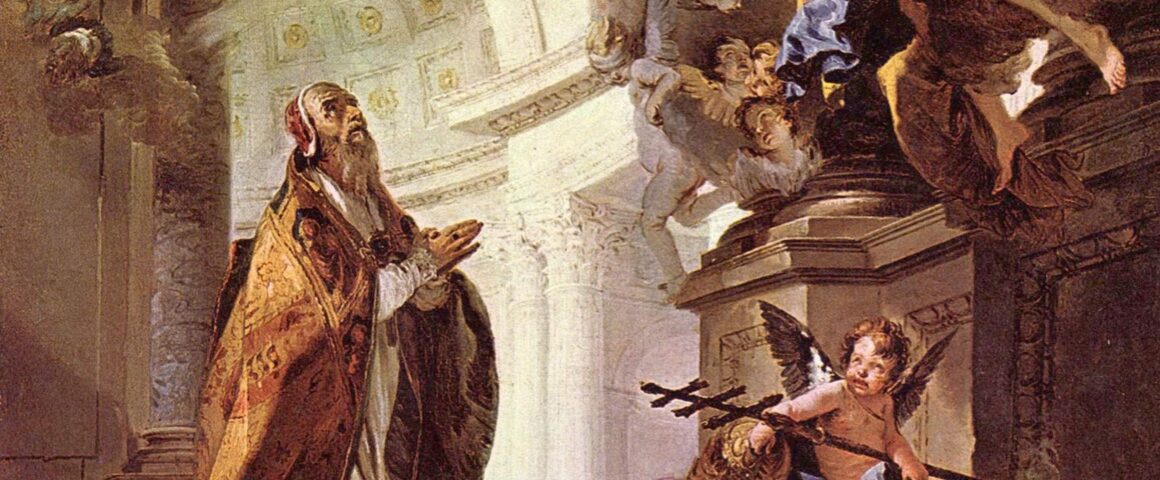
Header image: Giovanni Battista Tiepolo, A Vision of the Trinity, about 1735–1739, National Gallery, London. Detail of Saint Clement at prayer. Public domain; Wikimedia Commons / The Yorck Project. Cropped.