- SS. Crispin and Crispinian, Brothers of Soissons (October 25) [Black Letter Day]
- St. Edmund, King and Martyr (November 20)
- St. Hugh of Lincoln, Bishop and Confessor (November 17)
- St. Machutus, Bishop and Confessor (November 15)
- St. Martin of Tours, Bishop and Confessor (November 11)
St. Hugh
Of Lincoln.1
November 17.
(Born A.D. 1140; died A.D. 1200. Sarum Ep. and Gosp.: Eccles. xl. 1–5; St. Mark xiii. 33–37.)
We come out again into daylight and fresh air in a wide and solid world.
St. Hugh was of an old Burgundian house, the lords of Avalon, near Grenoble. ‘Early,’ says his ‘Magna Vita,’ written by one who lived long with him in a close intimacy, ‘he lost the solace of his mother, bereaved of her when yet a child.’ When he was eight years old his father, parting his property among his children, went with him into a house of Canons Regular at Grenoble, near his own castle. From infancy the child was under strict discipline, and yet not cut off from natural duties. There was a school of noble youths at Grenoble, in which his father had always been especially interested. Here he placed his son Hugh, exhorting him with fatherly tenderness. ‘The levity of thy schoolfellows, dearest son,’ he said, ‘is not lawful for thee; thy lot is not such as theirs. Little Hugh, little Hugh, I nurture thee for Christ, and jest and levity are not for thee.’
Quick in wit and work, of a vigorous and keen intelligence and a capacious memory, he studied diligently. Also he was ever ready to listen to the divine voice, like the child Samuel ‘Speak, Lord, for Thy servant heareth.’ Humble in all services to others, he had delight in the Church services, and so he grew up to nineteen. And then the father was growing old and infirm. The relation between the boy and the old seigneur, genial and gentle, with all his seriousness, had always been especially happy. And now the Prior confided entirely to the son the care of the old man. In this duty he delighted. As he often loved to tell his biographer in later years, ‘he led about his father, carried him, put on his shoes and garments, washed him, made his bed, prepared his food and gave it him,’ and in doing so received a thousand times his father’s blessing, which he loved (in memory) ‘to draw up thirstily from his eager heart.’ Beloved and blessed was he in this by all. ‘The blessing of a father builds up a house.’ And so he waited tenderly on his old father till his death.
At nineteen Hugh was ordained, and very early his earnest preaching waked up slumbering hearts to the love of the heavenly country; and before all he loved to plead with sinners.
But the more secular life of the Canons did not satisfy him. Having taken to the monastic life, he wished for the hardest to be found. The hardest was in all likelihood to be found in the newest Orders. Hugh of Avalon found what he sought on the snowy heights of the Chartreuse and in the monastery founded by St. Bruno about 100 years before. The rule was a combination of the life of the hermit and the cœnobite; each brother living alone in his cell, cut out of the rock, his bedding being a horsecloth, a pillow, and a skin; the dress a horse-hair shirt, worn night and day next the skin, and a white sheepskin, combined; the food a loaf given to each on Sunday morning, to last the week. The brotherhood met at a common table, but silence was strictly observed.
To this Order the young Hugh, brought to the Chartreuse one day by his prior, entreated to be admitted. He was but grimly welcomed. ‘The men who inhabit these rocks,’ an old monk said, ‘are hard as the rocks themselves; severe to themselves and others.’
This threat of severity was not likely to damp, but rather to stimulate a character like Hugh’s. No cause has won converts worth having, without having some cross to bind on the shoulder or stamp on the heart.
Hugh became a Carthusian, and gained from his rocks not their hardness but their steadfastness; which was to be well tested.
There was a library at the monastery, with abundance of books for reading, and abundance of quiet for prayer. The passion for learning grew on Hugh; and also, to balance this intellectual work, he, trained to such tender ministry by his devotion to his own father, had an old monk put under his care, ‘whom he cherished as a mother, serving him as Jesus Christ.’ The old monk was occasionally severe with his patient nurse and rebuked him for being so ambitious as to wish to be ordained priest. But another time he said, ‘Be not troubled, thou, my son, or rather my lord. When God’s time comes thou wilt be a bishop.’
At that time England, after the anarchy of Stephen, and the frightful oppressions and tortures of the barons, let loose from the repressing grip of the early Norman kings, was stirred from end to end by a great religious revival, the first of so many among our English people.
‘Everywhere in town and country men banded themselves together for prayer; hermits flocked to the woods; nobles and churls welcomed the austere Cistercians, a reformed offshoot of the Benedictine Order, as they spread over the moors and forests of the North. A new spirit of devotion woke the slumbers of the religious houses and penetrated alike to the home of the noble and the trader. London took its full share in the revival. The very aspect of the city was changed. The Priory of St. Bartholomew rose at Smithfield and St. Giles at Cripplegate.’ Then followed the struggle of Thomas Becket with King Henry, his murder, the indignation of Europe and of the English people, lay and clerical, the penitence of the vanquished sovereign at Canterbury, the enthusiastic pilgrimages to the new shrine of the new popular Saint Thomas of Canterbury, which threw the ancient homage to the English Dunstan into the shade.
Henry threw himself into the religious movement so far as to invite some of the Carthusians to England, and endow them with lands at Witham, in Gloucestershire, to be the first ‘Charterhouse’ in England. The first abbot could not agree with the Saxon peasants already in possession and soon threw up his office. The second died. Henry sent to the Chartreuse for a third. Reluctantly the brotherhood consented to part with their best to found the Order in the new country.
Thus Hugh of Avalon came to England, and won the hearts of the peasants and the King by that true justice, only possible to sympathy, which satisfied both.
‘My lord,’ he said to the King, ‘until the last obolus is paid to these men this place cannot be bestowed on us.’ ‘Jerusalem,’ he said, ‘must not be built with blood.’ Finally, when the former tenants were removed he restored to them the materials of their houses.
Then after many years, when still the cells and chapel Henry had promised were not built, three of the monks went in deputation to remonstrate with the King. One of them, named Gerard, a man of high birth and fiery temper, receiving but a vague answer from the King, said, ‘You think it a great thing to give us bread which we do not need. I leave to you your kingdom, and depart to our desert Chartreuse and our rocky Alps.’
Hugh tried to stay the fiery rebuke. The King was ‘philosophising, and did not move his countenance.’ ‘And what do you think, good man?’ he said to Hugh when the fiery Gerard ceased. ‘Will you also cede our kingdom to us and depart?’ But Hugh in his sympathetic way had been thinking evidently of Henry’s labours and of his family troubles, of his struggles with his turbulent barons and his no less turbulent children. And he answered the King submissively and mildly, ‘My lord, I do not despair of you. Rather I pity your hindrances and occupations, which weigh against the salutary care of your soul. You are busy; but when God will help, you will finish the good work you have begun.’
‘By the salvation of my soul,’ swore the King, ‘while I breathe you shall not leave my kingdom. With thee I will share my counsels; with thee also the necessary care of my soul.’
Never, those who knew him said, did Henry love and honour any man like this man. They said there was a remarkable likeness between the two, so that Hugh might have been his son; more sonlike indeed to him than any of his own children. His genial talk, his enthusiastic bringing before him the histories of illustrious men, his faithful counsel, and more faithful rebukes, — Henry was pleased with all. Hugh had a remarkable delight in collecting and diffusing the Holy Scriptures, and in this the King assisted him, in the purchase of manuscripts. ‘How much money do you want for this?’ he once asked. ‘One mark will suffice.’ Whereupon the King laughed softly and said, ‘How reckless you are in your demands!’ And then he ordered ten marks to be given. The Bible was Hugh’s delight and riches in tranquil days, his weapon in warfare, his food in hunger, his balm in sickness.
Meantime, while the King delighted in him, the peasants of the country round loved him no less, and sought him for teaching and help. He was believed to work miracles, but these, says his friend and biographer, ‘he cared for less than anything, in the lives of the saints. He neither desired much to hear of them nor to work any such himself. They were good, he said, no doubt, for those who admired them.’ To him, as to St. Gregory, the sanctity of the saints was the miracle; and the example.
Eleven years he remained Abbot of Witham, never seeking any higher post or wider sphere for himself. At the end of that time, he was elected Bishop of Lincoln, then a very large and disordered diocese. The King much desired this, but Hugh refused it again and again. Nothing but the command of his superior at the Chartreuse induced him to accept.
He rode to Winchester with the canons in his ordinary simple style, they on their richly caparisoned palfreys, with sumpter horses and gennets; he with his Carthusian wardrobe, consisting of blankets and sheepskin strapped behind him at the back of his saddle, till the canons, afraid of the ridicule of the crowd, had the straps cut unknown to him and passed his baggage on to the servants.
Soon after his installation he excommunicated the head forester of the King himself for oppressing his tenants about the forest game.
Not long after this the King sent to ask for a rich stall which happened to be vacant, for one of his courtiers. Hugh bade the messenger take back as an answer to the King’s letter that the prebendal stalls were for priests, not for courtiers, and that he must find some other way of rewarding temporal services. Henry, who himself had cared so much for Hugh and for his election, was hurt as well as offended, and summoned the Bishop to meet him at Woodstock, intending to show how gravely he was displeased. When Hugh arrived at the park gates Henry rode off with his retainers into a glade of the forest, and there sat down on the ground to receive the delinquent bishop; and when he approached, by the royal command, no one rose or spoke. Hugh saluted the King. There was no answer. No one moved or spoke. The Bishop turned towards the King, but still there was silence. At last Henry, looking up, asked for a needle and thread; he had hurt a finger of his left hand. It was wrapped in a strip of linen rag: the end was loose; he began to sew. Still the awful silence continued.
The Bishop watched him through a few stitches, and then grimly said, ‘Quam similis es modo cognatis tuis de Falesia! (Your Highness reminds me of your cousins of Falaise).’ Like a light but penetrating dart the daring words went to the King’s heart. Alone, of all present, Henry understood the allusion, and with a sudden reaction from his over-acted anger and silence to the old cordial understanding, he clenched his hands, struggled hard to contain himself, and at last rolled on the ground in convulsions of laughter. ‘Do you understand the insult this barbarian has heaped on us?’ he said. ‘My ancestor the great William’s mother came of a very middle-class family at Falaise, a town famous for its tanning; and so this mocker, seeing me sewing up my finger, recognises me as a kinsman of the tanners of Falaise.’ Then the king demanded explanations of Hugh as to his forester.2
The Bishop did not yield the point, but respectfully gave his reasons, saying he knew the King only desired justice in his dominions. Henry was convinced, and gave up the delinquent forester, whom the Bishop first had flogged, and then absolved, and made him his firm friend ever after. But no courtier afterwards asked for a stall at Lincoln.
If a man really honestly enjoyed his cell and horse cloth, with ministering to the suffering poor, more than any riches or honours the King could give — if he was quite free from worldly vanity, pride, and covetousness, and also victorious over the subtler temptations of spiritual vanity, and pride and covetousness, he must obviously have stood on a vantage-ground from which no king could displace him, possessed of a content no king could give him. It must also be remembered that St. Hugh was a Burgundian and no born subject of Henry’s, and that the royalty of Henry’s house was recent, so that probably his Angevin and Norman blood would seem to Hugh of Avalon no nobler than his own.
Among his own clergy he kept unity and peace, although, or perhaps because, he confessed ‘my own temper is sometimes hotter and sharper than pepper. I thank them for bearing with me.’
In the episcopate he kept, as much as possible, to his old Carthusian dress and ways of living, sometimes carrying stones with the masons for the building of his new cathedral and the various religious houses on that fine terrace at Lincoln with its wide outlook.
He had great delight in visiting the sick, and also in paying honour to the dead, especially the poor. ‘If they had been good they were worthy of honour; if not, they needed help the more.’ He would never allow any of his priests to perform the last rites if he were near. Once when he found that a poor beggar had been buried by the roadside where he had died, the Bishop stopped in his journey to perform the funeral service. For the sake of rendering this last service he delayed coming to King Henry’s table. And once he kept Richard Cœur de Lion (not the most patient of the fiery Plantagenet kings) waiting for dinner, while he was ministering beside a grave at Rouen. ‘He need not wait,’ said the Bishop to the courtier who came to fetch him; ‘let him go to dinner, in the name of God. Better the King dine without my company than that I leave my Master’s work undone.’ ‘It may be observed,’ says his biographer, ‘that he who neglected two kings to bury the poor, at his own burial, was followed by two kings.’
His compassion was deepest for those who had sunk the lowest; for lepers, then so common in England, he had the tenderest pity. He would spend days under the same roof with them, touch them and kiss them, feeling that in them he touched the hand of Him who touched the leper of old in Galilee.3 When the Chancellor of Lincoln, ‘a very good and learned man,’ once said to him, wishing to test whether, on account of the excellence of this work, this just man was elated in spirit, ‘St. Martin kissed the leper, and by kissing healed him; but you do not cure the lepers you kiss,’ the Bishop at once answered, ‘Martin’s kiss healed the body of the leper, but my kiss of the leper heals my soul.’ ‘Bone Jesu,’ exclaims his biographer parenthetically, after describing the loathsomeness of these diseased ones, ‘forgive my unhappy soul for referring to this.’ Yet while living in their lazarhouses, and consoling them with the tenderest words, he would gravely and faithfully reprove them, if needful, and seek to cure them of their sins. His heart went out in a rapture of love to the Saviour for His kindness to such. ‘Unhappy those,’ he said, ‘who feared anything so much as grieving Him, who thought anything sweet in comparison with Him, who thought anything bitter with Him.’
Another significant saying of his is worth remembering, as to miracles. Once, in a country town near Troyes, his chaplains were much impressed by the story of a miracle which a priest of the place described as having turned him from unbelief. This priest said he had seen the Sacramental wine at the altar turn visibly into blood. ‘In the name of God,’ said the Bishop, ‘let him keep to himself the signs of his unbelief, let him indeed gaze, if he will, through the little doors of his eyes, on Him whom he would not see by the inward gaze of faith. What have we to do with such things who every day partake of the Heavenly Sacrifice?’
For the diseases of the soul his pity was deepest of all. His sermons are said to have brought back multitudes of sinners. And from the execution of the sentence of death, in those days of cruel severity, he more than once rescued, at any peril, those who took sanctuary with him.
Allusions are also made in his Life, to his courageous quelling of riots in Lincolnshire and Northumbria, encountering a mob when all the rest had fled.
Children and animals also trusted and loved him, the shyest little ones, it is said, creeping fearlessly close to him in the houses which he visited. For them he had always smiles and fun, and yet a tender reverence. ‘Suffer the little children to come unto Me,’ echoed in his heart.
And there was one especial swan, very fierce and feared by everyone, who felt himself so understood by the Bishop that he accepted food from his hands, waited about for him, and would even poke his long neck into the ample sleeves and folds of his dress, making joyful sounds of welcome and also little soft cries (mussitare) for crumbs. Sometimes he would go back for a visit to his old convent of the Grande Chartreuse, where, with his liberal hand and gracious speech and bearing, he had an enthusiastic welcome from all, especially from the poor. At home he was the defender of the orphan and forsaken. And he would never accept fines (as was too common then) as an atonement for any wrong, instead of penitence and reparation.
His relations with Richard Cœur de Lion were as intimate and as original as with Henry. He had studied the English laws, and he absolutely refused to impose burdens on the clergy to furnish soldiers for foreign service, though he recognised the obligation to provide for military service at home. For this offence he was summoned to Roche d’Andely, near Rouen, to answer for his refusal to the King. He found him on a stately throne at the entrance of the choir, hearing Mass. Hugh went up to him and demanded the customary kiss. Richard frowned and turned away; the Bishop insisted. ‘You have not deserved it,’ said the King. ‘I have deserved it,’ said the bishop, grasping Richard’s robes and shaking him; ‘kiss me.’ The kiss was given. Then the archbishop and bishops would have placed Hugh in a place of honour, but he went through them all to the corner of the altar and knelt there with humblest devotion.
Afterwards the king yielded to his counsel as to foreign military service. But the bishop sought for deeper things, in his intercourse with the king. He sought to see Richard alone and asked him then if he had no sin on his conscience. Richard said he was conscious of no special sin but being too angry with his French enemies. But the bishop searched deeper. Were there no oppressions of the poor, no unfair exactions of taxes, no unfaithfulnesses to his queen? The king did not fly into a rage, but listened to the admonition and said afterwards: ‘If all bishops were like my lord of Lincoln, not a prince among us could lift up his head against them.’ Hugh was called with reason ‘the hammer of kings.’
But Richard also passed away from the affectionate rebukes of Hugh of Lincoln to another tribunal; and when he died, the bishop, a lion in real danger, insisted on going through a disturbed country, at peril of his life, to pay Richard the funeral honours he had often risked his displeasure rather than not pay to the poor.
And now of that strong royal house only John with his falseness and meanness was left. Between him and Hugh there could be no sympathy. ‘I trust you mean what you say,’ the bishop said to John; ‘you know I much hate lying.’ He warned him also against trusting in a stone amulet he wore round his neck. ‘Trust not in that senseless stone, but in the living stone, the Lord Jesus Christ,’ he said. And at Fontevrault he pointed out to John with significant earnestness a sculpture of the Day of Judgment, ‘with a group of crowned kings being led away by devils to the smoking pit.’
But the strong, well-worn frame was failing. He knew it, and prepared with humble confession of sin, but without terror, for death. He would not give up his hair-shirt, but yielded so far to the physicians as to take a little meat. The fever of which he died came on him in London. King John came to visit him on his deathbed, with blandest expressions of respect, but to him Bishop Hugh said little. Archbishop Hubert, who had much thwarted him, also came to see him, and suggested that he should ask pardon of him as his primate and spiritual father for the sharp words he had said to him. The bishop, on the contrary, thought it his duty to apologise, not for what he had said but for what he had omitted to say, ‘for your negligence and attachment to the world,’ said he, ‘do sore damage to the souls placed under your direction.’
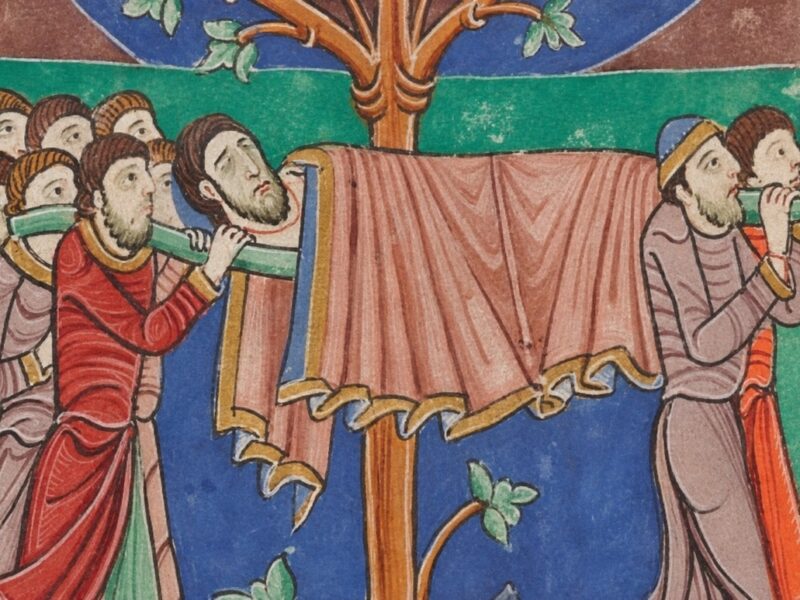
And so on the afternoon of March 17, 1200, St. Hugh of Lincoln died. The choristers of St. Paul’s were sent for to chant Complin for him for the last time. He had himself laid on the ashes on the floor of his room, and there, in great tranquillity, while they sang the Nunc Dimittis, his spirit ‘departed in peace.’ His body was carried to Lincoln. The highest and the lowest came to meet him, and the Jews (banished ninety years after from England for nearly four centuries) ventured to come to show their reverence for this just man. King John and three archbishops, Hubert among them, took the bier on their shoulders and waded knee-deep through the mud to Lincoln Cathedral. The king of Scotland stood apart in tears.
Notes
- Chief authority: Magna Vita St. Hugonis Episcopi Lincolnensis, in the Rolls Series, edited by Rev. James F. Dimock.
- Brev. ad Usum Sarum Sanctorale, St. Hugh, Lectio viii.
- Brev. ad Usum Sarum Sanctorale, Lectio vii.
Dedications of churches, one at Quethiock, in Cornwall. Represented in art with a tame swan, holding three flowers in his hand.
Source: Elizabeth Rundle Charles, Martyrs and Saints of the First Twelve Centuries: Studies from the Lives of the Black Letter Saints of the English Calendar (London: Society for Promoting Christian Knowledge; New York: E. & J. B. Young, 1887).