- SS. Crispin and Crispinian, Brothers of Soissons (October 25) [Black Letter Day]
- St. Martin of Tours, Bishop and Confessor (November 11)
- St. Machutus, Bishop and Confessor (November 15)
- St. Hugh of Lincoln, Bishop and Confessor (November 17)
- St. Edmund, King and Martyr (November 20)
- St. Clement of Rome, Bishop and Martyr (November 23)
- St. Catherine of Alexandria, Virgin and Martyr (November 25)
St. Catharine.
Of Egypt.
November 25.
(Martyred A.D. 307. Sarum Ep. and Gosp.: Ecclus. li. 1–8; St. Matt. xiii. 44–52.)
The legend of St. Catharine does not date further than the eighth century even in the East, and it does not rise above the horizon of Western Christendom until after the Crusades in the eleventh century.1
It is curious as an evidence of the common life which throbbed through medieval Christendom and of the flowing back of the East on the West through the Crusades, to find, by the beginning of the fourteenth century, Venice taking her as patroness of her colleges; fifty churches dedicated in her name in England; and in France the heroic peasant girl of Domremy, dreaming in her childhood among the forests of Catharine and Margaret as the foremost saints in Paradise, and believing she received that inspiration of ‘great pity’ by which she rescued France, through their voices.
When Joan of Arc was asked, during that six months’ trial at Rouen, ‘Did she know she was to be wounded at Orleans?’
‘I did know it,’ she said, ‘but I told the king nevertheless not to desist from action.’ And ‘St. Catharine heartened her,’ she said, ‘so that she rode on in spite of her wound.’
They asked her how she knew St. Michael and the angels from St. Margaret and St. Catharine.
‘By their voices,’ she said, ‘and because they told me.’
They asked her details as to their forms.
She would only say she saw the glorious faces, always the same; and a great light, and that the voice was ‘beautiful, gentle and humble, and spoke French.’
And, as no other saints except the mother of the Lord, the names of Catharine and Margaret have stamped themselves on our common speech — Margaret giving her name to the daisy with its golden heart and ‘crimson-tipped’ rays, the little children’s flowers, commonest of all; and Catharine to this day flashing in the Catharine wheels.
The legend of St. Catharine may be given thus: —
St. Catharine was the daughter of Costis and Sabinella, King and Queen of Egypt. From her earliest childhood she was the wonder of all for her beauty of mind and face. She studied Plato, and would have answered the questions of the Queen of Sheba better than Solomon.
Her father built her a high tower with many fair chambers full of books and mathematical instruments. And from the top she would study the stars in that clear sky of Egypt, and all the creation to her was full of wonder and delight.
Her father and mother were excellent and most loving to her, but they died early and left her a queen at fourteen, and wiser than all around her, but an orphan and alone. She was more beautiful than any princess in the world, but she did not care for any pomp, or dress, or all her precious things. God’s golden stars seemed to her more magnificent than all the treasures of earth, and she shut herself up in her palace and studied philosophy, Plato, and the stars, till she grew wiser than all the wise men of the East.
Then the people of the country grew disturbed, and came to her and entreated her to marry, that she might have one by her side to share the cares of government and lead them forth to war.
When she heard this she was much troubled.
‘What manner of man is this that I must marry?’ she said.
‘Madam,’ the spokesman of the people said, ‘you are our most sovereign lady and queen, and you have four notable gifts: the first, that you are come of the most noble blood in the whole world; the second, that you are a great inheritor; the third, that in wisdom you surpass all others; the fourth, that in bodily shape and beauty there is none like you. Wherefore we beseech you that these good gifts with which the great God has endowed you may induce you to take a lord to your husband, to the intent you may have an heir to the comfort and joy of your people.’
Then the young queen Catharine, with a grave countenance, said that if God had indeed so endowed her she must the more love Him; and if they would have her wed, her husband also must possess four noted gifts. ‘He must be of blood so noble that all men should worship him; so great that he shall never think I have made him king; so rich that he shall pass all others; so full of beauty that angels of God shall desire to behold him; and so benign that he will gladly forgive all offences done to him. Him, if you find him, will I take for my lord and husband of my heart.’
Then the councillors and people despaired, for they said, ‘Such a one as she has desired there never was nor ever will be.’
But she said, ‘If I do not find him he shall find me, for other will I none.’
Now, near the queen’s palace there lived a poor old hermit in a cave, and that very night the Holy Virgin Mother of our Lord appeared to him and told him that the King who should be Lord of the queen’s heart was none other than her Son. Then the hermit went to the palace and presented the queen with a picture of the Virgin and her Child; and when St. Catharine saw it her heart was so filled with its holy beauty that she forgot her books, her spheres, and the stars. Plato and Socrates became tedious to her as a twice-told tale, and she kept the sacred picture always before her.
That very night she had a dream. She met on the top of a high mountain a glorious company of angels, clothed in white, with chaplets of white lilies. She fell on her face before them, but they said, ‘Stand up, dear sister Catharine, and be right welcome.’ Then they led her by the hand to another company of angels, more glorious still, clothed in purple, with chaplets of red roses. Before these she fell on her face, dazzled with their glory; but they said, ‘Stand up, dear sister Catharine; thee hath the King delighted to honour.’ Then they led her by the hand to an inner chamber of the palace of heaven, where sate a Queen in state. The angels said to her, ‘Our most gracious Sovereign Lady, Empress of Heaven and Mother of the King of Blessedness, be pleased that we present unto you this our sister, whose name is in the Book of Life, beseeching you to accept her as your daughter and handmaid.’ Then our Blessed Lady rose and smiled graciously, and led St. Catharine to her beloved Son. But He turned from her and said sadly, ‘She is not fair enough for Me.’ Then St. Catharine awoke, and in her heart all day echoed the words, ‘She is not fair enough for Me.’ And she rested not until she became a Christian.
And when Catharine was baptised the Blessed Virgin appeared to her again in a dream with the Divine Child, and presented her to the Lord of Glory and said, ‘Lord, she hath been baptised, and I myself have been her godmother.’ Then the Lord smiled on her and held out His hand and plighted His troth to her. When she awoke she saw the ring on her finger, and thenceforth despised the world and all its pomps for Him.
Soon after this Maximin, the cruel tyrant, came to Alexandria from Italy full of rage against the Christians, and made an edict that there should be such a sacrifice to the gods as had never been known before. And from all the country they brought oxen and sheep to sacrifice, and the city was full of their lowing and bleating and of the preparation for the sacrifice and feast.
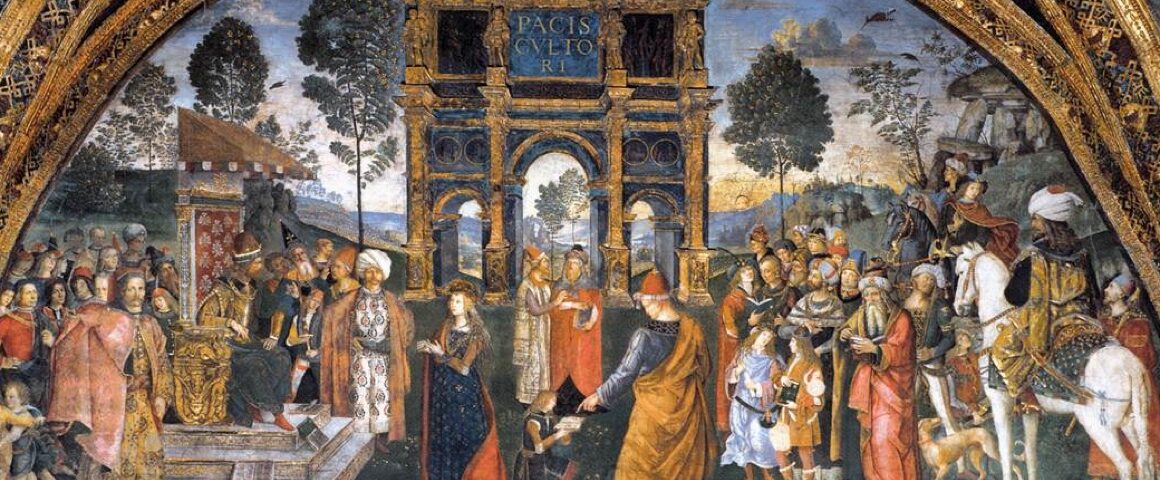
Then Catharine, the queen, knowing that after the blood of rams and oxen would flow rivers of the blood of the Christian brethren, did not wait to be summoned, but with her royal heart, taking the people under her protection, went herself to the great temple of the god Serapis, where Maximin was celebrating his wicked rites, and confronted him and demanded to be allowed to plead for the Christians and to show the glory of the Christian faith.
And her beauty of countenance and majesty of bearing being as great as her rank the Emperor was subdued, and permitted that a great assembly of the people should be called, and that also the priests and philosophers should appear to defend the gods and Catharine should speak for Christ her Lord.
And the assembly was convened, and fifty of the ablest sophists were called on to defend their gods; and they began with scorn, saying that the least of the scholars was able to answer this royal maid. Catharine, full of humility, had prepared herself by prayer and fasting, knowing that she had no strength but of God.
And such was the wisdom and majesty of truth and tender pleading with which she spoke, quoting their own wisest, such as Plato and Socrates, to prove there was one God, and only one, Creator of the glorious stars she knew so well, and of heaven and earth and all men, showing by Greek philosophers and Hebrew prophets, astronomers and sybils, that Christianity not only brought to them something glorious and new, but restored to them the old treasures of their forefathers which they had lost, — that the fifty opponents laid down their weapons of argument and confessed that she was right and that Christ the Lord was God. And with them a great multitude of the people believed.
But the rage of the cruel Maximin knew no bounds. He ordered the new converts to be massacred. And they went to the Christ they had confessed consecrated by the baptism of blood; and the glorious princess herself was both racked and tortured, and then laid with her bruised and wounded limbs in a dungeon, with no one to wait on her, to die of hunger. But her eloquence and her patience had touched the heart of the Empress Faustina, Maximin’s wife, and in a dream she saw Catharine come to her and offer her a crown from Christ the Lord. Therefore the Empress Faustina and Porphyry, the Emperor’s chief captain, came to her in the dungeon. And then the captive princess spoke to them of the Christ who had died for all, and for whom she suffered, so that the Empress and Porphyry believed. Catharine had no earthly promises to give them, none but the promise of following the Lord to death. She said they should go to their Lord by the path of martyrdom in three days if they were faithful to the end. Wounded, she healed their wounded souls; captive, she set them free; in the darkness of the dungeon she brought them light. In three days the tyrant had the Empress and Porphyry put to death. And then once more he began the combat of torments with Catharine. Four wheels were made with spikes, between which she was to be torn in pieces; and to these she was bound. But fire came from heaven and broke the wheels in pieces, so that the fragments flew far and wide and injured many. But Catharine stood in the midst untouched.
And at last she was led outside the city of Alexandria and beheaded by the sword.
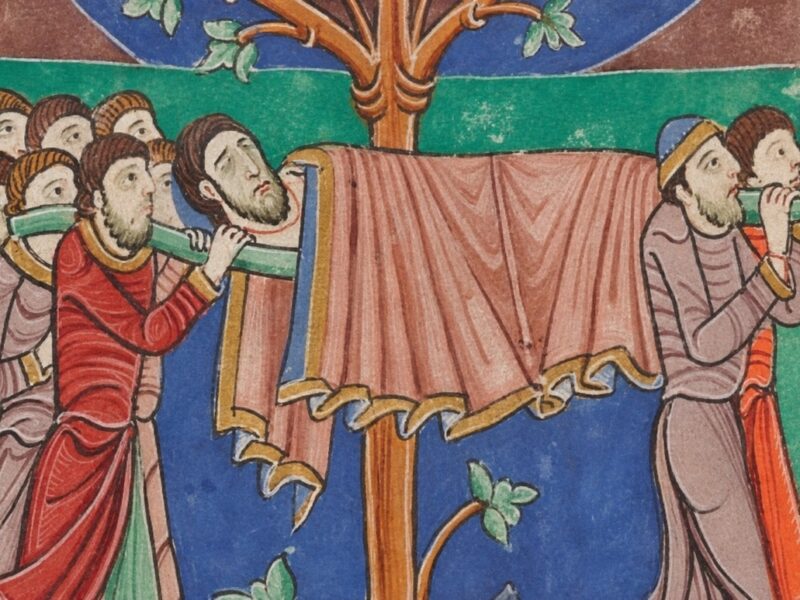
But the angels came and bore her body tenderly in their arms across the Red Sea and across the sandy desert, which the children of Israel had trodden of old, and laid her to rest on the top of the holy mount that must not be touched — Mount Sinai.
And thus after many hundred years she was found, her raiment indeed waxen old with the ages, but her body folded as in silken robes by the rich tresses of her fair hair, an aureole around her brow, and a heavenly fragrance breathing from the tomb. And meanwhile the blessed spirit had long dwelt with Him who had made her ‘fair enough for Himself.’
And so these two, Margaret and Catharine, shone on the West from the Eastern lands where they lived and suffered, the two great Virgin Patronesses; two highest types of womanhood: Margaret meek and patient and strong to suffer; Catharine queenly and wise, with her keen and cultivated intellect and her royal, fearless eloquence; going forth to encounter danger for her people as a mother bird for her brood, and from the depths of her dungeon bringing light and liberty even to those who had bound her there.2
Notes
- Ruinart (and Alban Butler, quoting Joseph Assemani) come to the conclusion that all the particulars we have on which we can depend are a passage in Eusebius about a Christian lady of Alexandria, illustrious for her high birth, great wealth, and likewise for her singular learning, who having resisted all the temptations and menaces of the tyrant Maximin, was by him despoiled of all her estates and goods and sent into banishment.
- Dedications of churches: 51. Represented with a wheel; with a sword, book, a lamb, a palm; carried by angels to Mount Sinai.
Source: Elizabeth Rundle Charles, Martyrs and Saints of the First Twelve Centuries: Studies from the Lives of the Black Letter Saints of the English Calendar (London: Society for Promoting Christian Knowledge; New York: E. & J. B. Young, 1887), pp. 182–188. Digitized original.
Header image: Pinturicchio, St Catherine’s Disputation, 1492–1494, Borgia Apartments, Vatican. Public domain; Wikimedia Commons / Web Gallery of Art. Cropped.