St. Edmund the Martyr.
November 20.
(Born A.D. 840; martyred A.D. 870. Calendars: Sarum, Scotch, Hereford. Sarum Ep. and Gosp.: Eccles. xxxi. 8–11; St. Luke xiv. 26–33.)
Four English martyrs are in our Calendar, from four successive centuries, who fell on English ground, besides the great missionary bishop who died by the hands of the heathen in Friesland. Of these four, three marked three successive campaigns by which Christianity was won and kept for England.
Nowhere in Europe was the fight for Christianity harder and more repeated than in England. Three times was the battle fought and won, with the persecuting forces of Imperial Rome and with the Saxon.
The protomartyr Alban marks the union of England with the Continent, and the period of Roman rule. Of Roman name, educated at Rome, he was slain, a victim to the ancient paganism, with its temples to Jupiter and to Diana, in the last desperate conflict of the decaying empire with the rising Church.
Over that early Roman civilisation the tide of northern barbarism swept, and utterly destroyed it. Pagan temples and Christian churches, Roman cities and villas, with the surrounding world of British peasants and slaves, vanished so entirely that when, 400 years after, Bede gives the story of Alban, though he preserves the tradition of a Christian man who, no doubt, really lived and died at Verulam, it is a tradition garlanded with flowers of legend from a world as foreign and far off as the stories of the virgin martyrs of Rome or Sicily.
From the next deadly battle between Saxon heathenism and Roman-British Christianity no martyr’s name has survived in our calendars. Yet that conflict also had its spiritual heroes.
Two thousand monks were gathered at Bangor in one of those vast religious settlements which were characteristic of Celtic Christianity, and after a three days’ fast a crowd of these ascetics followed the British army to the field near Chester, Æthelfrith, the Saxon chief, watched the wild gestures of these monks as they stood apart from the host with arms outstretched in prayer, and bade his men slay them in the coming fight. ‘Bear they arms or no,’ said the king, ‘they war against us when they cry against us to their God.’ And in the surprise and rout which followed, these monks were the first to fall.
Something of the martyr glory surely must be given to those whose prayers the enemy felt to be a warfare so real. This the final defeat of the early British Christians was in 593, nearly 300 years after the martyrdom of St. Alban. Four years afterwards Augustine of Canterbury won the Saxon kingdom of Kent to the Christian Faith. But it was as a foreign conquest. The links with the earlier Christianity were broken.
The next English martyr marks another wave of heathenism which swept from the barbarian North over England.
The Danish pirates in Scandinavia, uniting with those who had settled in Ireland, had conquered Northumbria, and, being beaten back in Mercia, threw themselves all the more fiercely on East Anglia.
There was reigning at the time the young king Edmund, not yet twenty-nine. Young as he was, he had been king, ‘under-king, landlord, and duke’ of East Anglia, Suffolk, and Norfolk for fourteen years. When King Offa went to end his days in piety and penitence at Rome, his boy successor was crowned, in 855, by Bishop Humbert, on Christmas Day, at Sudbury, a royal country house on the Stour.
Generous and just, peaceable and devout, he seems from the first to have entered on that especial conflict with the especial perils of his own position, which has been said to be the note of saintliness. ‘He hated flatterers, and would see with his own eyes and hear with his own ears, so much did he dread one-sidedness in his judgments, inaccuracy or falsehood of reports, and the manoeuvres and subtleties of human passions.’
His love of his people was rooted deep in the love of God, and his piety was fed by learning, marking, and inwardly digesting the Holy Scriptures. It is said that he lived as far as he could in solitude for one whole year in a tower which he had built for a country retreat at Hunstanton, in Norfolk, that he might learn the Psalter by heart, so as to be able to repeat it at night, when travelling, or in the intervals of his regal work.
The kingly ideal of the seventy-second Psalm seems to have moulded his life. He judged his people with righteousness and the poor with judgment. He judged the poor of the people and saved the children of the needy. He delivered the needy when he cried, the poor also, and him that had no helper. He redeemed their soul from deceit and violence, and precious was their blood in his sight. The widow and the fatherless found in him their protector. Thus it was in his peaceful days; and when the dark days of warfare came he sought with all the strength he had to ‘break in pieces the oppressor.’
‘And,’ so says Carlyle, ‘there is clear evidence that his people honoured, loved, and admired him to quite an astonishing degree, and indeed at last to an immeasurable and inexpressible degree; for finding no limits or utterable words for their sense of his worth, they took to beatifying and adoring him. “Infinite admiration,” we are taught, means worship. His life has become a poetic, nay, a religious mythus, though undeniably enough it was once a stern fact, as our poor lives are, and even a very rugged and unmanageable one, and clearly he had contradictory speeches and contradictory facts not a few to reconcile with himself. No man becomes a saint in his sleep. Edmund, for instance, instead of reconciling these same contradictory facts and speeches to himself, which means subduing and in a manlike and godlike manner conquering them to himself, might have merely thrown new contention into them, new unwisdom into them, and so have been conquered by them, much the commoner case. In that way he had proved no saint or god-like man, but a mere sinner, and unfortunately blamable, and more or less diabolic-looking man.
‘How then, may it be asked, did this Edmund rise into favour? Really, except it were by doing justly and loving mercy to an unprecedented extent, we do not know. The man, it would seem, “had walked,” as they say, “humbly with God,” humbly and valiantly with God, struggling to make the earth heavenly as he could, instead of walking sumptuously and pridefully with Mammon, leaving the earth to grow hellish as it liked.
‘On this people of Norfolk and Suffolk, living in industry and peace under their beloved young king, burst the Danish heathen hordes, under two of the fiercest of their chiefs, Hincmar and Hubba, sons of Ragnar Lodbrog. They seemed to have had an especial hatred of Christianity. They had destroyed and plundered towns and monasteries in Northumbria and Mercia. In the Fens they razed to the ground the great abbeys of Crowland, Bardney, Peterborough, Ely, and Huntingdon. They massacred the clergy and the nuns with fierce mockeries. At Peterborough Cathedral is shown the stone once placed over a pit in which fourscore murdered monks were buried.
‘From the Fens these pirates rushed down on Suffolk and burned the town of Thetford. There King Edmund gathered all his forces, encountered them in battle, and defeated them. But after their defeat large reinforcements so increased the Danish hosts that Edmund, wishing to avoid useless slaughter, disbanded the few troops he had and retired towards his castle of Framlingham.
‘The Danes seem to have held him personally in some consideration, for they endeavoured to make a separate truce with him, separating him from his compatriots; but the terms they offered not being such as could save his people or defend their Christianity, the King rejected them without hesitation.
‘Then a band of Danes took him prisoner at Bosor, on the Waveney, and brought him loaded with fetters to the tent of the chief, Hincmar.
‘Here again safety was offered him and certain terms of peace; but they involved the betrayal of his people and his faith, and the young King would not listen to them for a moment.
‘“Cannot we kill you?” cried they.
‘“Cannot I die?” answered he.
‘And so he was martyred — beaten and cruelly tortured, and then bound to a tree, shot to death as a mark for countless arrows, ‘the St. Sebastian of England.’ ‘Seen and felt by all men to have done a man’s part in this life pilgrimage of his; and benedictions and outflowing love and admiration from the universal heart were his meed. “Well done! well done!” cried the hearts of all men. They raised his slain and martyred body, washed its wounds with fast-flowing and universal tears; tears of endless pity, yet of a sacred joy and triumph — the beautifullest kind of tears; indeed, perhaps the beautifullest kind of thing; like a sky all flashing diamonds and prismatic radiance, all weeping yet shone on by the everlasting sun. And this is not a sky, it is a Soul, a living Face. Nothing like this Temple of the Highest , bright with some real effulgence of the Highest, is seen in this world.’
‘Now might all Anglia laud and follow a hero martyr and great true son of Heaven.
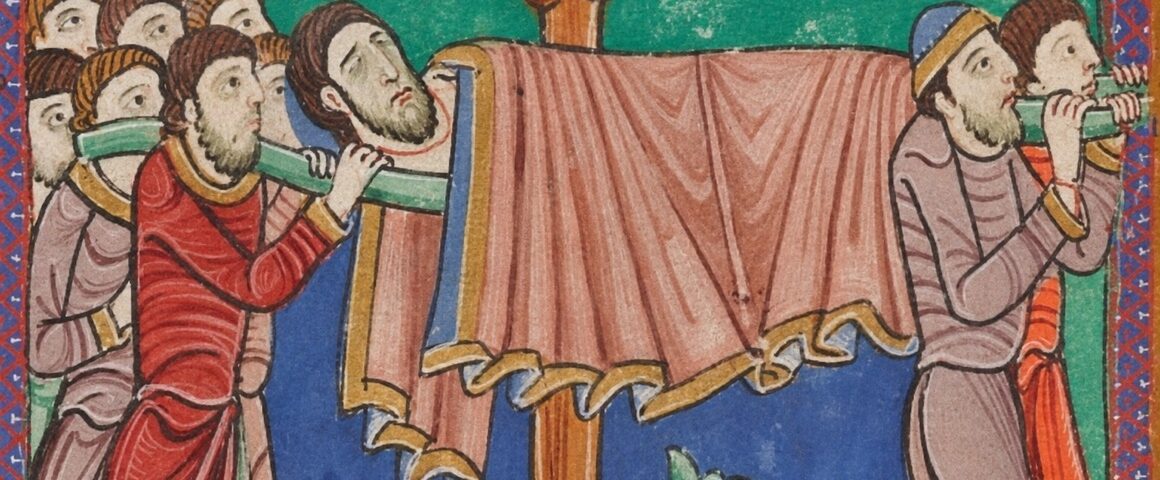
‘In this manner did the men of the eastern counties take up the slain body of their Edmund where it lay, cast forth in the village of Hoxne; seek out the severed head and reverently reunite the same. They embalmed him with myrrh and sweet spices, with love and pity and all high and awful thoughts; consecrating him with many stories of melodious adoring admiration and sun-dried streams of tears; joyfully yet with awe, as all deep joy has something of the awful in it, commemorating his noble deeds and godlike walk and conversation while on earth; till at length the Pope and cardinals at Rome, summing up the general verdict of mankind, declared with their Advocatus diaboli pleading and their other forms of process that he had in very fact lived a hero’s life in this world, and, being now gone, was gone, as they conceived, to God above, and reaping his reward there. Such, they said, was the best judgment they could form of the case; and truly not a bad judgment, acquiesced in and zealously adopted, with full assent of “private judgment,” by all mortals.
‘Pious munificence provided him a shrine, a wooden chapel, a stone temple, ever widening and growing by new pious gifts. Such the overflowing heart feels it a blessedness to solace itself by giving. The wooden chapel has become a stone temple; stately masonries; long drawn arches, cloisters, sounding aisles buttress it and girdle it far and wide. The united companies of men devote themselves in every generation to meditation on man’s nobleness and awfulness, and show forth the same as best as they can, thinking they will do it better here in presence of God the Maker and of the so Awful, so Noble made by Him. In one word, St. Edmund’s body has raised a monastery around it. New gifts, houses, farms come ever in. King Canute with his crown and gifts; many other kings, queens, wise men, and noble, loyal men. Beodric’s Worth has become St. Edmund’s Bury, and lasts visible to this hour.
‘Certain times do crystallise themselves in a magnificent manner. Let us withal be hopeful.’1
Notes
- Carlyle, Past and Present.
Dedications of churches: 55 (15 being in East Anglia), unless any be to St. Edmund the Archbishop. Represented in art crowned and pierced by many arrows, bound to a tree as above, a wolf guarding his body or crowned head, an arrow in his hand.
Source: Elizabeth Rundle Charles, Martyrs and Saints of the First Twelve Centuries: Studies from the Lives of the Black Letter Saints of the English Calendar (London: Society for Promoting Christian Knowledge; New York: E. & J. B. Young, 1887).