- SS. Crispin and Crispinian, Brothers of Soissons (October 25) [Black Letter Day]
For the October 25 commemoration of SS. Crispin and Crispinian, we reproduce Elizabeth Rundle Charles’s account of the brothers of Soissons, their witness to Christ, and the dignity of faithful work.
SS. Crispin and Crispinian, Brothers
Of Soissons.
October 25.1
(Martyred A.D. 288. Sarum Ep. and Gosp.: 1 Cor. v. 9–14; St. Matt. x. 16–22.)
Crispin and Crispinian,2 missionaries and martyrs at Soissons during the Persecution of Diocletian, are again links between the Anglican and Gallican Calendars.
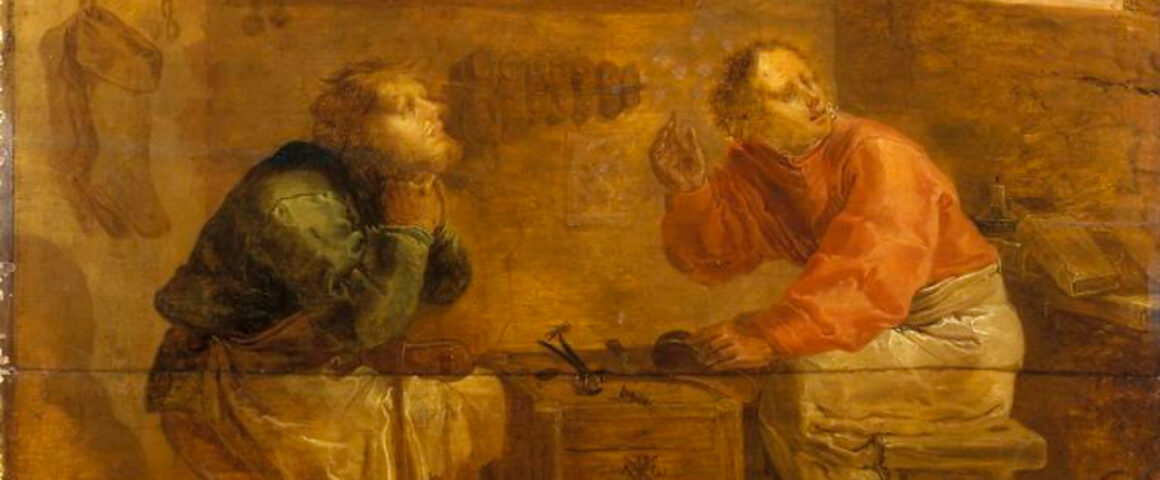
They were brothers, and in these monastic medieval biographies a glimpse of family life and affection is always precious. Of a noble Roman family, together they believed, together gave up all for Christ, and together went as missionaries to the North of Gaul, and there, at Soissons, together they worked (like St. Paul at his tents) at the trade of shoemaking, not choosing to be of charge to anyone. Sitting at the shoemaker’s last, they welcomed all who came, listened to their questions, taught them of Christ and all the time went on making excellent shoes.
Their courteous, polished manner, their easiness of access, and their good shoes, attracted many to their workshop. And so they remained living at their humble post in the city, sowing, unobtrusive and undisturbed, far and wide, the good seed; until the seed sprang up and bore fruit a hundredfold; and then the enemy, seeing the harvest of conversions, at last searched out the hidden sowers, found the brothers at their quiet work, and brought them before the tribunal.
‘Is it Jupiter, or Diana, or Apollo, or Mercury, or Saturn that you adore?’ they were asked.
‘We adore the One Only God,’ was the reply of the brothers.
‘Whence came you, and what are you doing in Gaul?’
‘We are of a noble Roman family. We came to Gaul in the name and for the love of Jesus Christ, True God, One with the Father and the Holy Spirit.’
Riches and honours were promised them if they sacrificed; and they were menaced with all kinds of tortures if they continued faithful.
‘Your threats alarm us not,’ they said. (The ‘they’ is the touching feature throughout the story of these brothers, undivided in life and death.) ‘The Christ is our Life; death to us is gain. Your silver and your honours, give them to those who serve you. Long since we renounced all these with joy for Christ.’ Then summoning their judges before the higher tribunal, they warned them of the judgment to come and held out to them the promises of eternal life.
The place of their imprisonment is still shown at Soissons; it was part of the residence of the Roman governors.
They endured prolonged torments by fire and in other ways, during which they sang in the words of the old Hebrew Psalmist, ‘Help us, O God, for the glory of Thy name. Wherefore should the heathen say, Where is now their God?’
At last their sufferings were ended by their being beheaded.
It is said that their persecutor, maddened by his failure to conquer them, threw himself into the flames which had been kindled for the martyrs.
The heart goes back affectionately to that open shoemaker’s stall at Soissons, from which so much that is bright in its picturesque streets, pleasant walks, and noble churches sprang.3
For not only as patrons of shoemakers may we think of Crispin and Crispinian, but as leaders of all co-operative labour, setting a saintly and royal stamp on all faithful work of the hands, heralds of a day when all men may be not lowered to a monotonous level, but lifted on different levels to infinite varieties of soil and aspect and climate, as in the mountain ranges, by each doing his best, and by all receiving their due; when all work may be ennobled by being done to the One Father, and for all the brothers, and therefore done well.4
Notes
- The day of the battle of Agincourt in Shakespeare’s Henry V.
- Shakespeare’s Crispin, Crispian.
- It is interesting to read in Alban Butler’s Lives, in connection with the shoemaker saints, a sketch of Le Bon Henri, founder of a religious guild of Brother Shoemakers—Frères Cordonniers. Henry Michael Buch was born of poor parents early in the seventeenth century at Erlon, in Luxembourg, and was apprenticed to a shoemaker, and early set before him SS. Crispin and Crispinian as examples of doing all work to God. He spent much of his leisure in prayer, in visiting the sick in hospitals and in their own houses, in rescuing wild boys and restoring them to their parents, in saving dissolute apprentices and reconciling them to their masters. Often he lived on bread and water, and would give his own food and clothes to feed the hungry and clothe the naked. Some of the tailors hearing the hymns and songs of praise of the shoemakers Henry had associated with him, and seeing their good and peaceful lives, founded a similar guild of their own. Henry was much honoured by the excellent Baron de Renty.
- In the sixth century a basilica was dedicated to them at Soissons, where they were buried. Represented shoemaking, with shoemaker’s tools or strips of hide, or with a cornucopia full of boots and shoes.
Source: Elizabeth Rundle Charles, Martyrs and Saints of the First Twelve Centuries: Studies from the Lives of the Black Letter Saints of the English Calendar (London: Society for Promoting Christian Knowledge; New York: E. & J. B. Young, 1887), pp. 125–127.