- SS. Crispin and Crispinian, Brothers of Soissons (October 25) [Black Letter Day]
- St. Martin of Tours, Bishop and Confessor (November 11)
For the November 11 commemoration of St. Martin of Tours, we reproduce Elizabeth Rundle Charles’s account of the bishop’s charity, missionary labours, and witness to Christ.
St. Martin
Of Tours.
November 11, and July 4.
(Born, A.D. 317; died, A.D. 401. Calendars: all. Nov. 11. Sarum Ep. and Gosp.: Ecclus. xliv. 17, 20, 21–23; xlv. 6, 7, 15, 16; St. Matt. xxv. 14–23.)
(Translation of St. Martin. July 4. Calendars: all, except Roman and Monastic. Sarum Ep. and Gosp.: Ecclus. xliv. 17, 20, 21–23; xlv. 6, 7, 15, 16; St. Luke xii. 32–34.)
A greater contrast as to the way in which we learn what we know of any two saints can scarcely be than between St. Hilary of Poictiers and his disciple St. Martin of Tours.
St. Hilary lives to us in his own writings, and legend has scarcely touched him. He stands at the edge of the daylight of the old classical world, so fast to fade away. Of St. Martin we have no writings and few spoken words; and every incident recorded of him is so touched with the dreamy twilight of the new mediæval world, on the threshold of which he stands, that the whole reads like a series of parables.
While the name of Hilary, with all his thoughtfulness, and his activity, is scarcely known except to students of Church history, the name of Martin has been borne upward on the heart of the people in every country of western Christendom, only less popular than that of St. Nicholas, because his fame extends only through the West.
The first English Church at Canterbury, after the mission of Augustine, was dedicated in Martin’s name; in our common speech, it lives on in Martinmas, and “St. Martin’s summer.” And through his name lives ever a lovely Christian ideal of a “sweet serious unfailing serenity; a heart full of piety towards God and pity for man;” a prompt, observant, generous kindliness for the destitute; a humility, not of a sad countenance, downcast and self-conscious, but childlike, loving, grateful, indifferent to self; no easy, smooth tolerance of falsehood, but a yearning to save the sinner; a true, tender protectiveness, a large patience of hope; and all this rooted, as in their deepest soil, and steeped, as in their constant element, in the love and following of Him Who was subject to death, even the death of the Cross.
He was born at Sabaria in Pannonia. His parents were pagan, his father a soldier, apparently of the old Roman soldier type. He received what learning he had (and it seems not to have been much) at Pavia. From what influence we know not, the name of Christ had touched him as a child. At ten years old he fled to a desert to become a catechumen, and like St. Catherine of Siena, and so many besides, moved by the life of St. Anthony and the Fathers of the Desert, he desired to become a monk. But at fifteen he was, at his father’s desire, enrolled in the army. Once a soldier, he seems to have been as good a soldier as he could.
At eighteen the movements of the Roman army led him to Amiens. And to Amiens belongs the first story which makes his life like one of the episodes of the Pilgrim’s Progress of the Middle Ages.
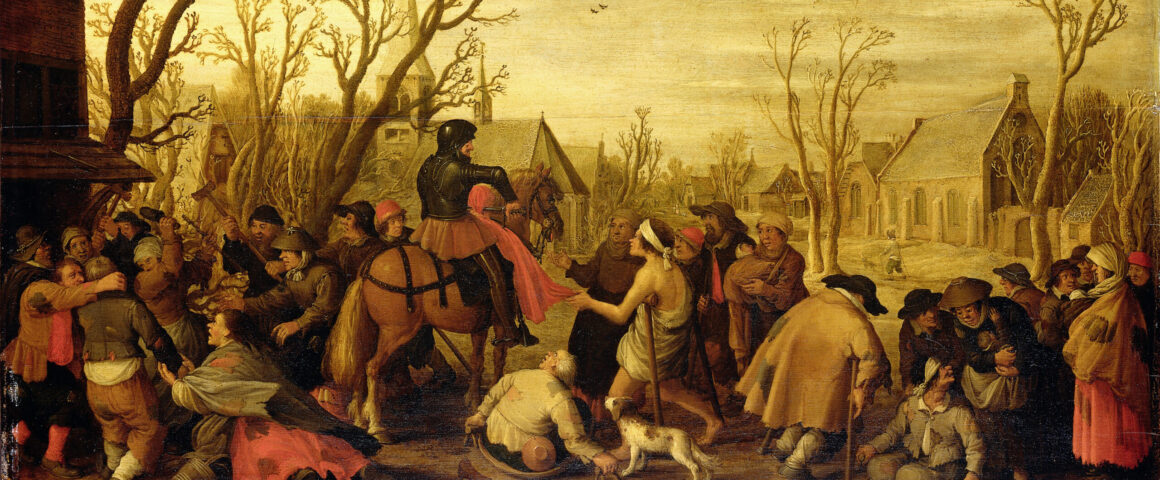
The young soldier was riding out of the Roman gate on the hill-side swept by the east wind, one bitter winter day, wrapped in his soldier’s cloak, along the great Roman road which joined Lyons to Boulogne, when he met a poor ragged man. Martin at once took his sword and cut his cloak in two, and gave half to the beggar. “The bystanders jeered or admired, according to their turn of mind,” and he went on.1 In the night he had a dream and saw our Lord among His angels clothed in the half-cloak he had put around the poor man. And the Lord said to His angels, “Know ye who has thus arrayed Me? My servant Martin, though yet unbaptised, has done this.”
And after this vision Martin went at once and was baptised.
He did not hurry out of his place. Fourteen years longer he remained quietly in his post as a soldier. But at last, when he was forty years old, the longing to devote himself to more direct service of his Lord overmastered him, and he requested to be allowed to leave the army. Julian the Apostate, the legend says, was then Emperor, and he said scornfully that Martin desired to quit the ranks in order to escape an impending battle. But Martin said: “Place me naked and unarmed in front of the battle; then shall ye see that armed with the cross alone I will not fear to encounter the enemy.” The Emperor took him at his word, and kept him under guard that night lest he should escape. But early the next morning the barbarous foes sent an envoy to entreat peace; and so Martin’s faith brought victory in the most Christian way, by making peace.
Freed from military service, he went to seek guidance for his future life from St. Hilary of Poictiers, who sent him back at once to his own people and his father’s house in Hungary, to do what he could for them. Martin succeeded in winning his mother to the Faith. On his way to Pannonia across the passes of the Alps, he fell among thieves. One of the bandits raised an axe and aimed a blow at his head, but another of the company intercepted the blow. However, Martin’s hands were bound behind him, and he was given in custody to one of the band. This man took him aside and began to ask him who he was. He gave the old answer of Perpetua and the martyrs of old, “I am a Christian.” The bandit then enquired if he felt afraid. He answered without hesitation that he never felt so much at ease, being confident that the Lord’s mercy would be especially with him in temptation. Rather, he felt sorry for him, his captor, who, living by robbery, was unworthy of the mercy of Christ. Entering then on the subject of the Gospel, he preached the Word of God to him. To be brief, the robber believed, thenceforth attended on him, and set him safely on his way, begging his prayers. “This man afterwards was seen in the profession of religion, so that the above narrative is given as he himself was heard to state it.”
Illyricum was then almost wholly Arian, and on his confessing the Catholic doctrine in one of the cities there, Martin was seized, beaten with rods, and driven from the city.
From Illyricum he went to Milan, where he lived some years in solitude, till he was driven thence by the Arian bishop Auxentius. He spent also some months in the little island of Gallina off the coast of the Riviera, living, like the hermits of Thebaid, with one companion hermit, on roots and herbs.
From thence he returned to Hilary, at Poictiers, and there founded the monastery of Lugojé, the first in France.
Four years after Hilary’s death the Christians of Tours, sixty miles from Poictiers, sought Martin out to be their bishop; although, as his biographer tells us, some opposed, “alleging that he was a contemptible person, unworthy of the episcopate, despicable in countenance, mean in dress, uncouth in his hair.”
As bishop of Tours he still kept to the monastic rules and to his simple, austere life, though with a fulness of authority and a graciousness such as corresponded to the dignity of a bishop. Unable to bear the interruptions of visitors in his cell near the church, he made himself a monastery about two miles out of the city; and so secret and retired was the place that he did not miss his beloved desert. On one side it was bounded by the high and precipitous rocks of a mountain; on the other, the little hovel in which he lived was shut in by the river Loire, which makes there a gentle bend. There was but one way into it, and that was narrow. His own cell was of wood. Many of the brethren made themselves cells of the same kind, but most of them hollowed out the stone of the mountain which was above them. No one had aught he called his own; all things were thrown into a common stock. Clad in camel’s hair, not touching wine except when compelled by bodily weakness, eating their meals together, otherwise scarcely leaving their cells, except for prayer; the younger occupied themselves in transcribing manuscripts, the older giving themselves up to prayer. There were eighty scholars under training after the pattern of their saintly master, many of them of noble birth. And among these what city or church did not count priests? Many became bishops.”2
Once a rich man, who had received benefit from his prayers sent Martin a hundred pieces of silver, which he accepted and spent in redeeming some of the many captives made in the wars of that stormy time.
Yet his duties to his flock in the city, and to the flocks of God in the remote places of his diocese, were never neglected. One day when preparing to celebrate Mass in the Cathedral, he saw a wretched naked beggar, as before in his youth, at the gate of Amiens. He told one of his deacons to clothe the man; but the deacon was too slow for the saint, whose heart was not at all chilled, since in his early days he had cut his mantle with his sword. The Bishop, therefore, with his old love and impetuosity, took off his sacerdotal habit and threw it himself around the beggar, and then, not waiting for other garments, in the very irregular vestments remaining to him he raised the sacred chalice; and “on his bare arms were seen chains of gold and silver hung there by the blessed angels.”
To this period also seems to belong one of the many legends of his encounters with the devil.
The devil, says the legend, envious of his virtues and especially hating his great charity, one day reproached him mockingly that he so quickly forgave the penitent. But St. Martin answered him sorrowfully: “O, most miserable that thou art, if thou also wouldst cease to persecute and seduce wretched men; if thou also couldst repent, thou also shouldst find mercy and forgiveness through Jesus Christ.”
With his disciples from the monastery, Martin made the missionary tours throughout Burgundy and around Autun and Chartres which have won him the title of the “Apostle of Gaul.” The cities were Christian, and pagan sacrifices were forbidden by law; but temples, altars, images and groves, remnants of the various strata of heathenism, Celtic and Roman, and Gothic, lingered in all the country districts, with their ignorant worshippers, among the little-changing peasant stock of all ages. Among these Martin went with his disciples, young and old, and told them of the Crucified Master, the benignant Saviour, to whom his own heart was so wholly given, whose impress was so stamped on his own life; and then destroying their “vain refuges” of idols, he led them to the “Rest” which the “weary and heavy-laden” toilers in all ages so especially need, and so largely find.
But not only among the people; to emperors and courts, to kings and princes this faithful ambassador went, and effectively; because first to the poor.
At his court at Treves Bishop Martin went to plead with the Emperor Maximus for the followers of his murdered predecessor Gratian; and also for the hunted Priscillianist heretics of Spain.
The Emperor and Empress could not do him honour enough. The other bishops courted and flattered them. Martin warned and rebuked them; and they courted him.
For some time Martin refused all the Emperor’s invitations, saying he could not accept hospitality from one who had deprived one Emperor of his dominions and another of his life. But Maximus pleaded that his honours had been forced on him, and showed so much penitence that at last Martin yielded.
The Emperor made it quite a festival and triumph when Martin consented at length to sit at his table.
Martin was placed on a couch close to the Imperial seat, and near him was his attendant presbyter. In the midst of the banquet the wine-cup was first handed to Maximus; he presented it to Martin to receive it back with his blessing. Martin took the cup and drank, and then instead of handing it back to the Emperor passed it on to his own presbyter. The Emperor professed to be moved with admiration, and also to be stricken with penitence; and from that time he often sought private interviews with Martin, obtaining absolution from him, and communing on “the heavens and the immortal life.”
The Empress also humbled herself in the dust before the aged bishop, believing in the miracle of his holy life, and the external miracles it was said to effect. She listened and wept, at his feet. At length she begged her husband, and they both begged Martin, to allow her, without assistance of attendants, to serve him a repast. “With her own hands she spreads a seat, she places a table by it, water she offers for his hands, food which she herself had cooked she sets before him. Then at a distance, as servants are taught, she stands motionless as if fixed to the ground. She mixes his draught, she presents it to him, showing in all things the reverence of an attendant and the humbleness of a handmaid.”
“When the small meal is ended, she sweeps up with all carefulness the broken bits and crumbs of bread, preferring such relics to imperial dainties.”3
But after all this patience and reverential homage, when the bishop had left, the Priscillianists (those ascetic Gnostic heretics from Spain for whom he had pleaded so fervently, in opposition to almost all the other orthodox bishops) were not spared. Soon after his departure, Priscillian and many of his followers were beheaded.
Afterwards, indeed, St. Ambrose and other bishops at the Council of Milan protested against this persecution; and Ithacus, the leader of the persecuting party, was excommunicated and deposed.
But Priscillian and his immediate followers had then already been executed; and moreover a military expedition was to be sent by Maximus to Spain by the Emperor’s orders to hunt out and kill all the heretics they could find.
The rough test of heresy adopted by the soldiery being “paleness of face and peculiarity of dress,” the expedition was likely to end in an access of wealth to the imperial treasures, but also in a great destruction of innocent persons and orthodox believers.
And in the following year Martin again came on a mission of mercy to the Court at Treves. Again, compliments and homage from the Emperor, but at the same time defence of his acts and persistence in the threatened expedition into Spain; until at length, irritated by Martin’s persistence in not communicating with the persecuting bishops, the Emperor quitted him hastily, in anger, and gave orders for the execution of Leucadius and Narses, the two officers of the condemned Gratian for whom Martin had come especially to plead.
Then Martin’s compassion overcame him. He re-entered the palace; he even consented to communicate with the persecutors of Priscillian, on condition that Narses and Leucadius were spared, and the expedition to Spain recalled.
The Emperor was satisfied. But not the bishop. He went on his way home with downcast mind. And about ten miles from Treves, passing through a deep and lonely forest, he remained there alone, in conflict with his conscience as to whether he had done right.
And, as he was thus examining himself, it is said, an angel appeared to him and said: “Martin, with reason thou art pricked in heart; but no other way was opened to thee. Retrieve thy virtue, resume thy firmness, lest indeed thou risk not thy renown, but thy salvation.”
And that was Martin’s last dealing with emperors and courts.
Eleven years longer he lived. And from time to time he used to confess to his friend, Sulpicius Severus, with tears, that from the mischief of that communion which he joined for a moment, and that not in heart but from compulsion, he was sensible of a diminution of his supernatural gift. He had “lost power to rescue those who were possessed of the devil.” Never afterwards would he go to great assemblies, nor even entertain great men at his monastery, lest he should give secret entrance to vanity and elation of spirit.
Perhaps it was after this that the most characteristic and significant of all his visions came to him. It is told by Sulpicius.
“While Martin was praying in his cell, the evil spirit stood before him clad in a glittering radiancy, by this purposing more easily to deceive him; clad also in royal robes, crowned with a golden and jewelled diadem, with shoes covered with gold, with serene face and bright looks, so as to seem nothing so little as what he was. Martin at first was dazzled by the sight, and for a long while both parties kept silence. At length the Evil One began. ‘Acknowledge,’ he says, ‘O Martin, whom thou seest. I am Christ. I am now descending upon earth, and I wished first to manifest myself to thee.’
“Martin still kept silent, and returned no answer. The devil continued to repeat his bold pretence: ‘Martin, why hesitate in believing, when thou seest I am Christ?’ Then understanding by revelation of the Spirit, that it was the Evil One, not God, Martin answered: ‘Jesus, the Lord, announced not that He should come in glittering clothing, and radiant with a diadem. I will not believe that the Christ is come, save in that state and form in which He suffered, save with the show of the wounds of the Cross.’
“At these words the other vanished forthwith as smoke, and filled the cell with so horrible an odour as to leave indubitable proof who he was. That this so took place, I know from the mouth of Martin himself, lest any one should think it fabulous.”4
Martin’s life was long spared to the world which so needed him. At eighty he went to a remote place in his diocese to make peace between two of his clergy. On his return his strength suddenly failed him, and he was stricken with fever, and felt his end near. He gathered his disciples together, and told them he was going. And they, like those around St. Ambrose, with passionate laments, entreated him not to leave them as sheep in the midst of wolves.
He was much moved, and said,
“Lord, if I be yet necessary to Thy people, I decline not the labour (non recuso laborare). Thy will be done.” But his wish was heard, not his prayer.
The fever held its course. He caused himself to be laid on ashes. His disciples would have persuaded him to accept the beggar’s luxury of “a little straw,” but he replied, “My sons, it becomes a Christian to die on ashes.”
His old enemy seems to have made a last assault on him in his last hour of darkness, not this time in gold and glitter and angelic serenity, but in unmasked malignity.
“Beast of blood,” Martin said, “deadly one, thou shalt find nothing in me. Abraham’s bosom is receiving me.”
And with these words he died.
His devoted disciple Sulpicius was at a distance when he died, and that very night seemed to see his master in a vision, clad in a white robe, with face like a flame, and with eyes like stars — “And while his person was what I had known it to be, yet what can hardly be expressed, I could not look at him, though I could recognise him. He slightly smiled at me, and bore in his right hand the book I had written of his life. I embrace his knees and ask his blessing as usual, and I feel the soft touch of his hand on my head, while together with the usual words of benediction he repeats the name of the Cross, familiar on his lips; then, while I gaze upon him, and cannot take my fill of his face and look, suddenly he is caught aloft, till after completing the immense spaces of the air, and following with my eyes the swift cloud that covered him, he is received into the open heavens and can be seen no more.”
And so for centuries his life was felt through Christendom, the soft touch of his kind hand, the words of benediction on his lips, and the familiar name of the Cross in his mouth, enshrined for us in these last days in the eloquent words, “Many spirits are abroad, and the credentials which they display are precious gifts of mind, beauty, richness, depth, originality. Christian, look hard at them, like Martin, in silence, and ask for the prints of the nails.”5
Notes
- Newman, Historical Sketches.
- Life of St. Marti by Sulpicius Severus, quoted by Cardinal Newman.
- Sulpicius Severus.
- Sulpicius Severus, Life of St. Martin translated by Cardinal Newman.
- Cardinal Newman, “St. Martin,” Historical Sketches.
Dedications of churches: one hundred and sixty. Represented in art on horseback, dividing his cloak with a beggar, as a Bishop, a Martinmas goose by his side. The chief authority is St. Martin’s Life, by his contemporary and friend Sulpicius Severus, quoted by Cardinal Newman in his Historical Sketches, and also Mrs. Jameson’s Sacred and Legendary Art, and Professor Ruskin’s Bible of Amiens.
Source: Elizabeth Rundle Charles, Martyrs and Saints of the First Twelve Centuries: Studies from the Lives of the Black Letter Saints of the English Calendar (London: Society for Promoting Christian Knowledge; New York: E. & J. B. Young, 1887), pp. 352–361.
Image: Joost Cornelisz. Droochsloot, St Martin Cutting Off Part of His Cloak for a Beggar, 1623. Rijksmuseum, SK-A-1930; on loan to the Limburgs Museum. Public domain. Cropped for the article header.