The two Books of Homilies are Forgotten Fenceposts even in the Global Anglican experience, despite documents such as the Cairo Covenant citing them authoritatively. Section 1.4 states: “The Church is constituted by grace alone to be a hearing Church, to be attentive to the Holy Scripture, God’s true word that sets forth his glory and human duty,” citing the First Book of Homilies, Homily 1, “A Fruitful Exhortation to the Reading and Knowledge of the Holy Scripture.” The American Anglican experience has ignored and dismissed the Homilies at a level only matched by the contemporary tendency to minimize the Articles of Religion. However, the Protestant Episcopal Church of the United States (PECUSA), in adopting its slightly edited 1801 Articles of Religion, retained Article XXXV, with the following language:
This Article is received in this Church, so far as it declares the Book of Homilies to be an explication of Christian doctrine, and instructive in piety and morals. But all references to the constitution and laws of England are considered as inapplicable to the circumstances of this Church; which also suspends the order for the reading of said Homilies in churches, until a revision of them may be conveniently made, for the clearing of them, as well from obsolete words and phrases, as from the local references.
1801 PECUSA Articles of Religion, 2019 Book of Common Prayer, ACNA at p. 789.
As I have written elsewhere, the Articles of Religion and the Ordinal carry authority within the Global Anglican Church and, in particular, within the Anglican Church in North America through its adherence to the Jerusalem Declaration, the Fundamental Declarations, and the Cairo Covenant. Therefore, where the Articles speak, we should digest, wrestle, and yes, apply them in their literal and grammatical sense internally and charitably externally, understanding that the Roman Catholic Church of today does not mirror the Roman Catholic Church of the mid-1500s.
A Brief History
How do we read and apply the Homilies today? The 1801 PECUSA Article XXXV gives us a basis for considering how to read these Homilies—namely, accepting the doctrine while acknowledging and rendering inapplicable any logic or arguments derived from English law. After all, the Homilies were first published as a collection of twelve sermons in 1547, and the second book was published in 1563 with an additional twenty-one sermons (the 21st sermon added in 1571). This suggests bishops and others within the PECUSA already viewed the Homilies as using antiquated language in the early 1800s. After all, they predated the PECUSA by some 230-plus years. Therefore, the revised PECUSA Article XXXV understandably calls for updating the Homilies with a simple edit regarding “obsolete words and phrases, as from the local references.”
Nevertheless, Article XXXV was retained and reworded to reflect the importance of the Homilies. Note the language of the American Article XXXV. It “is received in this Church,” yet not without some clarification, for the reception is “so far as it declares the Book of Homilies to be an explication of Christian doctrine, and instructive in piety and morals.” This is key. The Homilies cannot be disregarded, for if the Articles of Religion are authoritative, then this includes Article XXXV, which even in the American edition upholds the Homilies as teaching Christian doctrine, piety, and morals.
Yet American and Global Anglican provinces located outside the English realm are not bound by everything stated within the Homilies. This next sentence from the American Article XXXV clarifies: “But all references to the constitution and laws of England are considered as inapplicable to the circumstances of this Church.” This is logical and, to a certain extent, goes without saying. The American national experience differs from the English as much as it does from the Nigerian experience. Therefore, any situations, arguments, or reasoning in the Homilies related to or rooted in the English law or experience are not necessarily applicable in other provinces. What applies is the Homilies’ exposition of the Christian faith, rooted in the Scriptures as received by the ancient Church.
Although the Homilies were suspended from the original Article XXXV requirement that ministers preach them in their cures, this did not bar or ban the Homilies’ use for instructing, quoting, or teaching either from the pulpit on Sunday or during catechesis. The revised American Article XXXV reads only that PECUSA “also suspends the order for the reading of said Homilies in churches, until a revision of them may be conveniently made.” The order that ministers must read them (as required in the original Article XXXV) is suspended, however not the Homilies’ authority in and of themselves. Note that the Homilies were intended to be revised for the American context, and such a revision was intended to be a light revision at that. Namely, the editing was to remove and update outdated language and “the local references” related to English law and customs.
However, that revision was not to be written.
Publishing the Homilies in the States
The Homilies were not forgotten, at least not completely. The first American edition of the two Books of Homilies was published in 1815, a mere fourteen years after the American revision of the Articles in 1801. The editor introduced the first American edition of the Homilies with an “Advertisement” that sets the stage for the Homilies. Notably, he begins with the English (original) Article XXXV, quoted verbatim and followed by the American revised Article XXXV. This is noteworthy as it echoes and establishes precisely what the American Episcopal experiment was intended to be: a continuation of the Church of England but as the Church in the American States. Or, in the words of the first PECUSA prayer book:
It seems unnecessary to enumerate all the different alterations and amendments. They will appear, and it is to be hoped, the reasons of them also, upon a comparison of this with the Book of Common Prayer of the Church of England. In which it will also appear that this Church is far from intending to depart from the Church of England in any essential point of doctrine, discipline, or worship; or further than local circumstances require.
Preface, 1789 Book of Common Prayer, PECUSA
Quite simply, the American Church intended to adapt both the Book of Common Prayer and the Homilies for the American experience, not abandon or rewrite doctrine.
General Convention Speaks
The editor of the first American edition continues in his Advertisement, this time moving from quoting the English and American Article XXXV to now quoting directly from the Journal of the House of Bishops in the 11th General Convention, held just a year earlier in 1814:
The House of Bishops, taking into consideration, that the two Books of Homilies are referred to in the 35th Article of this Church, as containing a body of sound Christian doctrine; and knowing, by their respective experience, the scarcity of the volume, rendering it difficult for some candidates in the ministry to possess opportunities of studying its contents, propose to the House of Clerical and Lay Deputies, to make it a standing instruction to every Bishop, and to the Ecclesiastical Authority in every State destitute of a Bishop, to be furnished (as soon as may be) with a copy, or copies, of said work, and to require it to be studied by all candidates for the ministry within their respective bounds: under the expectation, that when offering for ordination, the knowledge of its contents will be indispensably required.
Advertisement, Sermons or Homilies appointed to be read in Churches, (The Two Books of Homilies), First American Edition, (1815) at pp. v–vi.
Although I have not yet found direct evidence, it appears reasonable to assume this first edition of the two Books of Homilies was published in 1815 precisely because of the action described at the 1814 General Convention. After all, how could the bishops expect candidates for the ministry to know their contents, which “will be indispensably required” unless they are published stateside? Regardless of whether my speculation is correct, the Editor continues his Advertisement by finally speaking in his own words halfway through it, after the initial long quotes that set the stage for the first American edition of the two Books of Homilies. He notes that, because of Article XXXV and the House of Bishops’ action, he is printing this American edition of the Homilies for clergy and candidates for ministry to study Christian doctrine, piety, and morals. He observes, “The Clergy have a more important interest in the publication [of the Homilies]; the contents of it being referred to in the promise, which they subscribe at their ordination.” Id. It is clear the PECUSA bishops, by their action in General Convention, intended and required study and knowledge of the Homilies and their doctrine through the resolution quoted above. Further, the Editor notes that, by virtue of the ordination vow, this included the Articles and therefore Article XXXV on the Homilies.
However, allow a slight detour, for if the reader is curious, as I was, whether the House of Clerical and Lay Deputies accepted the House of Bishops’ action in the 1814 General Convention, they did:
The following resolution concerning the book of homilies, was proposed and adopted, and sent to the House of Clerical and Lay Deputies for their concurrence.
The House of Bishops, taking into consideration, that the two books of homilies are referred to in the 35th articles of this church, as containing a body of sound christian doctrine; and knowing, by their respective experience, the scarcity of the volume, rendering it difficult for some candidates in the ministry to possess opportunities of studying its contents, propose, to the House of Clerical and Lay Deputies, to make it a standing instruction to every Bishop, and to the ecclesiastical authority in every state destitute of a Bishop, to be furnished (as soon as may be) with a copy or copies of said work, and to require it to be studied by all candidates for the ministry within their respective bounds: under the expectation, that when offering for ordination, the knowledge of its contents will be indispensibly required.
Journals of the General Conventions of the Protestant Episcopal Church in the United States of America, 1794-1814, (1817) at p. 311.
The same day, it was adopted by the House of Clerical and Lay Deputies:
The proposition sent yesterday from the House of Bishops, respecting the book of homilies, was taken up for consideration, concurred in, and returned to that house.
Id. at p. 303.
The next day, May 21, 1814, the House of Bishops recorded:
A message was received from the House of Clerical and Lay Deputies, informing, that they agreed to the canons, concerning the election and institution of ministers, and to the resolution concerning the book of homilies.
Id. at p. 313.
Received, Now How to Read The Homilies?
Clearly, the Homilies matter and are binding as to Christian doctrine, piety, and morals. This may come as a shock to contemporary Anglicans, especially in the States, but our forgotten history is calling out to us. Naturally, there arises a question: should the Homilies be read literally and accepted word for word? No, there’s no such requirement. Unlike the Articles of Religion, which the ACNA Fundamental Declarations require taking in their literal and grammatical sense (rightly plagiarizing from King Charles I the Martyr’s Royal Declaration prefixed to the Articles), the Homilies are broadly to be accepted for their commentary on the doctrine, piety, and morals of the Christian faith.
This is not my novel argument, but is a point made by the first American Edition of the Homilies, when the Editor states:
The extent in which the Homilies are to be considered as pledging the subscriber of them [meaning the clergy] relatively to doctrine, is well expressed by Bishop Burnet as follows:
Advertisement, Sermons or Homilies appointed to be read in Churches, (The Two Books of Homilies), First American Edition, (1815) at pp. v–vi.
At this point, the Editor reproduces another block quote but from another source, namely Gilbert Burnet, Bishop of Sarum, and his commentary on the Articles of Religion published in 1700. Bishop Burnet, writing approximately 140 years after the publication of both sets of Homilies, expresses how he advised the Church of England to read, understand, and receive the Homilies in his time:
In these Homilies the Scriptures are often applied as they were then understood; not so critically as they have been explained since that time. But by this approbation of the two Books of Homilies, it is not meant that every passage of Scripture, or argument that is made use of in them, is always convincing, or that every expression is so severely worded, that it may not need a little correction or explanation: All that we profess about them, is only that they “contain a godly and wholesome doctrine.” This rather relates to the main importance and design of them, than to every passage in them. Though this may be said concerning them, that considering the age they were written in, the imperfection of our language, and some lesser defects, they are two very extraordinary Books. Some of them are better writ than others, and are equal to any thing that has been writ upon those subjects since that time. Upon the whole matter, every one who subscribes the Articles, ought to read them, otherwise he subscribes a blank; he approves a book implicitly, and binds himself to read it, as he may be required, without knowing any thing concerning it. This approbation is not to be stretched so far, as to carry in it a special assent to every particular in that whole volume; but a man must be persuaded of the main of the doctrine that is taught in them.
Advertisement, Sermons or Homilies appointed to be read in Churches, (The Two Books of Homilies), First American Edition, (1815) at pp. v–vi (quoting An Exposition of the Thirty-Nine Articles, Bishop Gilbert Burnet (1700 original publication) (1833 Edition available here), at p. 492).
The American Editor’s direct quote is prudent for understanding the nature of the reception and reading of the Homilies. Therefore, I have done likewise, as Bishop Burnet’s advice is practical and wise. It retains the authority of the Homilies without needlessly binding us upon every jot and tittle of the Homilies. Global Anglicans and those of us in North America would benefit from heeding Bishop Burnet’s commentary and getting to work reading and understanding the Homilies, as they have much to teach us in this day and age.
A Practical Revision
The American edition was printed in two new editions in 1823 and 1844, with the scholarship clearly improving on the Homilies as demonstrated by the 1844 edition’s Advertisement. They show a clear line towards John Griffiths’ 1859 Edition of the Books of Homilies, which was the standard until the Rev. Dr. Gerald Bray’s critical edition, which is worth the steep price of admission.
However, what about the long-promised American revision of the Books of Homilies from the PECUSA Article XXXV? Did it ever occur, or were the Homilies forgotten?
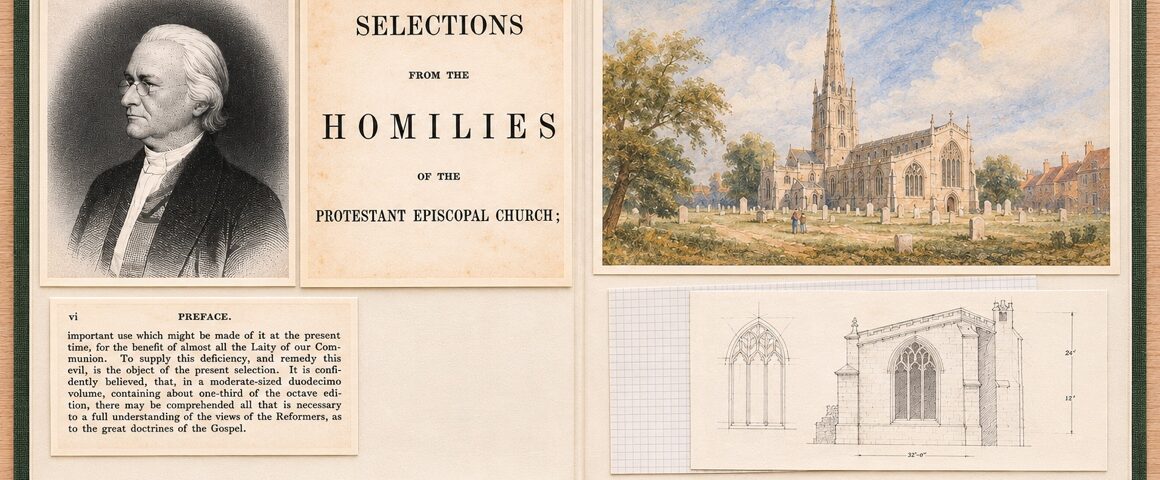
Enter the Protestant Episcopal Society for the Promotion of Evangelical Knowledge, which published Selections from the Homilies of the Protestant Episcopal Church (“Selections”) on or about 1850. This work contains a highly abridged version of many of the two Books of Homilies. Revisions include a short excerpt from the homily on fasting, thereby removing the English justification for eating fish and supporting national commerce as one of several reasons to fast. Likewise, the Homily on the Peril of Idolatry, the longest homily by far in the Books of Homilies, over a hundred pages (or more depending upon the edition), is edited to a manageable length of four pages in this revision. Fundamentally, the edited Selections from the Homilies are excellent for use once again within the local parish due to the editing by the Protestant Episcopal Society for the Promotion of Evangelical Knowledge. The spirit of the Society’s edits is in line with Bishop Burnet’s explanation as to how the Homilies are to be received: expounding Christian doctrine.
The Society’s intent seems self-evident; these selections are not from the Church of England’s Homilies, but are advertised by the Society as “from the Homilies of the Protestant Episcopal Church.” It owns the Homilies as PECUSA’s own: adapted, adopted, and now abridged for use within the American Church. The Selections appears to be an attempt at the long-awaited revision of the two Books of Homilies. Although this work was not adopted as the official revision, it did receive an endorsement from the Bishop of Virginia, the Rt. Rev. William Meade, who wrote the Preface. Bishop Meade explained the purpose of the work in his opening paragraph:
The following selection from the Homilies is designed chiefly for the Laity, although it is believed that there are those of the Clergy, who, not possessing, or else having not read the whole volume, will, by those here published, be led to the examination of the rest.
Preface, Selections from the Homilies, at p. v.
Bp. Meade noted, with an air of distress in his writing, that despite the promised revision in the revised Article XXXV:
No such revision has been made, or is likely to be made, and it is a cause of grief to many, that so much valuable matter relating to the doctrines of our religion, as discussed, established, and set forth at the Reformation, should be locked up in a large volume, and thus kept from the important use which might be made of it at the present time, for the benefit of almost all the Laity of our Communion. To supply this deficiency, and remedy this evil, is the object of the present selection.
Id. at pp. v–vi.
Meade blamed outdated wording and especially the length of the Homilies for their unfamiliarity to clergy and laity alike. The revision and abridgement reflected in the Selections were intended to help Americans “be truer Episcopalians,” according to Bp. Meade. Further, he encouraged the laity to read the Homilies themselves and recommended that they “be read by the Lay Reader from the desk, or by the Father or Master to his household.” Id. at pp. vii–viii. His vision extended from the country parish led by a lay reader to the head of a household teaching his family and individual laypeople across the American Church seeking to understand their faith.
Meade then takes a page out quite literally from the Advertisement authored by the editor for the first American Edition of the Homilies, and quotes verbatim the English and American versions of Article XXXV, the House of Bishops’ action in the 1814 General Convention, Bishop Burnet’s paragraph on the reception of the Homilies, and the first editor’s noting the binding nature of the Homilies on the clergy. Id. at pp. viii–x. Clearly, based upon the publication of the Selections, the Homilies remained binding into the 1850s, and beyond by virtue of Article XXXV remaining part of PECUSA’s constitutional framework and their printing in the PECUSA prayer books. Therefore, the goal of the Society and Bishop Meade was furthering the dissemination of the Homilies to the wider American Church.
Meade’s Preface to the Selections explains the reasoning “for choosing some and omitting others,” regarding each homily in the original two Books of Homilies. Preface, Selections, at p. xii. As one walks through the reasoning for abridging or editing out parts of the homilies, it is impossible not to see that abridgements are an application of Bishop Burnet’s reasoning and explanation on how to read and receive the Homilies. Namely, the Christian doctrine distilled from the Homilies is what is binding upon the Church and her clergy. Lest anyone think the Selections’ abridged version negates the full reception of the Homilies, hear the words of Bishop Meade:
Let him take up this volume, or, if they prefer it, the larger one from which it is drawn, in the same manner in which the wise and candid who are in search of truth take up the Bible, or any other book; let him ascertain the main drift of the writers, see where the emphasis is laid, what the great principles by which particular passages are to be explained; let him compare one part with another, and thus seek the true design and meaning of the whole.
Preface, Selections, at p. xv.
Indeed, let us take up and read. Let us chew the fat and spit out the bone. Patiently may we read and heed, learn and distill the Christian doctrine, piety, and morals received by the Church. For the Homilies are not a curiosity for the historian to study, nor the theologian to ignore, but are authoritative for Anglicans to acknowledge and accept. Those who adhere to the Jerusalem Declaration, the Abuja Affirmation, the Fundamental Declarations, the Global South Fellowship of Anglican Churches (GSFA) Cairo Covenant, the To Be a Christian Catechism, and Canons (each of which quotes and cites the Articles authoritatively) should be familiar with the Homilies and not afraid to use them in distilled doses to demonstrate doctrine, piety, and morals.
The two Books of Homilies are practical in their intent. They teach the importance of Scripture reading, justification, fasting, eucharistic theology, and deep reflections upon the incarnation of Christ, Christ’s Resurrection, and the Ascension, to name a few topics.
In the end, they are not to be locked up gathering dust, but brought into the light, studied, taught, and applied. Let us take up the challenge and wrestle with them. Not merely the clergy, but the laity also. As Bishop Meade ends his Preface, so let us conclude this day:
Having thus given a brief history of the Homilies, and a plain statement of the design of this selection, it is now commended to the blessing of heaven, and earnestly pressed upon the attention of the Laity of the Church.
Preface, Selections, at p. xvii.