The Articles of Religion are an authority articulating the doctrine of the Church of England as well as that of those who belong to the Global Anglican Communion. The Fellowship of Confessing Anglicans, better known as GAFCON and now as the Global Anglican Communion, outlined in the Jerusalem Statement a succinct summary of faith:
We, together with many other faithful Anglicans throughout the world, believe the doctrinal foundation of Anglicanism, which defines our core identity as Anglicans, is expressed in these words: The doctrine of the Church is grounded in the Holy Scriptures and in such teachings of the ancient Fathers and Councils of the Church as are agreeable to the said Scriptures. In particular, such doctrine is to be found in the Thirty-nine Articles of Religion, the Book of Common Prayer and the Ordinal. We intend to remain faithful to this standard, and we call on others in the Communion to reaffirm and return to it. While acknowledging the nature of Canterbury as an historic see, we do not accept that Anglican identity is determined necessarily through recognition by the Archbishop of Canterbury. Building on the above doctrinal foundation of Anglican identity, we hereby publish the Jerusalem Declaration as the basis of our fellowship.
The Articles are an authority for Anglicanism. They are not the sole authority or an authority in competition with Holy Scripture, the prayer book, or ancient creeds and councils. They are to be read together and not played down or played against other authorities, save that Scripture alone holds the trump card over the Articles and everything else. The beauty in the Jerusalem Statement’s articulation of the faith is that it is rooted in the Gospel, revealed in the Scripture, grounded in “the ancient Fathers and Councils of the Church” and “In particular, such doctrine is to be found in the Thirty-nine Articles of Religion, the Book of Common Prayer and the Ordinal.”
It is not pivoting the Reformation against the ancient church. It is a catholic faith reformed of medieval accumulations.
Hence, both the Jerusalem Declaration and the Anglican Church in North America’s (ACNA) Fundamental Declarations begin with the Gospel and Holy Scripture. Likewise, both documents uphold the authority of the Articles, in addition to upholding the authority of the catholic Creeds and Councils. The Jerusalem Declaration’s fourth point states:
- We uphold the Thirty-nine Articles as containing the true doctrine of the Church agreeing with God’s Word and as authoritative for Anglicans today.
The ACNA subscribes to the Jerusalem Declaration and therefore the Articles of Religion as a member of the Global Anglican Communion. The Articles are professed as “true doctrine” precisely because of their agreement with Holy Scripture, and therefore are “authoritative for Anglicans today.” Indeed, the Global South Fellowship of Anglican Churches (GSFA) Cairo Covenant (of which ACNA is a member) upholds the Articles of Religion, alongside the 1662 Book of Common Prayer and Ordinal attached as the doctrine of the Church. See Section 1, Paragraph 1.1(a), Doctrinal Foundation: Fundamental Declarations, Cairo Covenant, GSFA. These are clear statements and do not allow one to set aside or ignore the Articles.
The ACNA went so far as to state in the Preamble to its Constitution:
We affirm the Global Anglican Future Conference (GAFCON) Statement and Jerusalem Declaration issued 29 June 2008.
The Jerusalem Declaration is invoked authoritatively in ACNA Title II, Canon 8, Section 2, Of Standards of Sexual Morality and Ethics, where it states:
In view of the teaching of Holy Scripture, the Lambeth Conference of 1998 and the Jerusalem Declaration, this Church upholds faithfulness in marriage between a man and a woman in lifelong union, and believes that abstinence is right for those who are not called to marriage, and cannot legitimize or bless same sex unions or ordain persons who engage in homosexual behavior. Sexual intercourse should take place only between a man and a woman who are married to each other.
The first Article of the ACNA Constitution independently affirms the Articles of Religion in the seventh point of the ACNA Fundamental Declarations:
- We receive the Thirty-Nine Articles of Religion of 1571, taken in their literal and grammatical sense, as expressing the Anglican response to certain doctrinal issues controverted at that time, and as expressing fundamental principles of authentic Anglican belief.
Elsewhere, I have written on point 7 of the Fundamental Declarations, but suffice to say that the Articles are authoritative in the ACNA, and the ACNA prudently adopts language borrowed from King Charles I the Martyr’s Declaration prefixing the Articles while noting that the points of dispute between Anglicans and Rome have evolved over the centuries. The second clause prevents ignoring or dismissing the Articles, for they are “expressing fundamental principles of authentic Anglican belief.”
ACNA demonstrates how fundamental the Articles are by citing them throughout its Canons in the following sections:
- “A congregation of this Church is a gathering where the pure Word of God is preached and the sacraments are duly administered according to Christ’s ordinance (Article XIX).” Title I, Canon 6, Section 2, Concerning Congregations.
- “The qualifications concerning rightly and worthily receiving the Supper of the Lord with faith are provided in Article XXVIII of the Thirty-Nine Articles of Religion.” Title II, Canon 4, Section 3, Paragraph 5, Concerning Holy Communion.
- “The Anglican Church in North America affirms our Lord’s teaching that Holy Matrimony, commonly called a Sacrament (Article 25 and ACNA Catechism 124-125), is a lifelong covenant between one man and one woman, binding both to self-giving love and exclusive fidelity.” Title II, Canon 7, Section 1, Of Christian Marriage.
Further, the Jerusalem Declaration, Fundamental Declarations, and full text of the Articles of Religion are produced in the Documentary Foundations section of the 2019 ACNA Book of Common Prayer. Before anyone demotes the Jerusalem Declaration, despite its constitutional authority in the ACNA, they should read the Preface to the ACNA prayer book, which states, “The Jerusalem Declaration of 2008 located itself within the historic confines of what is authentically the Christian Faith and the Anglican patrimony, and sought to restore their fullness and beauty.” Additionally, the Articles are also invoked in the ACNA prayer book authoritatively in the following instances:
- “In the Thanksgiving over the Water, the words ‘made regenerate’ may bereplaced by the words ‘born again.’ Regeneration is a Biblical word (‘the washing of regeneration,’ Titus 3:5), and it appears in the Thirty-Nine Articles (IX and XXVII).” Additional Directions, Holy Baptism, at p. 172.
- “Less of the Apocrypha has been included than in the 1662 Book of Common Prayer; however, select passages have been retained, in keeping with the classic Anglican principle that “the Church doth read [these books] for example of life and instruction of manners; but yet doth it not apply them to establish any doctrine.” (Article VI of the Thirty-Nine Articles).“ Daily Office Lectionary, Annual Cycle of Lessons Appointed, at p. 736. This reasoning is notable as the Articles are used to justify a deviation from another formulary, the 1662 Book of Common Prayer.
The Church Catechism, To Be a Christian, is cited alongside the Articles of Religion in Title II, Canon 7, as reproduced above. The Church Catechism is important because it teaches the faith to laity, clergy, and outsiders alike. Title II, Canon 4, Section 2, Concerning Christian Formation, requires:
All Clergy shall take care that all within their cures are instructed in the doctrine, sacraments, and discipline of Christ, as the Lord has commanded and as they are set forth in the Holy Scriptures, in the Book of Common Prayer, and in the Church Catechism.
Before deciding that this canon’s omission of the Articles of Religion is intentional and therefore devalues their authority, we should open to page 6 of To Be A Christian: An Anglican Catechism. There we find the Church Catechism quoting Article VI:
Further, Article 6 of the Articles of Religion states, “Whatever is not read therein, nor may be proved thereby, is not to be required of any man that it should be believed as an article of the Faith.”
Classic sources for the explication and elucidation of scriptural doctrine include the following:
The catechism continues, stating the early church, the King James Bible, and its successors, the Book of Common Prayer (1549-1662), music and hymnody, the Lambeth Quadrilateral, and the Jerusalem Declaration each compose “classic sources” reflecting “scriptural doctrine.” Most notably for our purposes, the second bullet point on page 8 upholds:
The Articles of Religion (1571). The Articles, also known as the “Thirty-Nine Articles,” summarize the biblical faith recovered at the Reformation and have become the doctrinal norm for Anglicans around the world.
The Articles reflect the Scriptures, and this is why they “have become the doctrinal norm for Anglicans around the world.” They simply cannot be ignored. Clergy are bound to teach the Church Catechism, pursuant to the canons, and the catechism upholds them along with the other sources of doctrine as reflecting the Scriptural truths. Why, even within this section, on page 8 of the catechism, when it upholds the King James Bible and successor English Bibles as sources for doctrine, are the Articles once again invoked:
In keeping with the principles of the English Reformation that promote worship in language that the people understand (Articles of Religion, 24), the Bible has since been translated into many languages. Anglican Christianity has now spread to encompass.
Throughout the Church Catechism, this continues to be the case:
- “We learn from Scripture about these key events, including what they mean and how they hold together. Anglicans therefore affirm that the Holy Scriptures of the Old and New Testaments, which are contained in the Bible, are “God’s Word written” (Articles of Religion, 20).” “Part II, Believing in Christ, The Apostles’ Creed And the Life of Faith, p. 29.
- “This church believes the Apostles’ Creed, the Nicene Creed, and the Athanasian Creed. (Articles of Religion, 8)” Question 21, Concerning the Creeds, p. 31.
- “Holy Scripture is ‘God’s Word written’ (Articles of Religion, 20), given by the Holy Spirit through prophets and apostles as the revelation of God and his acts in human history, and is therefore the Church’s final authority in all matters of faith and practice.” Question 25, Concerning Holy Scripture, p. 32.
- “The thirty-nine books of the Old Testament and the twenty-seven books of the New Testament together form the whole of Holy Scripture. (Articles of Religion, 6)” Question 26, Concerning Holy Scripture, p. 32.
- ”It should be translated, read, taught, and obeyed accordingly. (Nehemiah 8:1–8; Psalm 94:8–15; Acts 8:26–35; 18:24–28; Jerusalem Declaration, Article 2; Articles of Religion, 20)” Question 33, Concerning Holy Scripture, p. 34.
- “They [The Apocrypha] may be read as examples of faithful living but “not to establish any doctrine.” (Articles of Religion, 6)” Question 35, Concerning Holy Scripture, p. 35.
- “The Church on earth gathers to worship God in Word and Sacrament, to serve God and neighbor, and to proclaim the Gospel to the ends of the earth. (Exodus 19:4–6; Psalm 22:22–23; Matthew 28:19–20; Ephesians 2:11–22; 1 Peter 2:4–10; Articles of Religion, 19)” Question 92, “The Holy Catholic Church,” The Apostles’ Creed, Article III, p. 49.
- “The Nicene Creed expands upon the Apostles’ Creed to list four characteristics of the Church: it is “one, holy, catholic, and apostolic.” (see Articles of Religion, 8)” Question 95, “The Holy Catholic Church,” The Apostles’ Creed, Article III, p. 50.
- “I should receive the sacraments by faith in Christ, with repentance and thanksgiving. Faith in Christ is necessary to receive the grace of the sacraments, and obedience to Christ is necessary for the benefits of the sacraments to bear fruit in my life. (Mark 16:16; John 6:52–58; Acts 2:38–47; 1 Corinthians 11:27–32; 1662 Catechism; Articles of Religion, 28)” Question 122, Concerning Sacraments, p. 56.
- “These are sometimes called “sacraments of the Gospel.” (Articles of Religion, 25; see also Matthew 28:19–20; Luke 22:14–20; John 6:52–58; 1 Corinthians 11:23–26; 2 Corinthians 1:21–22)” Question 123, Concerning Sacraments, p. 56.
- “They were not ordained by Christ as necessary to salvation, but arose from the practices of the apostles and the Early Church, or were blessed by God in Scripture. God clearly uses them as means of grace. (Articles of Religion, 25)” Question 125, Concerning Sacraments, p. 56.
- “Cursing, magic, broken vows, false piety, manipulation of others, and hypocrisy all cheapen God’s Name. These treat God’s Name as empty of the reality for which it stands. (Leviticus 5:4–6; 19:26b, 31; Psalm 10:2–7; Malachi 1:6–14; Matthew 5:33–37; James 3:5–12; Articles of Religion, 39)” Question 288, The Third Commandment, The Ten Commandments, p. 97-98.
- “I also keep the fifth commandment by showing respect for teachers and elders; by obeying, as far as is lawful, those who hold authority in the Church, my employment, and civil government; and by conducting myself in all things with reverent humility before God and my neighbor. (Exodus 22:28; Matthew 22:15–22; Romans 13:1–7; 1 Timothy 2:1–2; 5:1–4; Hebrews 13:7; 1 Peter 2:13–15; Articles of Religion, 37)” Question 304, The Fifth Commandment, The Ten Commandments, p. 97-98.
- “There are circumstances in which justice, the protection of the weak and defenseless, and the preservation of life may require acts of violence. It is the particular task of government to uphold these principles in society. However, our Lord calls us to show mercy and to return evil with good. (Numbers 35:9–34; Matthew 5:43–45; Romans 12:17–21; 13:1–4; Articles of Religion 37)” Question 313, The Sixth Commandment, The Ten Commandments, p. 103.
- “Everything I own I hold in trust as God’s steward, to cultivate and use for his glory and my neighbor’s good. (Genesis 1:28–31; Leviticus 25; Psalm 37:16; Proverbs 16:8; Luke 12:32– 34; 1 Timothy 6:6–10; Hebrews 13:5; Articles of Religion, 38)” Question 336, The Eighth Commandment, The Ten Commandments, p. 107.
The Church Catechism’s Appendix 5 is “A Note on the Articles of Religion,” and stresses that they express “fundamental principles of authentic Anglican belief,” are “one of the elements characteristic of the Anglican Way,” and that the ACNA “is determined by the help of God to hold and maintain, as the Anglican Way has received them, the doctrine, discipline, and worship of Christ and to transmit the same, unimpaired, to our posterity.” This Appendix 5 reiterates and summarizes what we have been discussing. Namely, the Articles are authoritative, and they are embedded within ACNA’s Constitution and Canons, the Fundamental Declarations, the 2019 ACNA Book of Common Prayer, and the Church Catechism, not to mention the Jerusalem Declaration (which is also upheld authoritatively in the same ACNA documents).
Finally, the closing statement of Appendix 5, that the Articles are one of the elements of the Anglican Way and are received as part of “the doctrine, discipline, and worship of Christ,” is not merely a repetition of the penultimate paragraph to the Fundamental Declarations, but also is quoted in the 2019 ACNA Ordinal. ACNA clergy take an oath to maintain “the doctrine, discipline, and worship” of the Church, which, by virtue of ACNA Constitution Article I(7), includes the Articles:
I do solemnly engage to conform to the Doctrine, Discipline, and Worship of Christ as this Church has received them.
2019 ACNA Book of Common Prayer, p. 473 (Ordination of a Deacon), 484 (Ordination of a Priest), p. 499 (Ordination and Consecration of a Bishop).
The Articles should no longer be hidden or explained away as historical but not foundational. Indeed, they are part of the foundation of authentic Anglicanism and therefore should be studied and utilized as fundamental principles of our faith, alongside and neither contrary to nor adversarial to the other Fundamental Declarations and paragraphs of the Jerusalem Declaration. The Articles are not the sole authority, but to deny their authority is to put oneself dangerously contrary to how ACNA has rooted itself upon “the Doctrine, Discipline, and Worship of Christ as this Church has received them,” and separates oneself from the catholicity of Anglicans in the global communion.
Let us look across the ocean towards Jerusalem. Let us remember the orthodox Anglicans who, from the Global South, gathered together to birth the ACNA and reconstitute true communion based upon a common faith rooted in common prayer and common doctrine. Let us read them as King Charles I the Martyr declared and ACNA has summarily adopted and humbly “submit to it [the Articles] in the plain and full meaning thereof: and shall not put his own sense or comment to be the meaning of the Article, but shall take it in the literal and grammatical sense.” (The King’s Declaration). Let us recall the recent words in the Abuja Affirmation:
The Jerusalem Declaration, which includes the Reformation Formularies, expresses our common confession of the Biblical truth, shared faith, and communal conviction. We are in fellowship with all who assent to the Jerusalem Declaration.
…
The Global Anglican Communion is a return to this historic sense of the Anglican Communion as “a fellowship of autonomous provinces bound together by the Formularies of the Reformation” (MDS) [Martyrs’ Day Statement].
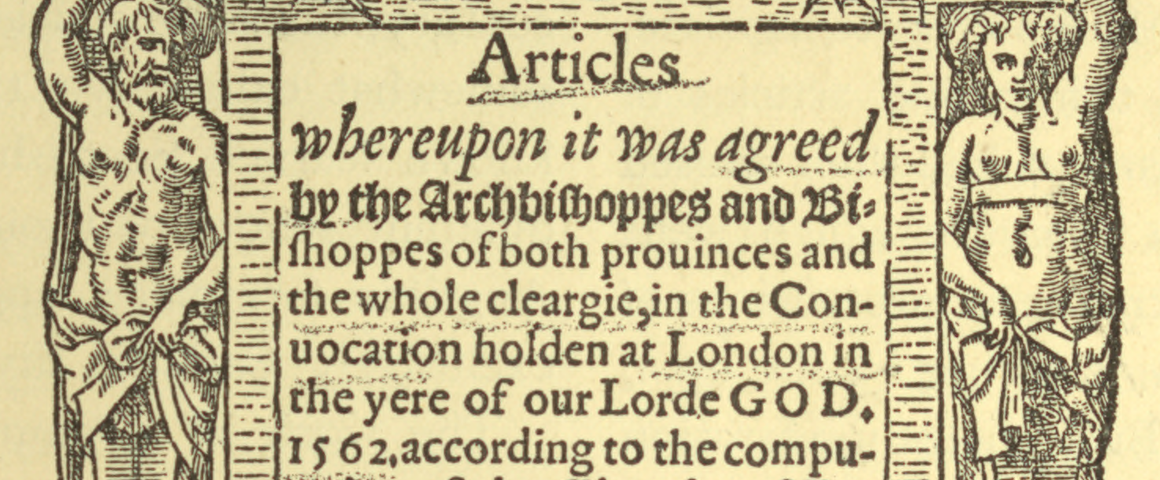
Image source: Archive.org.