- Doctoring Doctrine: Back to the Fundamentals
- Prefacing the Present
- First things First – Fundamentally Anglican
- The Gospel Sacraments
- Not an Oversight, an Overseer: The Episcopacy
- Confessing Our Profession: The Catholic Creeds
- We Shall Gather
- Common Prayer, Common Faith
- Fundamental Principles
- An Anglican Anchor: Hold Fast to the Faith
We confess Baptism and the Supper of the Lord to be Sacraments ordained by Christ Himself in the Gospel, and thus to be ministered with unfailing use of His words of institution and of the elements ordained by Him.
– The Fundamental Declarations, Point 2
The Fundamental Declarations of the ACNA pivot from the source of God’s revelation and the Gospel of Jesus Christ – Holy Scripture – and navigate us to the two sacraments “generally necessary for salvation” as the 1662 Book of Common Prayer Catechism proclaims:
HOW many Sacraments hath Christ ordained in his Church?
Answer. Two only, as generally necessary to salvation, that is to say, Baptism, and the Supper of the Lord.
The Lambeth Quadrilateral upholds the same and extends an olive branch to discussions for ecumenical dialogue to all Christians who profess and keep:
The two Sacraments ordained by Christ Himself–Baptism and the Supper of the Lord–ministered with unfailing use of Christ’s words of Institution, and of the elements ordained by Him.
The numbering of sacraments has long been debated throughout the ancient history of the Church. As the second Book of Homilies notes:
“Therefore neither it nor any other Sacrament else be such Sacraments as Baptism and the Communion are. But in a general acception the name of a Sacrament may be attributed to any thing whereby an holy thing is signified. In which understanding of the word the ancient writers have given this name, not only to the other five commonly of late years taken and used for supplying the number of the seven Sacraments, but also to divers and sundry other ceremonies, as to oil, washing of feet, and such like; not meaning thereby to repute them as Sacraments in the same signification that the two forenamed Sacraments are.”
– (Homily that Common Prayer and Sacraments Ought to be Ministered in a Tongue that is Understanded of the Hearers, p. 355-56).
When the Reformation entered England, the English Reformers were set on getting down to brass tacks and educating the faithful on the core sacraments upheld in Holy Scripture and taught by our Lord as sure and steady promises of comfort and grace, pointing to Christ crucified and risen. Hence, Article XXV holds:
There are two Sacraments ordained of Christ our Lord in the Gospel, that is to say, Baptism and the Supper of the Lord.
The second point of the ACNA Fundamental Declarations follows this long line of Anglican thinking, stating that baptism and the Lord’s Supper are received as the two generally necessary for salvation, precisely because they are “ordained by Christ Himself in the Gospel.” In keeping first things first, the ACNA anchors her catholic theology upon the evangelical proclamation of the Word of God found within the Holy Scriptures. The sacraments are not to be celebrated nor improvised on a whim, but are “to be ministered with unfailing use of His words of institution.” (Point 2, Fundamental Declarations). Words have meaning, and therefore we mean what the Lord says when it comes to baptizing in the Name of the Father, and of the Son, and of the Holy Ghost. When Jesus said “This is my body,” “This is my blood,” we do not edit them but faithfully pronounce what He hath said and done. Therefore, the Book of Common Prayer enshrines the Scriptures’ record of the words of institution when celebrating Holy Communion and uses Christ’s words and instructions from the Gospel of Matthew when baptizing. Finally, and not unimportantly, the Fundamental Declarations conclude that the sacraments Christ ordained Himself are “thus to be ministered with unfailing use … of the elements ordained by Him.”
Baptism requires water. No water, no baptism. The Lord’s Supper requires bread and wine. A cookie and a Coke are for the Sunday social hour and not Holy Communion. As the old saying goes, “Accept no substitutes.”
The beauty and poetry of the first two points of ACNA’s Fundamental Declarations is that they show us where we may encounter God, through His revealed Scriptures, and then how we may enter into and be nourished by the salvation bought for us at the great cost of Christ crucified, dead, buried, and risen from the grave. Hear the Word preached, read the Word revealed, die in the Word’s death, rise in the Word’s life, and eat the Word given to you. Word and Sacrament is the centrality of Christian ministry.
The theology we receive from Holy Scripture and distilled throughout Church history is reflected in several sources within Anglicanism and is touched upon in greater detail later in the Fundamental Declarations. Namely, in point 6, “We receive The Book of Common Prayer as set forth by the Church of England in 1662, … as a standard for Anglican doctrine and discipline,” therefore steering us to look to the rites for Holy Baptism and Holy Communion to understand what we believe through that which we pray. Further, point 7 steers us to “the Thirty-Nine Articles of Religion of 1571, taken in their literal and grammatical sense,” when seeking greater depth on baptismal and eucharist theology in the Anglican way.
Therefore, what point 2 delivers unto us – the centrality of the Gospel sacraments – we dive deeper through studying the 1662 liturgies, the oft-forgotten 1662 Catechism, Articles XXV, XXVI, XXVII, XXVIII, XXIX, XXX, and XXXI. These must needs be our starting point. By virtue of Article XXXV, Of Homilies, it does us well to be familiar with the relevant homilies touching upon the sacraments, most notably, That Common Prayers and Sacraments ought to be ministered in a known tongue and Of the Worth Receiving of the Sacrament of the Body and Blood of Christ.
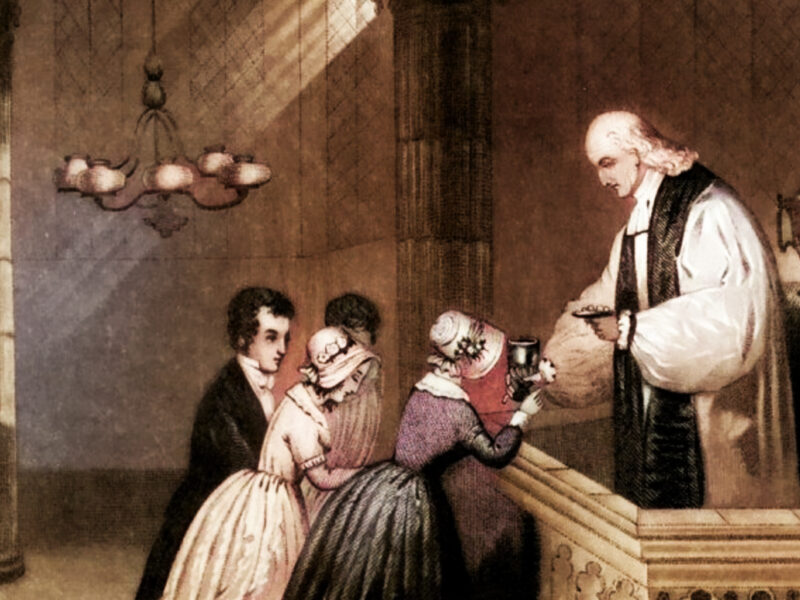
When we join together as the local expression of the body of Christ, we proclaim His death and resurrection with the Gospel sacraments. As we learn in Article XXV, they “be not only badges or tokens of Christian men’s profession, but rather they be certain sure witnesses and effectual signs of grace and God’s good will towards us, by the which He doth work invisibly in us, and doth not only quicken, but also strengthen and confirm, our faith in Him.” What unspeakable joy, peace, and fortification the Gospel sacraments bring to us by renewing and confirming our faith in Christ alone.
Let us close where we began, the 1662 Catechism. There, we are reminded what the “Curate of every parish shall diligently … instruct and examine so many Children of his Parish” and what those children are called to know, learn, and believe before their Confirmation and receiving Holy Communion:
Question. What meanest thou by this word Sacrament?
Answer. I mean an outward and visible sign of an inward and spiritual grace given unto us, ordained by Christ himself, as a means whereby we receive the same, and a pledge to assure us thereof.
Question. How many parts are there in a Sacrament?
Answer. Two: the outward visible sign, and the inward spiritual grace.
Question. What is the outward visible sign or form in Baptism?
Answer. Water: wherein the person is baptized In the Name of the Father, and of the Son, and of the Holy Ghost.
Question. What is the inward and spiritual grace?
Answer. A death unto sin, and a new birth unto righteousness: for being by nature born in sin, and the children of wrath, we are hereby made the children of grace.
Question. What is required of persons to be baptized?
Answer. Repentance, whereby they forsake sin: and Faith, whereby they stedfastly believe the promises of God made to them in that Sacrament.
Question. Why then are Infants baptized, when by reason of their tender age they cannot perform them?
Answer. Because they promise them both by their Sureties: which promise, when they come to age, themselves are bound to perform.
Question. Why was the Sacrament of the Lord’s Supper ordained?
Answer. For the continual remembrance of the sacrifice of the death of Christ and of the benefits which we receive thereby.
Question. What is the outward part or sign of the Lord’s Supper?
Answer. Bread and Wine, which the Lord hath commanded to be received.
Question. What is the inward part, or thing signified?
Answer. The Body and Blood of Christ, which are verily and indeed taken and received by the faithful in the Lord’s Supper.
Question. What are the benefits whereof we are partakers thereby?
Answer. The strengthening and refreshing of our souls by the Body and Blood of Christ, as our bodies are by the Bread and Wine.
Question. What is required of them who come to the Lord’s Supper?
Answer. To examine themselves, whether they repent them truly of their former sins, stedfastly purposing to lead a new life; have a lively faith in God’s mercy through Christ, with a thankful remembrance of his death; and be in charity with all men.