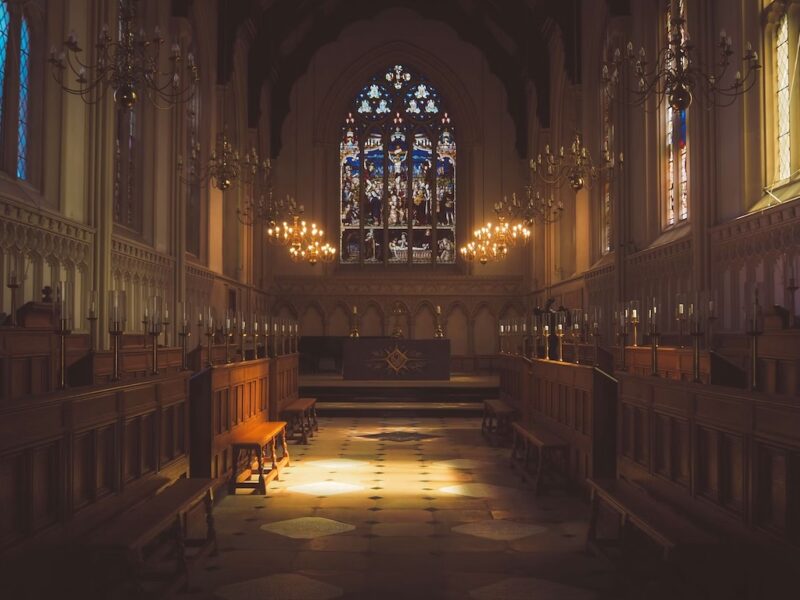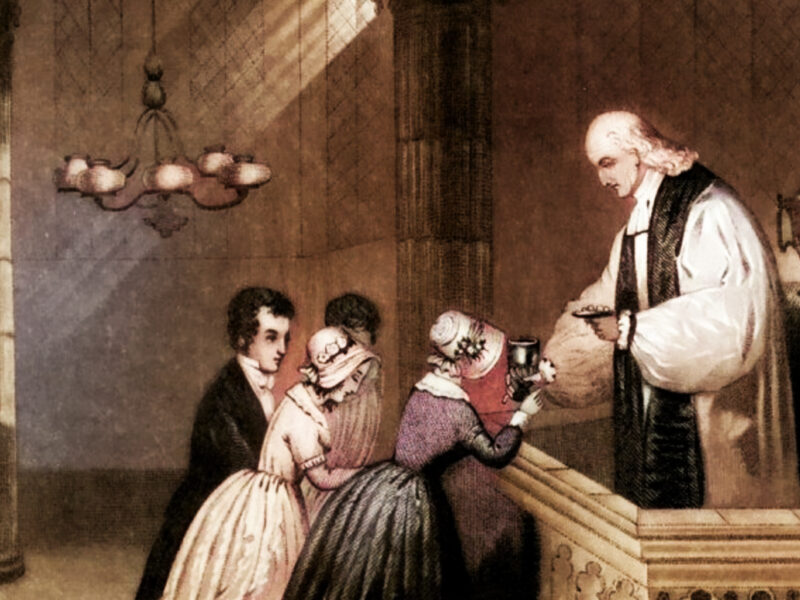
Last weekend, the Morning Service at Good Shepherd Anglican Church, Waynesboro, VA was according to the 1789 Book of Common Prayer as we wished to use the liturgy. I took the trouble to look over Mant and Wilson’s “Exposition of the Rubrics of the Book of Common Prayer” as I sought to educate myself on things like what parts of the service were sung in parish churches, and where the hymns and metrical psalms were placed in the early nineteenth century United States. We rearranged the sanctuary so that when we came to the Communion service Deacon Antony and I could conveniently stand at either end of the Table for the celebration, there were no candles or cross, and a dark red ‘Laudian Pall’ covered the holy table.
The service itself consisted of Morning Prayer, the Litany, and Holy Communion. Even with the minimal music customary in the 1830s and a modern length sermon it took about 90 minutes. In the 1789 Prayer Book the Litany can be shortened by the omission of the supplication and the Creed may be omitted in the Communion service – it was not the differences but the similarities to the familiar 1928 service that struck me. As far as the regular services are concerned, the revisions of 1892 and 1928 were evolutionary, not revolutionary, which set me thinking about other Anglican documents, and their context.
Foundational Documents and Evolutionary Texts
Reformation era churches wrote documents to define the extent of the protest against late-mediaeval Roman Catholicism – the Augsburg Confession, Luther’s Catechisms, the Second Helvetic Confession, etc. The English documents are the Articles of Religion, the Homilies, and the Book of Common Prayer which are intended to hang together as the theological baseline for Anglicanism and its liturgical expression. The three hang together remarkably well and, even though Anglicanism broadened out somewhat even before the revolutions of the nineteenth century, they still provide the foundation of the Anglican tradition to the degree that to alter or abandon one is to run the risk of throwing the others out of balance.
Although I was baptized in the Church of England and gravitated back there once, I figured out that I believe, I have spent more than thirty years in the Anglican Diaspora where I have learnt a significant lesson – that Anglican culture is not enough and the foundational documents do matter. The CofE treated them as ‘historical documents’ and has ended up as a Liberal Catholic sect as Hensley Henson predicted it would in the 1920s. The ACC largely ignores the Articles and ends up being Anglican Rite Old Catholic. The REC spent many years trying to make the Latitudinarian Prayer Book of 1786 work without quite getting it right. They compounded the problem with the Thirty-Five Articles, which although presented as an interpretative text used alongside the Thirty-nine Articles of Religion became something of a de facto standard, which wedded the REC to a sort of generic Evangelicalism at odds with its roots in the Protestant Episcopal Church, with the result that it became a none too happy halfway house between the two traditions.
My strictures against omitting or altering the Articles, Homilies and Prayer Book, should not be taken to mean that you cannot add documents protesting errors unheard of in the sixteenth century, such as Dispensationalism or the Ordination of Women, but you cannot abandon or replace the fundamental documents without creating an imbalance. Indeed, I would venture to suggest that documents such as the Free Church of England’s Declaration of Principles, the United Episcopal Church’s “Preface to the Constitution,” and other similar documents serve a useful purpose in seeking to preserve the substance of the faith entire whilst repudiating more recent errors.
To illustrate my point, I have appended a commentary I wrote on the Free Church of England version of the Declaration of Principles, which is slightly longer than the Reformed Episcopal Church’s version having incorporated some material from the “Preamble to the Constitution” of the Church of Ireland. Even though I am an Old High Churchman, I had three happy years in the Free Church of England under Bishop Cyril Milner before I married and moved to the USA, and thus became thoroughly acquainted with its documents.
The UK Context of the Declaration of Principles
In the UK, the context in which Declaration of Principles operated was different to that of the REC. Instead of a revised version of the 1786 Prayer Book and the Thirty-Five Articles, the FCE used the 1927 BCP which maintained the main services as they stood in the 1662 with very few alterations whilst being closer to the REC BCP in the case of the Occasional Services. whilst it may have deviated from the 1662 occasionally was “close enough” for the ordinary churchgoer not to feel any appreciable difference. Furthermore, the REC’s Thirty-Five Articles were not adopted by the FCE. Instead, they used a slightly modified version of the Thirty-Nine Articles which protests both Consubstantiation and Private Confession to a priest. Reading the Declaration of Principles in that context of the FCE Prayer Book and Articles allowed me to see it as a defence of the ‘Old Anglican Divinity’ which did not exclude the Old High Churchmanship altogether.
The contrast with the American REC situation is interesting. The use of the Declaration of Principles in conjunction with the 1786 Book of Common Prayer and the Thirty-Five Articles created a major adjustment of the tradition towards an Evangelicalism which is looser and less sacramental than that of the English Reformation and had a distinct whiff of Latitudinarianism about it. This is why the Reformed Episcopal Church, despite the fair omens and bright auguries of 1873-77 did not really prosper as it was too Anglican for Evangelicals, and too Evangelical for Episcopalians being unable to overcome the slight suspicion on both sides that it wasn’t really the real thing. This discomfort was enhanced by some of the founding generation of clergy who, unlike Cummins, Cheney, and Latane, were not rock-solid Evangelical Episcopalians but experimented with Arminianism, Dispensationalism, Fundamentalism, Higher Criticism, and Revivalism. In the UK, the Free Church of England, whilst slightly modifying the Prayer Book and Articles did not go in for the sort of wholesale changes that created suspicion among Episcopalians and Evangelicals in the USA. If you read the Declaration of Principles alongside the old Free Church of England documents, the impression created is one of a church body eager to exclude Ritualist innovation, but intent on preserving the substance of the old Evangelical Anglicanism.
Personally, I do not have a problem with reading the FCE (or REC) Declaration of Principles in the context of the 1662 and 39 Articles, but with other documents it can result in something which is ultimately a variant form of Anglicanism not quite true to the English Reformation, or its workings out over the ensuing 250 years.
❦
On the FCE Declaration of Principles
Introduction
In view of the ongoing stresses within both the Reformed Episcopal Church and the Free Church of England arising from their connections with GAFCON, Anglican Church in North America, or Anglican Mission in Europe, it is perhaps worth giving a moment’s consideration to the implications of the Free Church of England’s Declaration of Principles. These fall into two classes. The first question is whether the Declaration reflects the mainstream of Evangelical Anglican thought and practice, and the second, whether it contains anything that might prove to be an insurmountable barrier to such churches coming into communion with the United Episcopal Church of North America. The tensions between some members of the REC and the FCE arise from three sources – the ordination of women, the influence of the Charismatic Movement on the theology of the large bodies – and the three steams theory used to create an apparent unity within the ACNA and GAFCON. In this paper I am going to primarily address myself to the situation that obtains in the Free Church of England, however, these considerations are also relevant to any discussions that we might have of those bodies which are descended from the Free Church of England, such as the FCE (Evangelical Connexion.)
Background
The Free Church of England came out of the ‘Calvinist’ side of the Evangelical Revival of the mid-eighteenth century, and although you cannot trace its institutional history back to that period, there is a continuity of ideas from Whitefield, the Countess of Huntingdon, and Thomas Haweis, through to those independent Evangelical Anglican congregations that formed in the 1840s during the crisis over “Newmania.”[1] These congregations coalesced into the Free Church of England which was incorporated by Poll Deed in 1863 as an outgrowth of the Countess of Huntingdon’s Connexion. In turn, the Free Church of England received the Historic Episcopate from the Reformed Episcopal Church in 1876.
A clash of personalities led to a period of fragmentation with the original body splitting into three bodies – the original Free Church of England, the Reformed Episcopal Church in the United Kingdom, and the Reformed Church of England.[2] The latter two reunited in the 1890s, and in turn, they united with the Free Church of England in 1927. After 1996, rising tensions between the pro-Ecumenical and anti-Ecumenical sides of the Free Church of England following abortive negotiations between that denomination’s Central Council and representatives of the Church of England led to a split in the early 2000s, with the latter group being denominated the “Evangelical Connexion.”
The governing documents of the FCE, after Scripture are the 1927 Book of Common Prayer, a slightly revised version of the Articles of Religion, and the unalterable Declaration of Principles, all of which are printed in the Prayer Book. The changes to the Articles need not detain us here, as they were largely insignificant. The Free Church of England BCP is a mix of 1662 with the American Proposal of 1785/6 and tends to reflect the prevailing anti-Tractarian outlook of mid-Victorian Evangelicals.[3]
The Declaration of Principles was adopted by the Free Church of England in 1876 as part of its federative union with the Reformed Episcopal Church. The UK and US texts are not identical, and the FCE version is reproduced in full without commentary at the end of this article. To use a soccer metaphor, the Declaration really is “a game of two halves” with the first reflecting the Evangelical Ecumenicism of the founders of the Reformed Episcopal Church, whilst the second half addresses certain Tractarian and Ritual innovations in belief and practice which had become anathema to the Low Church party by the late-1860s.
A brief preamble declares the Church to be,
a branch of the Holy Catholic Church of the Lord Jesus Christ, united by Faith to Him, who is the Head over all things to the church which is Body, and recognising the essential unity of all who, by a like Faith…
It declares its fundamental theological position to be one of
“holding “the faith once delivered unto the saints”, [and] declares its belief in the Holy Scriptures of the Old and New Testaments as the Word of God, and the sole Rule of Faith and Practice; in the creed “commonly called the Apostle’s Creed”; in the Divine institution of the Sacraments of Baptism and the Lord’s Supper; and in the Doctrines of grace substantially as they are set forth in the Thirty-nine Articles of Religion.
The mention of the Apostles’ Creed without the usual addition of the Nicene and Athanasian Creeds – both of which are contained in the FCE Prayer Book – may seem a little peculiar, but reflects the somewhat misguided enthusiasm of Bishop Cummins and other founders of the Reformed Episcopal Church for the 1786 General Convention’s Revision of the Book of Common Prayer.[4] There is no evidence to suggest that Cummins objected to the Nicene Creed, and like most Evangelicals of the period any awkwardness concerning the Athanasian Creed would have centred on the damnatory clauses.
Cummins and his circle were firmly convinced by the argument that there were ‘Romanizing germs’ not just in the 1789 Liturgy, but also in the 1662 Book of Common Prayer. Both texts had been hijacked by the Ritualists to support their peculiar tenets, by interpreting the Liturgy as softening, or modifying the sacramental theology contained in the Articles of Religion.
The sufficiency of Scripture, the Divine Institution of the two Sacraments, and the authority of the Thirty-Nine Articles albeit restricted to ‘the doctrines of Grace’ are all maintained in the Declaration of Principles. Cummins’s view on this subject did not appear like Melchizedek but reflects the Protestant ecumenical platform first presented to the General Convention by W. A. Muhlenberg in 1856. The ‘Muhlenberg Memorial’ had sought to provide a path into the Episcopal Church for other Protestants by emphasizing unity of doctrine.[5]
In addressing the institution of Episcopacy, the Declaration states:
2. This Church recognises and adheres to Episcopacy, not as of Divine Right, but as a very ancient and desirable form of Church polity.
In the context of mid-nineteenth century Anglicanism, this statement is unexceptionable, though it might have generated a little bit of tension between the stricter High Churchmen and the Evangelicals on the basis that the former would have preferred “the most…” rather than “a very ancient and desirable form of Church polity.” Unlike the Tractarians and their successors who usually ‘unchurched’ non-episcopal church bodies, the Old High Church had acknowledged the existence of other forms of polity in the Continental Protestant churches and could honestly address the historical problems surrounding its development. At the same time, the Old High Churchmen believed that non-episcopal churches could benefit from adopting episcopacy into their systems, and to this end had supported both the attempt of Jablonski to introduce
Episcopacy back into Prussia in 1701-13, and the Anglo-Prussia Jerusalem Bishopric in the 1840s.[6] This position was not always shared by Evangelical Anglicans who consider polity to be very much a secondary issue.
With regards to the Church service:
3. This Church, retaining a Liturgy which shall not be repressive of freedom in prayer, accepts the Book of Common Prayer, as it was revised, prepared and recommended for use by the General Convention of the Protestant Episcopal Church, A.D. 1785, reserving full liberty to alter, abridge, enlarge and amend the same, as may seem most conducive to the edification of the people, “provided that the substance of the faith be kept entire”.
Again, the early REC’s touching faith in the Protestantism of the 1785 Prayer Book is on full display. The clause ‘repressive of freedom in prayer’ simply reflects the common Evangelical practice of extemporary prayer before and after sermons, and upon emergent occasions. In practice, however, the Free Church of England did not allow itself to be drawn into this mindset, as later in the Declaration of Principles, we find the following functional emendation,
In accordance with the liberty given in Clause 3 of the above Declaration of Principles, this Church accepts the Book of Common Prayer of the Church of England, with such revisions as shall exclude sacerdotal doctrines and practices.
Thus, the main services of the Free Church of England were near identical to the 1662 Book of Common Prayer, with the revisions being mainly confined to the Baptismal Office and the Marriage Service which are like those in the proposed American BCP of 1786.
The Fourth Article of the Declaration addresses certain Ritual innovations in doctrine and practice stating that,
4. This Church CONDEMNS and REJECTS the following erroneous and strange doctrines as contrary to God’s Word:
The Declaration then goes on to condemn five propositions, the first of which “That the Church of Christ exists only in one order or form of ecclesiastical polity;” is clearly directed at the increasingly widespread practice of condemning as ‘no churches’ those bodies without Episcopal polity. Historically, the Anglican relationship with the non-Episcopal Churches on the continent had been cordial, but not close. Some of the Caroline Divines, including John Cosin (1594-1672) had communicated in Huguenot churches during the Interregnum, and whilst High Churchmen such as William Howley, George Tomline, and Charles James Blomfield may have wondered why Continental Protestant did not make more effort to restore Episcopacy within their Churches, the continental bodies which had lost Episcopacy for political reasons were still regarded as legitimate Churches by the Old High Churchmen.[7]
The next three propositions are an attack on the ‘revival of the Mass’ which Evangelicals believed was a major plank of the Ritualist programme. The attack is a remarkably narrow one, intended to maintain the old Eucharistic theology of the Church of England. The first of these,
That Christian Ministers are “priests” in another sense than that in which all believers are “a royal priesthood”;
Is intended to reinforce the concept of not only the priesthood of all believers but also serves as a reminder of the origin of the word priest in the English language as deriving from the Greek ‘presbyteros’ via Latin. Because of the nature of Germanic paganism, the concept of a sacrificial priesthood was poorly developed and not clearly distinguished from practitioners of magic, or chieftains, the habit had grown up of using ‘priest’ in the sense of one who offers prayer and/or sacrifice to the god because of the high mediaeval doctrine of the Mass. This is a secondary use of a word that refers primarily to the Christian minister or elder.
The next clause –
That the Lord’s Table is an altar on which the oblation of the Body and Blood of Christ is offered anew to the Father;
…deals with the sacrifice of the Mass, and it is remarkably moderate in that it still allows the concepts of the Eucharist as being a ‘sacrifice of praise and thanksgiving,’ of ‘a commemorative sacrifice,’ or of a ‘feast upon the sacrifice’ that occur in Anglican writings of the 17th and 18th centuries. However, it reinforces the condemnation of the ‘sacrifices of masses’ – the concept of propitiatory sacrifices in addition to Calvary – contained in Article 31.
The fourth proposition:
That the Presence of Christ in the Lord’s Supper is a presence in the elements of Bread and Wine;
Simply reiterates and reinforces the doctrine contained in 28th and 29th of the Articles of Religion. As E. Harold Browne observes in his commentary of the Thirty-Nine Articles, the doctrine of the Church of England had always been that of ‘a real, spiritual presence, which is the doctrine of Calvin, and some other continental Reformers.’
The final proposition states,
That Regeneration is inseparably connected with Baptism
…which at face value would seem to condemn the doctrine of Baptismal Regeneration held by the Reformers, the Caroline Divines, and the Old High Church. However, most 18th= and early 19th-century adherents of the doctrine of Regeneration would have been in qualified agreement with this statement, as the likes of Daniel Waterland (1683-1740) made a clear distinction between ‘regeneration,’ which is the formal title to the benefits of the covenant that are obtained in baptism, and the ‘renewal’ or ‘renovation’ of spirit that is necessary for those benefits to be applied to the individual.[8] However, the old position came to be contested mainly because of a shift in language use around 1820 – 1830 which inclines Evangelicals, especially those influenced by the Second Great Awakening to more closely align regeneration – new birth, or rebirth – with the actual gift of salvation. The later Tractarians also tended to equate regeneration with salvation and thus baptismal regeneration in their eyes became an objective gift of salvation that could be lost through unrepented post-baptismal sin – a position that was at odds with the overwhelming majority of earlier High Churchmen.
The penultimate paragraph of the Declaration of Principles reaffirms the Reformed and Protestant character of the church, and is lifted almost word-for-word from the Preamble and Solemn Declaration of the Church of Ireland (1870)
This Church, as a Reformed and Protestant Church, doth hereby re-affirm its constant witness against all those innovations in Doctrine and Worship whereby the primitive Faith hath been from time to time defaced or overlaid, and which at the Reformation were disowned and rejected.
The same also applies to the closing sentence
This Church will maintain communion with all Christian Churches, and will set forward, so far as in it lieth, quietness, peace and love, among all Christian people.
Though it lacks the reference to the Church of England present in the Irish original.
Conclusion
From the point of view of someone who is committed to the Bible, the Articles of Religion, the Book of Common Prayer, and the historic threefold ministry, what are the concerns that exist with the Free Church of England Declaration of Principles? Quite simply stated, they devolve to one, and one only – that is, to what degree does the 1785/6 Proposed Book of Common Prayer influence their working theology? Given that the working Prayer Book is that of 1927, whose deviations from the 1662 text are largely confined to the Pastoral Offices, and the South American branch of the Evangelical Connexion used the Spanish edition of the 1928 Book of Common Prayer, one would have to say that the 1786 Prayer Book has very little day-to-day influence on their theology. Therefore, it is legitimate to take the Declaration of Principles in isolation as being a testimony to the historical origins of the Free Church of England and its adherence to the Evangelical and Protestant tradition within Anglicanism. When coupled with Oracio Commun, or with the Free Church of England or 1662 Books of Common Prayer, the Declaration of Principles merely protests certain Anglo-Catholic positions, and a reaffirmation of their Evangelical identity within the Anglican tradition.
❦
THE DECLARATION OF PRINCIPLES
adopted by the Free Church of England in 1876, and readopted in 1927
[Full Text]
The Free Church of England, otherwise called the Reformed Episcopal Church, which is a branch of the Holy Catholic Church of the Lord Jesus Christ, united by Faith to Him, who is the Head over all things to the church which is Body, and recognising the essential unity of all who, by a like Faith, are united to the One Divine and Common Head, doth make declaration of its Principles:
1. The “Free Church of England otherwise called the Reformed Episcopal Church in the United Kingdom of Great Britain and Northern Ireland”, holding “the faith once delivered unto the saints”, declares its belief in the Holy Scriptures of the Old and New Testaments as the Word of God, and the sole Rule of Faith and Practice; in the creed “commonly called the Apostle’s Creed”; in the Divine institution of the Sacraments of Baptism and the Lord’s Supper; and in the Doctrines of grace substantially as they are set forth in the Thirty-nine Articles of Religion.
2. This Church recognises and adheres to Episcopacy, not as of Divine Right, but as a very ancient and desirable form of Church polity.
3. This Church, retaining a Liturgy which shall not be repressive of freedom in prayer, accepts the Book of Common Prayer, as it was revised, prepared and recommended for use by the General Convention of the Protestant Episcopal Church, A.D. 1785, reserving full liberty to alter, abridge, enlarge and amend the same, as may seem most conducive to the edification of the people, “provided that the substance of the faith be kept entire”.
4. This Church CONDEMNS and REJECTS the following erroneous and strange doctrines as contrary to God’s Word:
First, That the Church of Christ exists only in one order or form of ecclesiastical polity;
Second, That Christian Ministers are “priests” in another sense than that in which all believers are “a royal priesthood”;
Third, That the Lord’s Table is an altar on which the oblation of the Body and Blood of Christ is offered anew to the Father;
Fourth, That the Presence of Christ in the Lord’s Supper is a presence in the elements of Bread and Wine;
Fifth, That Regeneration is inseparably connected with Baptism.
In accordance with the liberty given in Clause 3 of the above Declaration of Principles, this Church accepts the Book of Common Prayer of the Church of England, with such revisions as shall exclude sacerdotal doctrines and practices. This Church, as a Reformed and Protestant Church, doth hereby re-affirm its constant witness against all those innovations in Doctrine and Worship whereby the primitive Faith hath been from time to time defaced or overlaid, and which at the Reformation were disowned and rejected.
This Church will maintain communion with all Christian Churches, and will set forward, so far as in it lieth, quietness, peace and love, among all Christian people.
Notes
- The first FCE congregations were formed in Ilfracombe and Exeter in the wake of the Tract XC controversy. ↑
- Much of this fragmentation was down to Thomas Hubbard Gregg (1840-96) who aligned with the FCE in 1876. He seems to have had difficulties with both less than 100% Anglican nature of the FCE and with the ‘Yankee’ General Council. ↑
- This third generation of Evangelicals is often nicknamed ‘Recordite’ after the Evangelical magazine ‘The Record’ which started publication in 1836 which represented the younger, more aggressively anti-Catholic Evangelicals. ↑
- Cummins tends to refer to the 1786 proposal as the 1785 Prayer Book, or Bishop White’s Prayer Book, neither of which is completely accurate. ↑
- The Muhlenberg Memorial is reflected in 15 and 36 of the 1958 PECUSA Constitution and Canons, and in turn are reproduced as Canons 16 and 35 of the 1996 UECNA set. ↑
- Jablonski was a Bishop of the Bohemian who served as court chaplain in Koenigsberg, he had the support of the king, but unfortunately three of the principal players – the King of Prussia, Queen Anne, and Archbishop Sharp of York, all died 1713. Friedrich-Wilhelm IV of Prussia tried to reintroduce Episcopacy back into the Prussian Union in 1848, but the revolutionary atmosphere in the Synod constrained him. ↑
- This idea is explored at some length in Peter B. Nockles: “The Oxford Movement in Context” (CUP, 1992) ↑
- An interesting illustration of the language shift is John Bird Sumner (1780-1862) whose 1815 ‘Apostolical Preaching’ cautiously approves of the doctrine of Baptismal Regeneration, but who, as Archbishop of Canterbury, refused to endorse the Tractarian view of baptismal regeneration by finding for Cornelius Gorham. It must be said that in this case both Gorham, and Phillpotts were a little peculiar in their views. Gorham had come close to being refused ordination by Bowyer Sparkes, Bishop of Ely, some forty years before because of his views on baptism, and Phillpotts’ views on baptism regeneration were unusually strong an Old High Churchman, having been influenced by Martin Routh and Christopher Bethell. ↑