- Doctoring Doctrine: Back to the Fundamentals
- Prefacing the Present
- First things First – Fundamentally Anglican
- The Gospel Sacraments
- Not an Oversight, an Overseer: The Episcopacy
- Confessing Our Profession: The Catholic Creeds
- We Shall Gather
- Common Prayer, Common Faith
- Fundamental Principles
- An Anglican Anchor: Hold Fast to the Faith
We confess the godly historic Episcopate as an inherent part of the apostolic faith and practice, and therefore as integral to the fullness and unity of the Body of Christ.
Point 3, The Fundamental Declarations
The episcopacy is the ministry of overseeing the Church. It is a ministry found within Holy Scriptures and evolved from a more local orientation with a metropolitan surrounded by what we would today call suburbs and rural communities in a wider metro area into the rural parts of the county. The language adopted for the episcopacy matched the Roman political districts with dioceses becoming the common vernacular as episcopal sees grew in power and the extent of the cities, towns, and villages under their oversight.
Although the episcopacy has grown in overseeing more square miles and therefore more congregations, the roots are found in Holy Scripture “as an inherent part of the apostolic faith and practice,” according to Point 3. Since Anglicans are people of the Good Book, as we learned in Point 1, the ACNA therefore sees the episcopacy “as integral to the fullness and unity of the Body of Christ.”
Notice the ACNA charitably does not “dechurch” or “unchurch” Christians lacking episcopal oversight. Instead, they invite them into a “fullness” in experiencing the “unity of the Body of Christ.” This language echoes the themes found within the Chicago-Lambeth Quadrilateral. The PECUSA 1886 Chicago resolution, adopted by the House of Bishops, notes that ecumenical reunion could be had by any Christian church that adopts:
The Historic Episcopate, locally adapted in the methods of its administration to the varying needs of the nations and peoples called of God into the unity of His Church.
This same language would be adopted two years later at the 1888 Lambeth Conference.
Notably, neither the Fundamental Declarations nor the Chicago-Lambeth Quarilateral claim that the historic episcopacy must be locked into the late medieval system. However, what is required of Anglicans and those who seek unity is the historic episcopacy linked to the Holy Scriptures. We see in the Scriptures how St. Paul laid hands upon St. Timothy and St. Titus and sent them as bishops to plant congregations under their care. Beyond the Scriptures, the Apostolic Fathers record the ministries of early bishops and the development of the extent of their oversight from a single metropolitan congregation to overseeing multiple congregations and weighing in on disciplinary matters.
Although the model of episcopal oversight could be over widespread lands and distant congregations as in the Middle Ages to the modern era, it can also be more localized as seen through other periods of the Church. The fundamental of Point 3 is that the Anglican Church has the historic episcopacy, and reflects the apostolic faith and practice enshrined in Holy Scriptures. The requirements of the episcopal ministry are found in the Scriptures and are summarized in terms of duties and qualifications through the Ordinal.
As the Jerusalem Declaration of 2008 holds:
We recognise that God has called and gifted bishops, priests and deacons in historic succession to equip all the people of God for their ministry in the world. We uphold the classic Anglican Ordinal as an authoritative standard of clerical orders.
Point 7, Jerusalem Declaration
The classic Anglican Ordinal, attached to the 1662 Book of Common Prayer, is upheld in Point 6 of the Fundamental Declarations, which we will review in greater detail later in this series. However, to understand what constitutes the “godly Historic Episcopacy” of Point 3, we should understand that the Ordinal is fundamentally the Anglican source to reference, pray, and ordain men called to serve as bishops:
We receive The Book of Common Prayer as set forth by the Church of England in 1662, together with the Ordinal attached to the same, as a standard for Anglican doctrine and discipline, and, with the Books which preceded it, as the standard for the Anglican tradition of worship.
Point 6, The Fundamental Declarations
The Ordinal’s Preface, crafted by Archbishop and martyr, Thomas Cranmer, notes that the “apostolic faith and practice” of three orders of ministry is precisely why Anglicans retain the historic succession of bishops:
It is evident unto all men diligently reading holy Scripture and ancient Authors, that from the Apostles’ time there have been these Orders of Ministers in Christ’s Church; Bishops, Priests, and Deacons.
Preface to the Ordinal, Book of Common Prayer (1662)
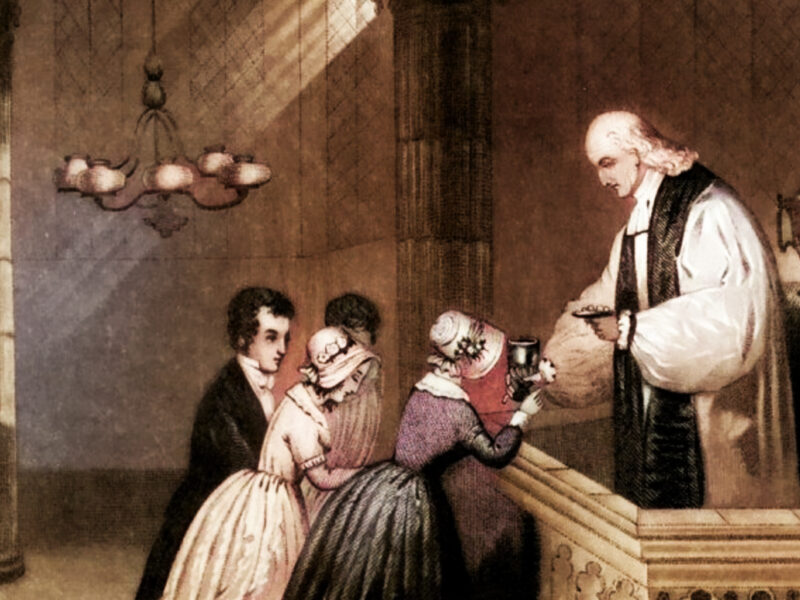
The episcopal ministry is one of oversight and, therefore, authority. For “a priest, acting under the authority of the bishop,” is the nature of any Church with the trifold ministry (To Be A Christian: An Anglican Catechism, Q&A 83, p. 36). The bishop is the sole minister who administers “Confirmation [by] the laying on of the bishop’s hands with prayer for strengthening by the Holy Spirit.” Id. (Q&A 137, p. 59). Furthermore, “Ordination is the laying on of the bishop’s hands with prayer,” and is limited to the ministry of bishops. Id. (Q&A 140, p. 60).
A bishop is not an imperial prince nor an untouchable judge, but is a servant of Christ. The bishop lays his hands as a literal representative of becoming the hands of Christ. But he is also called to use his mind to teach the faith once delivered, his mouth to preach the Gospel, his heart to love the Church as Christ loves His flock, and his feet to visit the congregations committed to his care as a steward. As the catechism puts it:
Bishops represent and serve Christ and the Church as chief pastors, catechists, and missionaries in the tradition of the apostles. They are to confirm and ordain, and to guard the faith, unity, and concerning sacraments discipline of the Church. (Isaiah 61:1–11; John 20:19–23; 21:15–19; Acts 20:17–35; 1 Timothy 3:1–7; Titus 1:7–9; 1 Peter 5:1–5; Ignatius of Antioch, Letter to Polycarp 1.2–2.2)
To Be A Christian, Q&A 143, p. 60-61
Retaining bishops in the historic succession is a notable and commendable preservation of “the apostolic faith and practice.” However, the Church must also discern and raise godly men into this service. For there is no one above our Master and no one who is lord in the Church except for the Lord Jesus. The Ordinal is clear that a bishop must discipline the Church to keep her obedient to Christ and prevent her from straying. Still, the bishop is also a man under authority and must be obedient to Christ both personally and within his public ministry. Fundamentally, a bishop oversees the ministry because he is administering the Word and Sacrament to the flock under his care as a faithful steward, and not lording authority as though he imagines himself as a Gentile king.
Ye know that the princes of the Gentiles exercise dominion over them, and they that are great exercise authority upon them. But it shall not be so among you: but whosoever will be great among you, let him be your minister; And whosoever will be chief among you, let him be your servant: Even as the Son of man came not to be ministered unto, but to minister, and to give his life a ransom for many.
Matthew 20:25-28 (KJV)
“This is a true saying, if a man desire the office of a bishop, he desireth a good work.” (1 Timothy 3:1, KJV). Let us, as the Anglican Church in North America, come together discerning, seeking, and calling godly men who meet the Lord’s requirements for the “godly historic Episcopate” with 1 Timothy 3:1-7 and Titus 1 open in one hand and the Ordinal in the other, before we quickly lay any hands upon any man.
I do not think there are many among Bishops that will be saved, but many more that perish: and the reason is, that it is an affair that requires a great mind. Many are the exigencies which throw a man out of his natural temper; and he had need have a thousand eyes on all sides. Do you not see what a number of qualifications the Bishop must have? To be apt to teach, patient, holding fast the faithful word in doctrine. What trouble and pains does this require!
* * *
I do not speak thus as wishing to put us bishops to shame, but to repress your hankering after the office.
Homily 3 on the Acts of the Apostles, St. John Chrysostom
Image by Wikimedia Commons.