- Doctoring Doctrine: Back to the Fundamentals
- Prefacing the Present
- First things First – Fundamentally Anglican
- The Gospel Sacraments
- Not an Oversight, an Overseer: The Episcopacy
- Confessing Our Profession: The Catholic Creeds
- We Shall Gather
- Common Prayer, Common Faith
- Fundamental Principles
- An Anglican Anchor: Hold Fast to the Faith
[T]hat if thou shalt confess with thy mouth the Lord Jesus, and shalt believe in thine heart that God hath raised him from the dead, thou shalt be saved. For with the heart man believeth unto righteousness; and with the mouth confession is made unto salvation.
— Romans 10:9-10 (KJV)
We confess the faith that Christ has revealed to us through His life, death, and resurrection as illuminated by the Holy Spirit who breathed out the divinely inspired writings of Holy Scripture. Though the Scriptures are clear, the Church catholic fought through synods and councils with heretics within and schismatics without over the articles of faith. The articles of faith were summarized and systematized in abbreviated and Scripture-supported statements of faith, which we commonly call the Creeds. Anglicans within the Anglican Church in North America are rooted and anchored by point 4 of the Fundamental Declarations, not to neglect nor ignore the catholic and orthodox tradition of the early saints and councils, but to anchor ourselves upon the sound, Scriptural doctrine enshrined in the catholic creeds:
We confess as proved by most certain warrants of Holy Scripture the historic faith of the undivided church as declared in the three Catholic Creeds: the Apostles’, the Nicene, and the Athanasian.
— Point 4, The Fundamental Declarations
The ACNA receives the wisdom of the Apostles’, the Nicene, and the Athanasian Creeds as distillations of the united Church of Christ because each is first supported by Holy Scripture and therefore opposes heresies ancient and modern. Second, professing the confessions within the Creeds reaffirms the holy intention of Anglicans to neither depart from the faith once delivered nor create or fall into heresies old or new. Anglicans historically have rejected claims that they are departing from the ancient faith and are creating a new one. Fundamentally, ACNA repeats (albeit in a reorganized manner) what Anglicans have long professed through the Articles of Religion:
VIII. Of the Three Creeds.
The three Creeds, Nicene Creed, Athanasius’ Creed, and that which is commonly called the Apostles’ Creed, ought thoroughly to be received and believed; for they may be proved by most certain warrants of Holy Scripture.
These three Creeds go hand-in-hand with Word and Sacrament ministry. The Apostles’ Creed provides the basis of our engrafting into the Church at our baptism and our strengthening by the Holy Spirit in our confirmation. The Nicene Creed nourishes us after the proclamation of the Word as a pledge of our allegiance to the King before He nourishes us at His Holy Table with the Blessed Sacrament of the Lord’s Supper. The Athanasian Creed catechizes us annually on Trinity Sunday (Additional Directions to Holy Communion, 2019 Book of Common Prayer) and thirteen times a year during the major feast days during morning prayer in the 1662 Book of Common Prayer and 2003 Reformed Episcopal Church Book of Common Prayer.
The Apostles’ Creed, as the Baptismal Symbol; and the Nicene Creed, as the sufficient statement of the Christian faith.
— Lambeth Resolution 11, 1888
These three creeds summarize without simplifying the catholic consensus. The Apostles’ Creed introduces us to faith in the Triune God and reveals His divine love to save humanity through Christ Jesus. The Nicene Creed expounds upon the hypostatic union of the God-man, Jesus Christ, fully God and fully man, and the Holy Spirit’s mission and ministry through His body, the Church. The Athanasian Creed poetically describes the triune God and rebuts the madness of the zeitgeist. Denying a Person of the Blessed Trinity is to deny the Living God. Confuse the substance, and you will confound your salvation. Multiply the Godhead, and you recreate the pagan pantheon.
Whosoever will be saved, before all things it is necessary
that he hold the Catholic Faith.
Which Faith except everyone do keep whole and undefiled,
without doubt he shall perish everlastingly.
The fact that the Creeds are from the ancient fount of catholic orthodoxy is precisely why we receive them as faithful wells that never run dry. Though they are short statements, they are theological heavyweights that all should give pause and study in depth. Entire books have been written on a single creed. The traditional Anglican catechism and the ACNA To Be A Christian catechism have sections on the Apostles’ Creed. We memorize their weighty words and never reflect upon them to our own detriment. The Creeds are restraints from the madness of a Church tempted by the devilish whispers of the world, calling us to conform to sin and compromise doctrine. Yet the Creeds are a comforting response to the satanic temptations for the Church to collaborate with the Enemy and flirt with the spirit of the age. Further, the Creeds are a harness against the Christian who would rather craft novelty and deviate from the old ways in favor of strange fire, stranger teachings, and itching ears. Or, as the ACNA catechism commends the Creeds:
19. What is the purpose of the creeds?
The purpose of the creeds is to declare and safeguard for all generations essential truths about God, the Church, and the world, as revealed in Holy Scripture. (Deuteronomy 7:9–11; Psalm 145:4–13; John 20:30–31; 2 Timothy 1:13–14; Hebrews 2:1–4)20. What does belief in the creeds signify?
Belief in the creeds signifies acceptance of God’s revealed truth and the intention to live by it. To reject any element of the creeds signifies a departure from the Christian faith. (Matthew 16:13–20; 2 Timothy 3:14–15; 4:1–5; James 2:10–26)— To Be A Christian: An Anglican Catechism, p. 31.
How shall we confess Christ? Professing Him through the Creeds. How shall we publicly attest to our Lord, our God, our Savior? Confessing the Creeds crafted by the saints of old to saints anew. What words shall we have readily upon our hearts and minds when the world demands an account for Whom we believe? The Creeds, which succinctly attest to the Almighty God who judges sin, saves sinners, and shall call all mankind into account.
Whosoever therefore shall confess me before men, him will I confess also before my Father which is in heaven. But whosoever shall deny me before men, him will I also deny before my Father which is in heaven.
— Matthew 10:32-33 (KJV)
The scholar should sit and speak nothing against, the bishop boast in nothing more, the theologian teach nothing departing therefrom, and the laity learn and lay up the Scriptures’ treasures distilled within “the three historic Creeds as expressing the rule of faith of the one holy catholic and apostolic Church.” (Point 3, Jerusalem Declaration). When Anglican Christians profess faith in Christ, it shall always be through the audible confessions of faith found within the Apostles’, Nicene, and Athanasian Creeds.
Let us hold fast the profession of our faith without wavering; (for he is faithful that promised;) And let us consider one another to provoke unto love and to good works.
— Hebrews 10:23-24 (KJV)
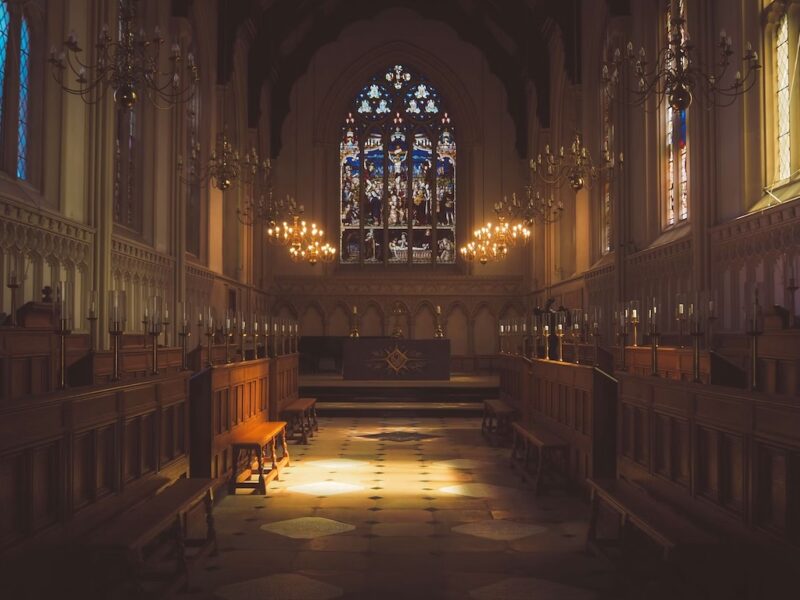
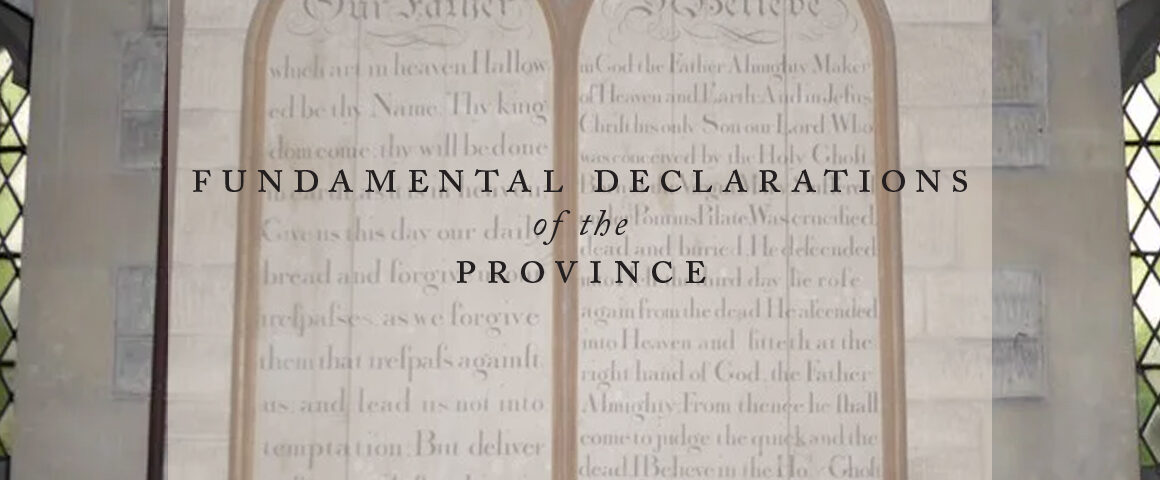
Image: Inside St Mary, Fawley