An American Anglican Returns After Twenty-Eight Years
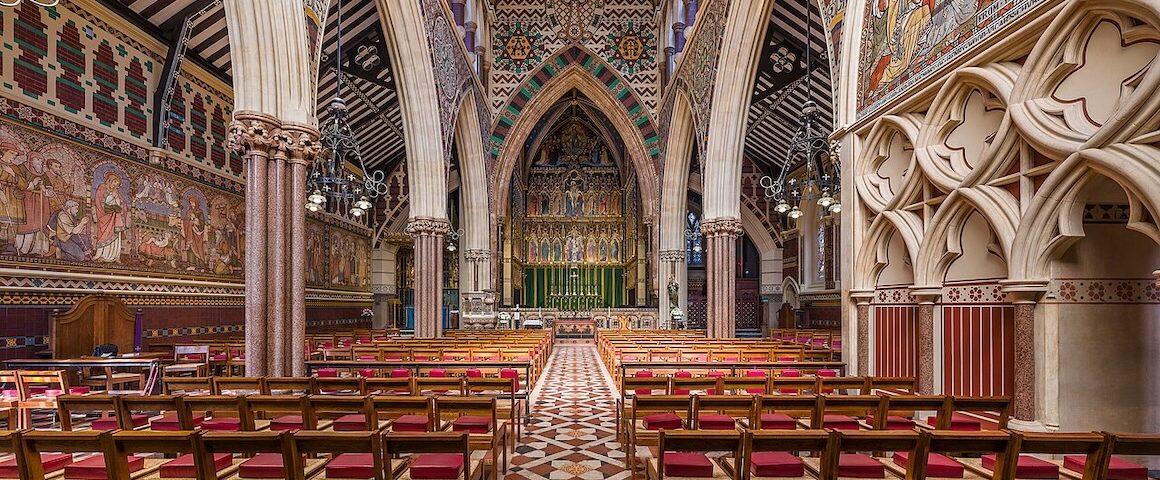
I once heard a remarkable statement from someone who had emigrated from Communist Hungary to America. He escaped by swimming the Danube River under gunfire to western shores. He said that he was born American; he just didn’t realize it until he was 18 years old. Well, I was born Anglican; I just didn’t realize it until I was 18. My father was a Methodist minister in Minnesota, and in the summer of 1998, just days after my high school graduation, we flew to England to spend two months there in a pulpit exchange. We lived and ministered in an English Methodist parsonage and church in Wiltshire, while the English minister lived in our home in Minnesota and ministered in our churches. It was a magical summer in many ways. I suppose that in high school, if you had asked me what the Church of England was, or what Anglicanism was, I could have only given you a vague definition. But after arriving in England, I immediately began noticing cathedrals, and lovely, ancient, stone parish churches at the heart of each town we passed through. I was intrigued. And so, after two weeks of attending the Methodist church my dad was pastoring, I took the train the next Sunday morning to Bath, to attend a Sunday morning service of Holy Communion at Bath Abbey. An African Bishop just happened to be visiting, so the preaching was good. The surpliced boy choir sang, the music resounded from stone floors and gothic vaulted ceilings, and light streamed through the large medieval windows, and I realized this was probably the most beautiful thing I had ever seen. Anglicanism had planted a seed in my soul that would flower more fully over the next 4 years in college, and beyond, and ultimately carry me through a season of unbelief, and bring me back to faith in God. What I was experiencing and drawn to, but could not then explain, was the via media, or middle way, that is unique to the Church of England. I grew up in evangelical culture in the Methodist Church, and assumed, and remain convinced, that the heart of Christian faith was a sinner’s saving faith in Christ’s acts of mighty redemption on the Cross. Here, at Bath Abbey, and other Church of England Churches, I heard this familiar, sweet Evangelical song in the words of the Book of Common Prayer, but was struck by something new: the Catholic beauty of Gothic stone, surpliced choirs, chasubles, candles, incense, and reverent ritual. This was the via media; that oft-maligned, but true and lovely beauty-mark of Anglicanism, and it immediately impressed itself upon me. Evangelical words and Catholic ritual remain a striking and powerful spiritual juxtaposition. I am forever grateful to the Church of England in the summer of 1998, sharing her lovely, unique charism with me.
Starting Saturday, July 11th, I am, as I have come to think of it, In Search of the Church in England. I am an American Anglican traveling through England seeking the living inheritance of English Christianity — in cathedrals, parish churches, pilgrimage paths, liturgy, music, ruins, and ordinary worshippers.
I am so excited to visit and worship in some historic churches throughout Britain these next two weeks. But what am I hoping to find 28 years later? What does this American Anglican imagine the Church of England to be? Why does England still exert such a pull on me? What will I do with perhaps inevitable disappointments? As I have mulled over these questions, I have found, in prayer, that a posture of repentance and humility will be best for my soul, and for my ability to have fruitful conversations. I am determined not to fume or grieve when I inevitably encounter woolly-headed Broad Churchmen, or outright revisionism in some of the Cathedrals I will be worshipping in. Instead, for these two weeks, I will observe, pray, walk, write, photograph, record impressions, and begin conversations. Beyond this year, I hope to hike to all CofE cathedrals and pilgrimage trails in the British Isles in the next ten years. Does this become a book? Maybe. We will see, but I feel God stirring me to go to England, to walk, pray, make friends, and write about it.
Many American Anglicans—especially Catholic-minded ones like me—live with a curious tension. Our ecclesiastical future may be some combination of American and global, but much of our spiritual imagination remains English. We sing English hymns, read English divines, admire English church architecture, and invoke English saints. We read and know Newman, Pusey, Andrewes, Herbert, and Lewis better than we know similar American divines and authors. This year, I led our parish choir in music by Tallis, Gibbons, Stanford, Wood, Britten, Darke, & Rutter- all names that are as dear and familiar to Anglican musicians as an old pair of slippers. The Church of England, still, has a gravitational pull on us all.
Yet relatively few of us American Anglicans have actually encountered the Church of England on its native soil. I still remember that summer of 1998. And two weeks in 2006. But what has changed? How has memory distorted what I experienced? How have I changed? I have a hopeful belief that through worship, fellowship, and writing I will discover that God is not done with the Church of England yet.
There can be an undercurrent of tensions in conversations in the ACNA when the Church of England comes up. After all, we are not, on paper, a recognized province of the Anglican Communion (literal backdoor conversations with Archbishops Duncan and Beach at Lambeth Palace aside). And we often protesteth too much that the Church of England is too far gone anyway. I’m uncomfortable with this. Yes, the Church of England is dogged by cultural pressures to which the ACNA is not similarly exposed (some in our fold may argue to the contrary, but another conversation…). But I am hopeful that I will find an encouraging spiritual vitality in worship and fellowship in ordinary English and Scottish parishes. It is also vital that we remove the log in our own eye. We see the vanguard of liberalism in the CofE pop up in the news, but are less able to see our own cultural drift. Many of our parishes and dioceses lost much when we left The Episcopal Church: stone churches, organs, vestments, music libraries, pulpits, fonts, etc. We, understandably, reached for the nearest tools of rented spaces and amplified guitars. Lex Orandi, Lex Credendi– “the law of prayer is the law of belief- that famous Anglican maxim is also a confession of Marshall McLuhan’s observation that “the medium is the message.” And the medium in many of our ACNA parishes is indistinguishable from that of the culture we bathe in. “One man’s cultural drift is another man’s outreach,” the ACNA and CofE churchmen growl at each other. For the next two weeks, enough of this. I will be irenic; I will be hopeful. Schism has been a continuing bitter fruit of the English Reformation. I pray to die a reconciled Episcopalian in a renewed, orthodox Episcopal Church. And I pray my children die reconciled western Catholics after Rome finally invites the Protestants to Vatican III, as Cardinal Pole had assumed. Yes, friends, Pangloss is going to England.
In the end, to be a Catholic Christian is, among other things, to have a high view of the visible Church. If Christ actually did commission the apostles as bishops, and command their successors to baptize and commune sinners for the forgiveness of sins in His name, then those who love His Church- His Bride- need never lose hope. For the Holy Spirit will never abandon the Church whom he has washed and sanctified. Wicked and- worse- bored bishops cannot sink her. Christ may chasten, prune, and exile her. The last 30 years sure feel like a chastening and pruning, to be sure! But a Catholic Christian is a hopeful Christian, because there is a day when we will be called out of exile, back to Israel.
And England is my Israel. Our Israel, friends. And so, I return on Saturday to my spiritual center, seeking the beating heart of English Christianity. This time, with a wife, four children, and my brother’s family of four (himself an Anglican priest). Various members of our family will be visiting with me in these English churches, cathedrals, and abbey ruins. Some of my family are more or less indulgent of my endless church crawling. Sometimes it will be all ten of us; other times it may be just me. I will try to be respectful and reverent, but also try to get enough pictures and videos to gather and post visual impressions. I will post daily: emotional impressions, liturgical impressions, architecture, smells, weather, conversations, fatigue, disappointment, moments of transcendence, tensions within Anglicanism, beauty and decay existing together. All of it.
And so I return—not to the perfect church- certainly not to a golden age, but to the place where Anglicanism first taught me to worship the Lord in the beauty of holiness. I go hoping to find signs of life and signs of holiness. And I go because I was glad when they said unto me, “We will go into the house of the Lord.’ Our feet shall stand in thy gates, O Jerusalem… Yea, because of the house of the Lord our God, I will seek to do thee good. Amen.