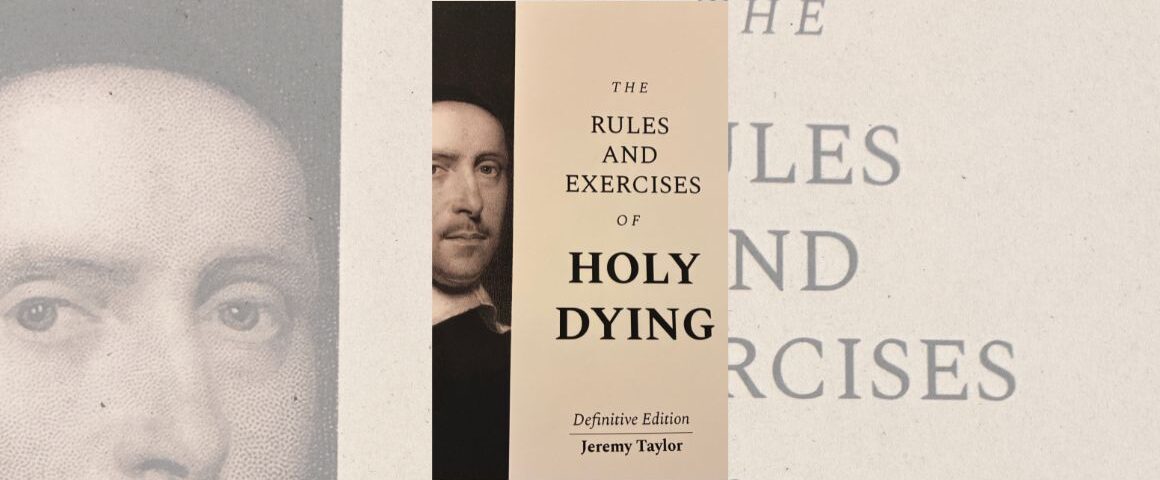
The Rules and Exercises of Holy Dying: Definitive Edition. By Jeremy Taylor. Edited by C. T. Sacred Standard Books, 2025. 425 pp. $30 (paper).
My work here is not to please the speculative part of men, but to minister, to practice, to preach to the weary, to comfort the sick, to assist the penitent, to reprove the confident, to strengthen weak hands and feeble knees, having scarce any other possibilities left me of doing alms, or exercising that charity by which we shall be judged at doomsday.
– Jeremy Taylor, p. 13
A new and accurately titled Definitive Edition of Jeremy Taylor’s classic, The Rules and Exercises of Holy Dying, is now available on Amazon. This edition was edited from the 1883 edition, which married Taylor’s Holy Living with Holy Dying. Sacred Standard Books has separately produced a definitive edition of Holy Living, also available on Amazon. This definitive edition of Holy Dying retains the 1883 edition’s footnotes, alongside numerous resources that assist in bringing this Anglican classic to life for new readers in the 21st century.
The Editor’s Note provides a helpful explanation outlining the additions he made to the 1883 Edition. The most obvious update is the reformatted text. It assists the modern reader, and if this were the only update, it would be reason enough to add the Definitive Edition to your bookshelf, even if you already own an older reprint of the text. However, the editor has done more than merely reformat the text. He has also translated the original Latin and Greek present in the 1883 Edition’s footnotes to English. This opens up the usability and usefulness of the footnotes for the average reader. Far too often, when reading a work published in the 19th Century and earlier, the reader refers to the footnote only to find an Augustine quote in the original Latin – which puts the average English reader at a disadvantage if they are unable to read Latin.
Perhaps the best addition is the inclusion of several indices that help in finding relevant items while engaging with Taylor’s work. I particularly find the Index of Names helpful, which provides brief biographical details about the person referenced. I will note that the page(s) where the person is referenced are included at the end of the brief biographical sentence and can be confusing at first when a year precedes the page number. A simple “p.” before the page number would be helpful, but this is a minor improvement and not something impossible to divine when using the Index of Names. Overall, the inclusion of this index is extremely beneficial since so many persons referenced by Taylor are unknown to contemporary readers.
The first necessity that is to be served is that of repentance, in which the ministers can in no way serve him but by first exhorting him to confession of his sins, and declaration of the state of his soul.
– Jeremy Taylor, p. 252
Likewise, the Glossary is an extremely useful section that provides definitions and context for dozens of words either foreign to most English readers or with meanings forgotten over the centuries. I am convinced that every republication of classic works needs a Glossary in order to fully understand and appreciate the author’s intent. Instead of modernizing (which some readers know I have done in the past), I agree with the editor’s approach to leave the language untainted and to educate the reader with a Glossary for those words requiring further explanation.
There is a useful Scriptural Index, which is organized in order of the 66-book canon of Scripture, and puts apocryphal references at the end. This tool is useful when searching for Taylor’s use of Scripture and the Apocrypha. Note that on page 368, a special section exists for Scriptural references for a section where Taylor employs numbered paragraphs. It took a moment to understand that the editor is first referencing the paragraph number tied to the text. What strikes me as odd is that the Scripture references are initially footnoted within Taylor’s text from numbered paragraphs 1 through 17, but then one must flip to page 368 to see the corresponding Scriptural references for paragraphs 18 through 69. As one who has republished classic texts, I presume this decision was made to avoid unnecessarily having pages of text dominated by footnotes; however, I would have opted to put all the footnotes for this numbered paragraph section in the Scriptural Index instead of breaking it up.
The editor’s inclusion of a section of Illustrations is well appreciated. He includes five illustrations drawn from the first published editions of Holy Dying, which illuminate not only the book but also Jeremy Taylor. Speaking of which, the editor wisely published the Rev. George Croly’s A Sketch of the Life and Times of Bishop Taylor, originally drawn from an 1838 edition of Taylor’s Holy Living, as an introduction. This was an excellent choice by the editor, as Croly’s biography exposes the reader to who Jeremy Taylor is and provides context as to his magnificent works, Holy Living and Holy Dying. The biography is not brief, but is thankfully thorough, running at 49 pages. Croly tells Taylor’s biography with a mixture of Taylor’s own words, correspondence from others during Taylor’s life, and a general history about the saint who lived before, during, and after the English Civil War. One obtains a grasp of history and an understanding of Bishop Taylor that assists the reader who is about to engage Holy Dying.
Sickness, is in some sense eligible, because it is the opportunity and the proper scene of exercising some virtues. It is that agony in which men are tried for a crown.
– Jeremy Taylor, p. 118
The text of Taylor’s Holy Dying is well preserved in this edition. The only updating is related to spelling. The editor explains what he changed in the Editor’s Note by pointing out examples of antiquated spellings updated for ease of reading and inserting section numbers previously left out of online scans of Holy Dying. The reformatting is much appreciated by this reader, and my only quibbles are minor. The footnote numbers are the same font size as the footnote text, which can be distracting but is a matter of personal preference. The other quibble that I pray is updated or simply a quirk of my copy is that the text is a lighter black than my old eyes would desire. The text is not faded, just simply not as black as most texts purchased from retailers. It is readable, but noticeable enough to older eyes that I suggest ensuring you are in a well-lit room.
Taylor’s work, Holy Dying, is an Anglican classic that deserves this Definitive Edition treatment. I am thrilled the editor chose this work to update and enhance so scholars and laity alike may take up and read. I pray that parishes and seminaries alike pick up this edition and utilize it for classes and book clubs to rediscover the gems of wisdom within Bishop Taylor’s words. Death is avoided and ignored in today’s world, especially within North America and the West. However, Anglicans pray in the Litany for the Lord to deliver us “from sudden death.” Since we traditionally pray the Litany thrice a week for this mercy, we should prepare for it by contemplating how we live today to ensure we have a holy death tomorrow.
Taylor begins his work by providing advice and spiritual rules on how to consider death and how we might live until we have a holy death. His seriousness is to be commended in the unserious world where we find ourselves. Chapter 2 moves from considering a holy death to preparing for one, “by way of exercise,” that is, living in such a manner that we are ready. Taylor pivots in Chapter 3, warning us about the nature of sickness and how it can serve either as a temptation to fear and sin or as a reminder to prepare oneself for one’s own mortality. Taylor’s advice will offend the modern sensibilities of many. Good, we need the offense and to be shaken by the stoic words of Taylor into contemplating sickness and how it too is for our sanctification.
By a daily examination of our actions we shall the easier cure a great sin, and prevent its arrival to become habitual.
– Jeremy Taylor, p. 70
Taylor continues his work by meditating on how anyone can use sickness to receive the graces of the Holy Spirit, ranging from patience, faith, repentance, charity, and prayer. Finally, Bishop Taylor closes in Chapter 5 with eight sections instructing clergy on visiting the sick and tending the dying. Once again, those who confuse ministry with therapy will find Taylor’s advice and counsel harsh. However, Taylor emphasizes to the clergy that there is no time like the present for confession of sins, repentance, and delivering the Gospel, especially when one’s parishioner lies upon their deathbed. The deathbed is the final trench of battle. The last charge is about to be made. Hell’s gates are to be stormed and heaven’s kingdom to be gained. To love one’s neighbor is to tell them the truth: death is near, and either Satan delights, or the angels rejoice. Sinner, do you repent and place your sole trust and hope and faith upon Christ Jesus, God the Son, slain for the salvation of the world and for your soul?
Taylor forces us to consider and to ask, “Have I died to myself today?” For unless we die daily, we live in death to our sins. But if we die today, then we live for Christ not only today but eternally. Therefore, let us take up and read so we may take up and live for a holy death and blessed rest in the arms of Jesus Christ.
The very suffering is a title to an excellent inheritance; for God chastens every son whom he receives; and if we be not chastised, we are bastards, and not sons. … Suffer, therefore, God to choose his own circumstances of adopting thee, and be content to be under discipline, when the reward of that is to become the son of God: and by such inflictions he hews and breaks thy body, first dressing it to funeral and then preparing it for immortality.
– Jeremy Taylor, p. 110