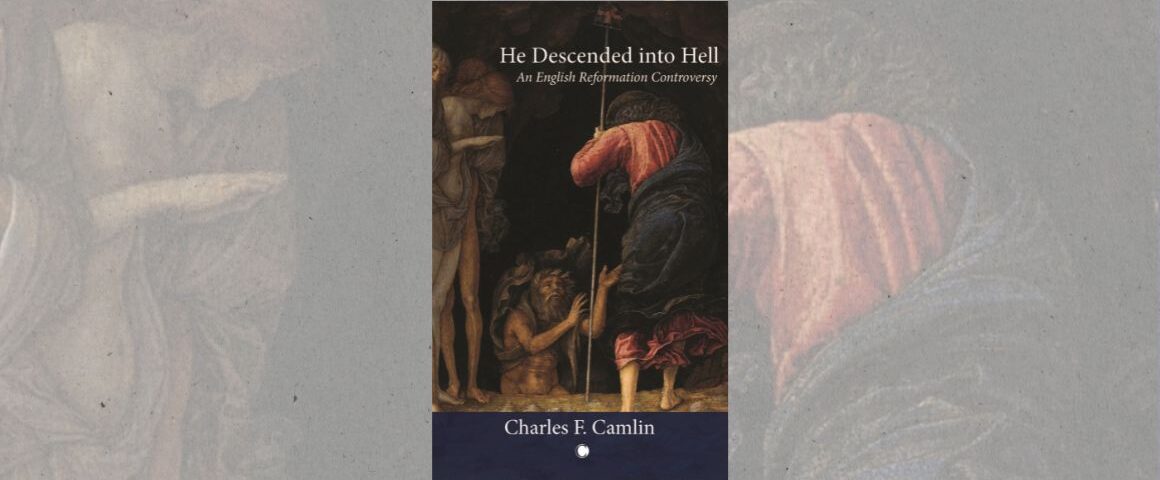
He Descended into Hell: An English Reformation Controversy. By Charles F. Camlin. Cambridge, UK: James Clarke & Co., 2025. 252 pp. $120 (hardback), $37.50 (paper).
Article III of the Thirty-nine Articles affirms the doctrine of Christ’s descent into hell as an element of catholic theology, historically shared by Christians the world over. However, it is notable that while the Article teaches that Christ “went down into Hell,” it does not elaborate on what precisely is meant by “Hell,” nor does it explain for what purpose Christ went there. These omissions are not incidental, as both questions were heavily controverted at the time of the English Reformation. The purpose of Charles Camlin’s new book, therefore, is to offer an account of the controversy.
Having said this, Camlin aims to do more than give a mere historical summary, for he approaches the topic with a particular question in mind: “This book will seek to explore the extent to which the English reformers of the Tudor period followed through on their stated purpose to have their teachings consistent with the Church Fathers concerning the doctrine of Christ’s descent into hell” (2–3). Accordingly, Chapter 1 surveys patristic treatments of the doctrine, and Chapter 2 covers the medieval period on through the reign of Edward VI. In these two chapters, Camlin discusses how the doctrine of the descent developed via eminent Christian thinkers throughout the first 1500 years of church history, establishing the doctrine’s background up to the early stages of the English Reformation. Chapter 3, then, focuses on the Elizabethan era, analyzing several disputes surrounding the doctrine that took place between various clerics and scholars within the Church of England. Camlin concludes that “the Church of England was consistent with the Fathers in maintaining a literal descent of Christ into hell; but it was not entirely consistent regarding the purpose of his descent.” More specifically, while a number of the fathers taught that Christ delivered the Old Testament saints from Sheol and translated them to heaven, the Church of England ultimately “chose to depart from the view of the Fathers. The cause of this departure was a fear of lending any credence to the concept of purgatory” (209). Hence, on Camlin’s account, the Church of England discarded part of the catholic patrimony on Christ’s descent because it was “too closely aligned with the teaching of Rome” (4).
Although Camlin does not much elaborate on the greater significance of his argument that the Church of England differed to some degree from a prevalent teaching of the fathers concerning Christ’s descent into hell, he appears to find this development regrettable. Indeed, Camlin seems to think a common alternative in historic Anglican thought—that Christ preached to the saints in Sheol without delivering them from their estate—is of dubious value. In his words, “It begs the question as to what benefit Christ’s descent brought to those in Hades” (27). Now if the matter were entirely as Camlin presents it, namely, that the Church of England departed from the fathers on this point primarily (or perhaps solely) for fear of appearing too Romish, I would be inclined to agree with him that such a development was indeed unfortunate. As I understand it, however, the rationale frequently put forward by English divines for this shift in doctrine was not a concern for appearances, but a concern for scriptural primacy. In his influential Exposition of the Creed, Bishop Pearson states that whatever sense is made of this part of the Apostles’ Creed, it must “be conformable unto that Scripture upon which the truth of the Article [i.e., this portion of the Creed] doth rely.”[1] He writes further on that, by this criterion, the belief that Christ delivered the Old Testament saints from Hades into heaven is found wanting:
It cannot be certain that the soul of Christ delivered the souls of the saints of old from hell, and imparted to them the beatifical vision, except it were certain that the souls are in another place and a better condition now than they were before. But there is no certainty that the patriarchs and the prophets are now in another place and a better condition than they were before our blessed Saviour died; there is no intimation of any such alteration of their state delivered in the Scriptures.[2]
Isaac Barrow, another notable Anglican theologian, comments on the notion that Christ translated the Old Testament saints into heaven in like manner:
That he [Christ] went to rescue and conduct into glory the souls of the patriarchs, and other good persons, from that infernal limbus, in which till then they were detained, (a place by no likely means to be proved existent otherwhere than in the fancy of its inventors;) or, that he went to deliver the souls of the just, and prophets, from the wicked powers, into whose power they had fallen, (as Justin Martyr, in his Dialogue with Tryphon, p. 105.) That He went to affront, triumph over, and terrify the powers of darkness on their own ground, or in their own dominions. These and the like conceits seem enough discountenanced by saying the Scriptures nowhere plainly declare any such thing, and that therefore they have no good ground to stand on (they pretend only one or two difficult and obscure places in the first Epistle of St. Peter, which are capable of fair expositions not favorable to them;).[3]
Multiple commentaries on the Articles also take up this position, finely articulated by Bishop Gibson:
There is an extraordinarily strong tradition among the Fathers that Christ descended to the patriarchs and prophets of the Old Dispensation, and preached to them, and bettered their condition. There is no other passage of Holy Scripture [besides 1 Peter 3:19] from which such a tradition can have originated; and it would therefore seem that the Fathers took it that those mentioned by S. Peter were but specimens, so to speak, of a class—of those, that is, who had lived and died under the Old Covenant. It may be so. But this is all that can be said. Where Scripture is silent, such an inference must be more or less precarious, and though the opinion may appear a probable one, it can only be held (if at all) as a ‘pious opinion,’ which cannot be pressed upon any as a part of the faith.[4]
The point here is not that such figures are necessarily correct in saying there is insufficient scriptural warrant to believe that Christ translated the Old Testament saints into heaven, but rather that, insofar as this lack of scriptural support can be evidenced, the Church of England has had good reason to depart from the fathers on this point, much stronger than the fear of being perceived as too close to Rome, which Camlin focuses on almost exclusively as their purported rationale for doing so. To be sure, Camlin does cite concrete examples of this sort of thinking, and he acknowledges that some (e.g., William Fulke and Bishop Bilson) also cited scriptural concerns as their basis for moving away from patristic teaching, but he does not dwell on the latter consideration as a potentially sound justification for the Church of England’s doctrinal shift. To reiterate, fear of appearances would be a weak reason for breaking with the fathers, whereas scriptural concerns are far more defensible, but Camlin does not discuss at length the merits of the latter justification. Absent this discussion, readers may be left uncertain as to whether the Church of England’s doctrinal shift was so regrettable as Camlin suggests, if indeed (as numerous divines have claimed) the doctrine is not clearly taught in Scripture. It is also worth nothing that, while Camlin is apparently skeptical of the idea that Christ’s preaching in Hades was declaratory (rather than accomplishing a change of condition for the Old Testament saints), this position has been upheld by many in the Anglican tradition, with Bishop Horsley often cited as a representative proponent:
If he [Christ] went to proclaim to them (and to proclaim or publish is the true sense of the word ‘to preach’) the glad tidings, that he had actually offered the sacrifice of their redemption, and was about to appear before the Father as their intercessor, in the merit of his own blood, this was a preaching fit to be addressed to departed souls, and would give new animation and assurance to their hope of the consummation in due season of their bliss; and this, it may be presumed, was the end of his preaching.[5]
These observations are made, not to say definitively that the fathers who taught Christ’s translation of the Old Testament saints into heaven were wrong, but to draw attention to the fact that the Church of England’s shift away from this doctrine can theoretically be explained on more defensible grounds. Yet whatever one makes of these disputed questions, it remains the case that Camlin provides an excellent survey of the doctrine of Christ’s descent into hell. Other contemporary treatments of the doctrine are extant, but none explore it as it relates particularly to the English Reformation the way Camlin does. In short, this book makes a valuable contribution to historical theology, one that will be of special interest to clergy and laity within the Anglican tradition, and for which the author deserves commendation.
Notes
- John Pearson, An Exposition of the Creed (Cambridge: Cambridge University Press, 1882), 437. ↑
- Pearson, Exposition of the Creed, 468. ↑
- Isaac Barrow, Works, vol. VI (London: A. J. Valpy, 1831), Sermon XXVIII, 146. ↑
- Edgar C. S. Gibson, The Thirty-Nine Articles of the Church of England, 2nd ed. (London: Methuen and Co., 1898), 174, italics original. See also Gilbert Burnet, An Exposition of the Thirty-Nine Articles, ed. James R. Page (New York: D. Appleton & Company, 1842), 71, and G. F. Maclear and W. W. Williams, An Introduction to the Articles of the Church of England (London: Macmillan and Co., 1895), 66. ↑
- Samuel Horsley, Sermons, vol. II (New York: T. and J. Swords, 1811), Sermon XX, 102. See also H. C. O’Donnoghue, A Familiar and Practical Exposition of the Thirty-Nine Articles of Religion (London: Taylor and Hessey, 1816), 36–37, and Edward Harold Browne, An Exposition of the Thirty-nine Articles: Historical and Doctrinal, ed. J. Williams (New York: E. P. Dutton and Company, 1874), 101–102. ↑