- Festivals and Fasts: Saint Bartholomew (August 24)
- Festivals and Fasts: Ember Days in September
- Festivals and Fasts: Saint Matthew (September 21)
- Festivals and Fasts: Saint Michael and All Angels (September 29)
- Festivals and Fasts: Saint Luke the Evangelist (October 18)
- Festivals and Fasts: All Saints (November 1)
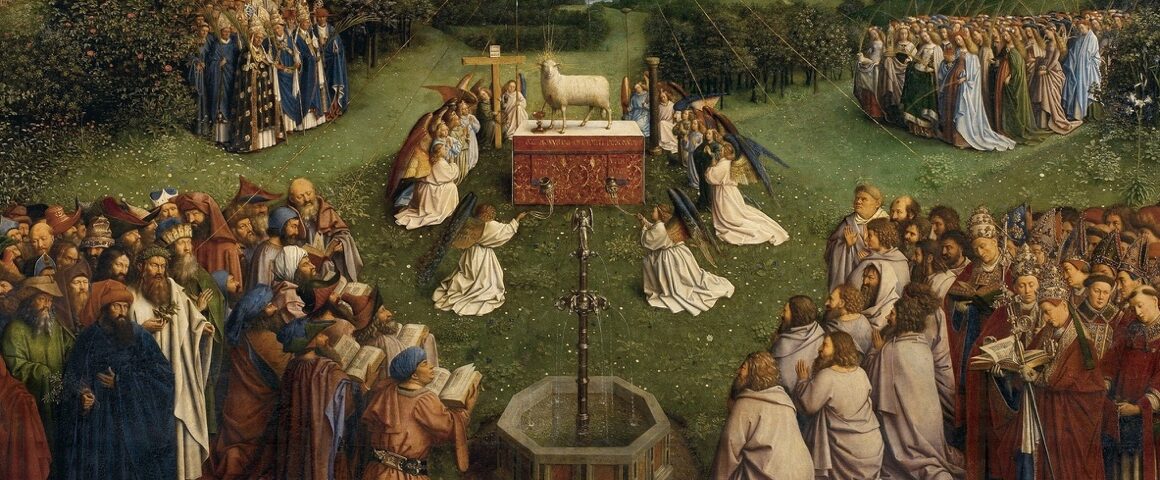
For the feast of All Saints (November 1), we present this selection from Robert Nelson’s Companion for the Festivals and Fasts of the Church of England. May his reflections on the communion of saints encourage us to follow their example in holiness, to choose our companions wisely, and to seek those joys which God hath prepared for them that love him.
All Saints—November 1.
Q. What Festival does the Church this day celebrate?
A. That of All Saints.
Q. What do you mean by a Saint?
A. In the beginning of Christianity, the word Saint was applied to all believers, as is plain by the use St. Paul and St. Luke make of it: afterwards, none were called so but such as eminently excelled in all Christian virtues (Acts 9:13; Rom. 16:15); and though that sense still continues in the Church militant, yet it now generally signifies such good men, as (whose earthly tabernacle being dissolved) have a house not made with hands, eternal in the heavens (2 Cor. 5:1), and so are become a part of the Church triumphant.
Q. What persons may be denominated saints in the Church militant?
A. Such who not only believe the doctrines of the Christian religion, but conform their whole lives to the precepts of it: such who not only have a holy faith, but are purified thereby; who have a sincere regard to God and another world in all their actions, and are constant and uniform in the discharge of their duty; who abstain from all kind of evil, perfecting holiness in the fear of God (2 Cor. 7:1).
Q. What seems to be the design of the Church in instituting this Festival?
A. To honour God in his saints. It being through the assistance of his grace that they were made conformable to his will in this life, and through the bounty of the same gracious Lord, that his free gifts are crowned with happiness in the other.
Q. What further end does the Church aim at?
A. To encourage us here below to run the race that is set before us with patience, seeing we are encompassed with so great a cloud of witnesses to work in us firmness and resolution of mind, by propounding the examples and patterns of holy men gone before us, who, in their respective ages, have given remarkable testimony of their faith in God, and constant adherence to his truth (Heb. 12:1).
Q. By what means did the Saints in heaven attain that happiness they now enjoy?
A. It was purchased for them by the death and sacrifice of our Saviour Jesus Christ; the benefits whereof they were made capable of receiving, by the purity of their faith, by the uncorruptedness of their morals, by their constancy and perseverance in despite of all sufferings and persecutions, and by fighting manfully under Christ’s banner to their lives’ end.
Q. Wherein consists the happiness of the next life?
A. In this life we are not able to conceive the happiness God hath prepared for those that love him. It doth not yet appear what we shall be (1 John 3:2); but the Scripture in general hath assured us, that God will reward those that diligently seek him, not according to our narrow and limited conceptions, but according to the exceeding greatness of his power and goodness (Eph. 1:19). So that God having promised to make us happy in the next world, we have all the reason imaginable to put our trust and confidence in him, as to the way and manner of effecting it.
Q. What light have the Scriptures given us in this matter?
A. The wisdom of God is pleased sometimes to condescend to our low apprehensions, and to reveal his sublime rewards by such things as we are most apt to value and admire; and therefore it is represented in some places under the metaphor of a kingdom, a crown, and a treasure, it being expressly called the kingdom of the Father, a crown of righteousness, a crown of life, and a crown of glory, a treasure in heaven, and a treasure that faileth not, though the greatest kingdoms and treasures of this world bear no proportion to the least degree of heavenly glory (Matt. 13:43; 2 Tim. 4:8; Jam. 1:12; Rev. 2:10; 1 Pet. 5:4; Matt. 19:21; Luke 12:33). But the excellency of this happiness is more particularly set forth to us by everlasting life, by the vision of God, and by a likeness to him, and by being with Christ (Rom. 6:22; Matt. 5:8; 1 John 3:2; Phil. 1:23). All which implies that we shall in the next life live free from sin, the great torment and affliction of devout souls in this; that we shall be exempted from all those evils and miseries which are the consequence of it, and which attend us through this earthly pilgrimage; a sort of happiness that the most sensual are affected with. And not only sin and sorrow shall cease to be, but we shall enter upon the possession of all those pleasures we are made capable of enjoying: for when the spirits of just men are made perfect, there shall be nothing to hinder the constant influences of infinite goodness; so that our understandings shall be entertained with the knowledge of God; the most perfect and excellent Being, the source and fountain of all truth, and our wills vigorously employed in choosing and embracing the most desirable goods, and our affections determined to the most delightful objects; for our minds, being then enlarged to their utmost capacities, shall have a more perfect, certain, and clearer knowledge of God than we can attain to in this life; and from the sight of his glory, the love of his goodness, and the admiration of all his excellences, we shall be transformed into his likeness, both in the purity and spirituality of our souls; whence must result infinite pleasure and satisfaction, incessantly expressing itself in hymns of praise and thanksgiving. Besides, it must needs raise in us fresh transports of joy and rapture, to see our glorified Redeemer exalted to the right hand of God; and all the blessed inhabitants of this heavenly Jerusalem will, in a degree, contribute to our happiness by their profitable and delightful conversation. And, to complete our bliss, it shall never change nor have an end, but we shall pass eternity in knowing and loving, in praising and cheerfully obeying the blessed Trinity, Father, Son, and Holy Ghost.
Q. How is the pattern of the Saints accommodated to our imitation?
A. In that they were mere men, clothed with flesh and blood, and an imperfect nature, liable to sin as well as we, and once strove with the same unruly passions, and were exposed to the same difficulties as we are now surrounded with; and that we have the same holy precepts to direct us, the same grace to assist us, the same promises to encourage us, the same holy table for our spiritual nourishment. So that what was attainable by them, may be acquired by us, if we are not wanting to ourselves.
Q. What obligations lie upon all Christians to holiness of life?
A. They are obliged to it by the precepts of the Gospel, which strictly command holiness; by the promises, which are so many encouragements to a holy life; by the threatenings, which are so many powerful arguments against sin: add to this the engagements of the baptismal vow made in their infancy, and which they since took upon themselves in confirmation, and have frequently renewed at the Lord’s table.
Q. What do you mean by the communion of Saints?
A. That the Saints have in common one God, one Christ, one Spirit, one Lord, one faith, one baptism, one hope; and that they communicate with one another in all duties of piety and charity, by mutual help and assistance in times of persecution, by mutual beneficence and liberality in time of want, and by mutual participation of one another’s prayers.
Q. What communion have the Saints here below with the Saints above?
A. Those upon earth are called fellow citizens with the Saints, and of the household of God, of the same family with those in heaven (Eph. 2:19; 3:15). We bless God for them, rejoice at their bliss, give thanks for their labours of love, and pray that with them we may be partakers of the heavenly kingdom. They pray for us, for our consummation and bliss, rejoice at our conversion; but what further the Saints of heaven do particularly in relation to us, or what we ought to perform in reference to them, is not revealed in Scripture, nor can be concluded from any principle of Christianity.
Q. What duties result from the belief of this article of our Creed?
A. To walk in the light, as God is in the light; there being no communion with his holy nature without sanctity. Humbly and cheerfully to acknowledge so great a benefit. To express an ardent affection to those Saints which live, and a reverent respect to those which are now with God. And particularly to direct and enlarge our charity to those who are of the household of faith.
Q. What may we learn from the observation of this Festival?
A. The wisdom and happiness of being religious. That heaven deserves the utmost we can do or suffer to obtain it. That through many tribulations we must enter into the kingdom of God. That we ought to honour the Saints, by commemorating their piety, congratulating their victories over the world, and rejoicing in their glory; but chiefly by propounding their example for our imitation; to learn from them to be humble and meek, and to submit all our desires to the will of God; to govern our senses by reason, and our reason by the dictates of revelation; to take up the cross, and resist unto blood; striving against sin; that by living as the Saints once did, we may at length inherit those promises which they, by their faith and patience in this world, now inherit in the next.
Q. Wherein consists the advantage of propounding the examples of the blessed Saints for our imitation?
A. It convinces us of the possibility of performing our duty, by shewing us men, clothed with flesh and blood, that have practised it; and so is apt to cure that sloth and despondency which the weakness of our nature is apt to suggest to us. It gives us sensible evidences of the happy fruits of a pious life, which make greater impressions than those consequences which reason draws for our conviction; and hereby disposes us vigorously to imitate those virtues which shined in them with so great a lustre.
Q. If examples at so great a distance have such a power, ought we not to exercise great care in reference to what company we daily converse with?
A. Solomon long since observed, that he that walketh with wise men shall be wise; but that the companion of fools shall be destroyed (Prov. 13:20): which sufficiently denotes, that if we design any progress in piety and virtue, that wisdom which Solomon recommends, we must frequent those who are eminent examples of it; and avoid, as much as is possible, such fools who make a mock at sin. And this method is common to mankind in all other cases; when they aim at perfection in any particular skill or part of learning, they covet the conversation of those who are known to excel that way.
Q. Is it possible, in the general converse of the world, to avoid bad company?
A. It is very difficult for those whose business and circumstances carry them into a great deal of company always to avoid that which is bad; and charity sometimes may oblige good men to converse with such in order to their reformation, where there are any probable hopes of making bad men better; but however it is very much in every man’s power to choose what sort of company he designs for his diversion and entertainment; a matter of such importance, that it requires most serious consideration.
Q. What ought a man chiefly to consider in the choice of his company?
A. He ought chiefly to fix upon such as have virtuous and Christian principles, and who endeavour to shew the effects of them in their lives and conversations; for as men of no principles are very much unqualified for friendship, because they have no foundation to support it; so men that act contrary to their good principles, give but a scurvy proof of their sincerity. Besides, men sceptically inclined may endanger the firmness of our faith, as wicked men may the strength of our virtue.
Q. What other rules may be observed in the choice of our company?
A. When we have secured the main point, and fenced against the greatest danger of conversation, we ought to have a particular regard to the temper and disposition of those we select for our constant companions; for if they have a great deal of passion, and a little share of sense, our freedom and friendship will expose us to vexatious difficulties. Though we are never so much upon our guard, a great deal of fire will sometimes heat us; we may be provoked, and then we are the worse for such company. After these cautions, I think the advantages of learning and wisdom, of quickness and vivacity, may justly challenge a regard, since they must be very agreeable entertainments when good men of mild temper are the masters of them.
Q. Who ought to have the greatest regard in the choice of their company?
A. It concerns all good Christians to take care in this point; for the contagion of vice is powerful, and their greatest security is in standing at a distance from it; the frailty of virtue is great, therefore all caution should be used not to expose it to an infectious air. But young men, when they first appear in the world, ought to have a particular regard to it, their future happiness, both temporal and eternal, depending so much upon the qualifications of those they converse with. Though they have received good principles in their education, yet they want practice to confirm the habits of virtue, and courage to resist the allurements of vice. They are apt to catch at any thing that indulges and countenances their irregular appetites. The misfortune is, when they want prudence most, they have least of it; therefore it is happy when they will listen to the advice of their parents, or some experienced relation, who is able to direct them in an affair of such consequence.
Q. What are the mischievous effects of bad company to good men?
A. If they are not by degrees entirely corrupted, yet the horror they ought to have for sin is very much abated by their seeing it frequently committed. They are led into uncharitable thoughts concerning their neighbour, whose reputation in such company is never spared, but loaded with all injurious and contumelious usage. Besides, it makes their own duty difficult, for by not discountenancing such practices by one means or other, they may contract a share in the guilt of them, and embroil their own minds by reflecting, whether or no they did what became good Christians upon such occasions.
The Prayers
I. For the Imitation of the Saints.
O Almighty God, who hast knit together thine elect in one communion and fellowship, in the mystical body of thy Son Christ our Lord; grant me grace so to follow thy blessed saints in all virtuous and godly living, that I may come to those unspeakable joys which thou hast prepared for them that unfeignedly love thee, through Jesus Christ our Lord. Amen.
II. For the Love of God.
O God, who hast prepared for them that love thee such good things as pass man’s understanding; pour into my heart such love towards thee, that I, loving thee above all things, may obtain thy promises, which exceed all that I can desire, through Jesus Christ our Lord. Amen.
III. For Following the Example of Good Men Departed.
Almighty God, make me so wise in this state of probation and trial, as to provide for eternity, by walking in those paths that conducted thy blessed saints to everlasting bliss. Keep it for ever in the purpose of my heart, as it was in theirs, to obey those laws, which thou my Maker and Sovereign hast enjoined, and according to which I shall be one day judged. Grant that I may with all possible care avoid sin, the greatest evil, and the most mischievous to my main interest; and that I may at any expense seek thy favour, which is better than life: that, following thy blessed saints in the meekness and humility of their minds, in the mortification of their carnal appetites, in their entire submission to thy divine will, in their charity to the souls and bodies of men, in their patience under sufferings, and in their readiness to take up the cross, I may attain that happiness they now possess, and inherit those promises which they are made partakers of, through the merits of Jesus Christ our Lord. Amen.
IV. Thanksgiving for the Perseverance of Good Men.
Most gracious God, the author of sanctity and lover of unity, whose wisdom hath established an admirable communion between the members of the same mystical body, whereof thy Son Jesus Christ is the head; I bless and praise thy holy name for all thy servants departed this life in thy faith and fear. I congratulate their victories over the world, who overcame themselves, and led in triumph their own passions. I commemorate with all thankfulness their heroic piety, who served their Lord in hunger and thirst, in prison and chains, on racks and in tortures, and who undauntedly encountered death, armed with the greatest terror. I rejoice in the glory and happiness they are now advanced to, the greatness of which the heart of man cannot conceive. Beseeching thee to give me grace so to follow their good examples, in the wise bestowing of my time here below, that I may follow them in their happy passage out of this world, and with them be made partaker of thy heavenly kingdom, which I beseech thee to hasten, and shortly to accomplish the number of thine elect; that I, with all those that are departed in the true faith of thy holy name, may have our perfect consummation and bliss, both in body and soul, in thy eternal and everlasting glory, through Jesus Christ our Lord. Amen.
Image source: Wikimedia Commons.