“And when he had consulted with the people, he appointed singers unto the Lord, and that should praise the beauty of holiness, as they went out before the army, and to say, Praise the Lord; for his mercy endureth forever.”
– 2 Chronicles 20:21 KJV[1]
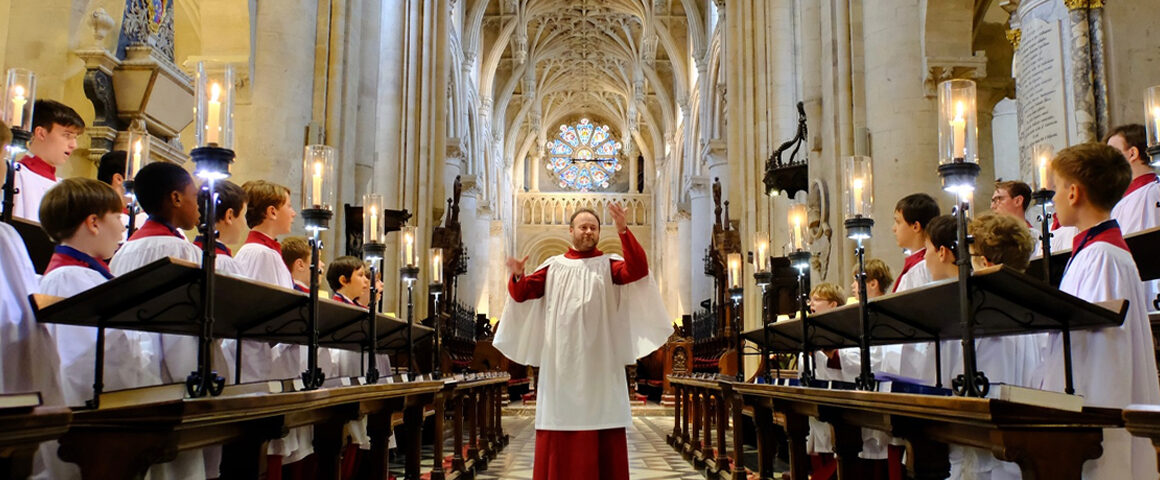
Choral Evensong is the traditional Anglican service of evening prayer. It is built almost entirely of chanted psalms, readings, and Biblical canticles. It was born in England at the Reformation, and it is a unique treasure of Western civilization. It requires nothing of the listener except presence – a quiet, unhurried space where both high art and God’s Word meet at day’s end.
Beauty is not a luxury. It is an absolute necessity for human life. More than that, it is an artifact of spiritual warfare. When King Jehoshaphat marched into battle, he did not put his archers on the front line. He sent out the singers. He placed song at the vanguard of a military campaign, because beauty is not merely decorative. It is a holy defense.
I. The Echoing Stone
Consider the 1991 Choral Evensong Live recorded at King’s College, Cambridge, under Sir Stephen Cleobury.[2]
Track with Psalm 89 – “My song shall be alway of the loving-kindness of the Lord.” The choir moves through traditional Anglican chants over the steady, low hum of the organ pedal. The boys’ voices deliver the alternating verses with restraint. Then the harmony changes. The music transitions smoothly from a somber, heavy tone, to a triumphant brightness. It does not hit like a mere “special effect.” The music shifts the listener’s reference point entirely. The stone church opens upward, revealing hidden dimensions, placing individual concerns against a vast horizon.
Then comes the Second Lesson from Luke 24: the Road to Emmaus. Two heartbroken disciples walk alongside a stranger, their hope destroyed. They only recognize Him in the breaking of the bread. Later, as the service reaches its culmination, the office hymn “Praise, My Soul, the King of Heaven” lifts the room. The music makes the mystery more tangible to the hearer with sound.
In The Choral Service of the United Church of England and Ireland (1843), John Jebb captured the nature of this work:
The Choral Service is the voice of the Church in her corporate capacity… it is not the mere expression of individual devotion, but the continuous, objective offering of praise.[3]
Proper church music is an objective act of worship. As Jebb implies, it binds the soul to a reality outside itself. It anchors us to God and to the long line of ancestors who stood before Him in praise.
As Simon Reynolds observes in Lighten Our Darkness: A Celebration of Choral Evensong, thousands of agnostics, spiritual refugees, and exhausted moderns are quietly filling cathedral pews. They do not come for slick presentations or topical lectures. They come because their inner lives are starved for transcendence. Of Evensong’s enduring pull, Reynolds writes that it offers:
A unique landscape of prayer and music where the searching soul can simply inhabit the silence, caught up in a worship that does not demand immediate intellectual capitulation, but woos through the quiet majesty of holy order.[4]
II. The Necessity of Beauty
We live in a pragmatic age. We judge ideas strictly by their immediate utility – their “cash value” as it were. Modern religion routinely falls into the same pragmatic trap, replacing traditional liturgy with a functional noise designed for “felt needs” – therapy, helpful tips for living, and modern ideology. This is mere utilitarian static. We treat beauty as trim, rather than as the load-bearing architecture it really is. Structure dictates form, and form governs function. The church’s liturgy accompanied by music is at its best a most artfully devised beauty machine.
Percy Dearmer notes in The Art of Public Worship (1919):
Christianity requires beauty, just as it needs goodness and truth; not because we like them, but because of their divine origin… When we try to explain the reason, we tend always to explain it in terms of utility, and thus to explain it away.[5]
Dearmer refuses to let us downgrade beauty to mere personal taste. Beauty is a transcendental attribute of God, co-equal with Goodness and Truth. Strip beauty from worship under the banner of practical efficiency or immediate relevance, and you do not have a more authentic faith. You get “business church” – dry, dull, stupid, and utterly uninspiring. You get merely a horizontal and human affair. Take away beauty, and you take away God Himself.
III. The Architecture of Warfare
Spiritual warfare doesn’t usually appear to us as abstractions, but in the imagination. Modern Evangelicalism, for example, often treats formal beauty as an obstacle, a fancy and gaudy distraction that puts on airs and blocks authentic faith. This is a catastrophic miscalculation. Beauty does not obscure the mission; beauty is the mission. The adversary wins whenever he convinces us to swap holy reverence for bare utility, leaving us with a small, flat, and restricted world – not the cosmos of our loving Maker.
This explains why Jehoshaphat marched his singers out ahead of his army. Holy song is not just for a victory celebration after the dust settles. It stands as an artifact of war, deployed to anchor the heart before the clash begins.
In The High Church Tradition (1941), G.W.O. Addleshaw describes how the classic Anglican divines understood liturgy:
The principle of edification… was one which our forefathers regarded as of vital importance in liturgical worship… to provide an act of worship meeting every need of the soul as a man comes before God.[6]
The great need of our day is for beauty, not removed from goodness and truth, but inseparably bound up with them in God’s mystical economy of being. Today’s ever-present pragmatism hollows out life. It drains the transcendent from the ordinary. It reduces the mystery of existence to simple transactions. Beauty does the exact opposite. It restores depth, weight, and the vertical dimension to man’s day-to-day experience.
A single sung phrase echoing through an ancient nave ties our present to the long line of ancestors who stood in the same place, singing the same words, before the same God. This reminds us that we are neither the beginning nor the master of our own existence; we are creatures who stand in a long line of all that has come before.
This is why we cannot treat Choral Evensong merely as a museum piece, or an aesthetic luxury. It is a sacred inheritance, which is why it is under constant threat… Threat from market pressures, and the misguided churchly cheapness sometimes called “relevance.” To preserve it today requires more than the mere passive admiration of a few cultured aesthetes. It demands active stewardship, physical presence, and arguments in its defense. We must step into the choir stalls with full hearts, fill the pews with open ears and mouths, and champion Evensong in the darkening days ahead.
Beauty is essential. It is both our great spiritual defense and, in fact, God’s loving communication of Himself. Evensong drives back the gray utility of this age. It “lightens the darkness” and points us back to Him, whose mercy endureth forever.
Notes
- 2 Chronicles 20:21 (King James Version), https://www.biblegateway.com/passage/?search=2+Chronicles+20%3A21&version=KJV. ↑
- Choir of King’s College, Cambridge, Choral Evensong Live from King’s College, directed by Stephen Cleobury, organ by Christopher Hughes, recorded July 1991, Warner Classics, catalogue no. 2081162, https://www.prestomusic.com/classical/products/7965794–choral-evensong-live-from-kings-college. ↑
- John Jebb, The Choral Service of the United Church of England and Ireland: Being an Enquiry into the Liturgical System of the Cathedral and Collegiate Foundations of the Anglican Communion (John W. Parker, 1843), https://books.google.com/books/about/The_Choral_Service_of_the_United_Church.html?id=CIICUJ86RHkC. ↑
- Simon Reynolds, Lighten Our Darkness: Discovering and Celebrating Choral Evensong (Darton, Longman & Todd, 2021), https://www.dltbooks.com/titles/2283-9780232534627-lighten-our-darkness. ↑
- Percy Dearmer, The Art of Public Worship (A. R. Mowbray & Co., 1919), https://openlibrary.org/works/OL1091739W/The_art_of_public_worship. ↑
- G. W. O. Addleshaw, The High Church Tradition: A Study in the Liturgical Thought of the Seventeenth Century (Faber and Faber, 1941), https://catalogue.nli.ie/Record/vtls000405879. ↑