- Festivals and Fasts: Saint Bartholomew (August 24)
- Festivals and Fasts: Ember Days in September
- Festivals and Fasts: Saint Matthew (September 21)
- Festivals and Fasts: Saint Michael and All Angels (September 29)
- Festivals and Fasts: Saint Luke the Evangelist (October 18)
- Festivals and Fasts: All Saints (November 1)
- Festivals and Fasts: Saint Andrew (November 30)
For the feast of Saint Andrew (November 30), we present this selection from Robert Nelson’s Companion for the Festivals and Fasts of the Church of England.
Saint Andrew—November 30.
Q. What festival doth the Church celebrate this day?
A. That of the Apostle St. Andrew.
Q. Of what parentage and country was he?
A. He was born at Bethsaida, a city of Galilee (John 1:44), standing upon the banks of the lake of Genesareth, son to Jonas, a fisherman of that town, and brother to Simon Peter (Luke 1:62). It is not decided by the ancients, whether he was the elder or younger; the major part think St. Andrew to have been the younger.
Q. How came our Saviour to choose his disciples out of Galilee?
A. Because it was the chief scene of our Saviour’s ministry; a circumstance noted by all the Evangelists; and St. Peter also stamps it with this character in his sermon to Cornelius, the word which began from Galilee (Acts 10:37). Our Saviour was both conceived and brought up at Nazareth, a city of Galilee; he began his solemn publication of the Gospel at Capernaum, the metropolis of Galilee; he preached all round the region of Galilee; he began his miracles at Cana, in Galilee; he was transfigured at mount Tabor, a mount of Galilee; our Saviour’s ordinary residence was in Galilee; and he appointed his disciples to come to see him in Galilee, when he was risen from the dead (Matt. 2:23; 4:13, 23; John 2:11; Matt. 17:2; 28:10).
Q. Was our Saviour’s vouchsafing his principal abode to the province of Galilee any testimony of his being the Messiah?
A. The prophecy of Isaiah, ix. 1, 2, 3, plainly relates to this matter: and to this purpose it is quoted by St. Matthew (Matt. 4:13–16), when our Saviour made Capernaum the seat of his preaching. The land of Galilee, or of Zebulun and Nepthali, had the misfortune to be first in that calamity which befel their nation by the Assyrians (2 Kings 15:29); by occasion of which calamity then newly happened, Isaiah comforted them with this prophecy, that in recompense of that misery they suffered above the rest of their brethren, they should have the first and chiefest share of the presence and conversation of the Messiah that was to come.
Q. How was St. Andrew awakened to expect the Messiah?
A. By being a disciple of John the Baptist (John 1:35–40), who trained up his proselytes under the discipline of repentance, which prepared them to entertain the doctrine of the Messiah; whose approach he told them was near at hand, representing to them the dignity of his person, and the importance of the design he was come upon.
Q. How came St. Andrew acquainted with our Saviour?
A. Being with John the Baptist one day as Jesus passed by, and hearing him say, that he was the Lamb of God that taketh away the sins of the world, he followed our Saviour upon this testimony, to the place of his abode, hearing his instructions, and improving his faith by conferring with him; upon which account by several of the ancients he is styled the first-called disciple, though in a strict sense he was not so; for though he was the first of the disciples that came to Christ, yet he was not called till afterwards.
Q. What was the first effect of his faith in the Messiah?
A. He went to his brother Simon, and imparted to him the joyful news, that he had found the desire of the world (John 1:41) and their long-expected happiness, the Christ who was promised by the Prophets; and carried him immediately to Jesus; where, after a short stay, they returned again to their own houses, and exercised their calling.
Q. When did St. Andrew become our Saviour’s disciple and constant attendant?
A. About a year afterwards, when, being fully convinced of the greatness and divinity of our Saviour’s person, by the miraculous draught of fishes, our Saviour commanded him, with his brother Peter, to follow him, designing to make them fishers of men (Matt. 4:18–20); who accordingly left all, and constantly attended our Saviour’s person, and was afterwards called by him to the office and honour of the apostolate.
Q. What became of St. Andrew after our Saviour’s ascension?
A. It is generally affirmed by the ancients, that the Apostles agreed among themselves, by lot, say some, probably not without the special guidance and direction of the Holy Ghost, what parts of the world they should severally take; and that in this division St. Andrew had Scythia, and the neighbouring countries, allotted him as his province.
Q. How and where did St. Andrew suffer martyrdom?
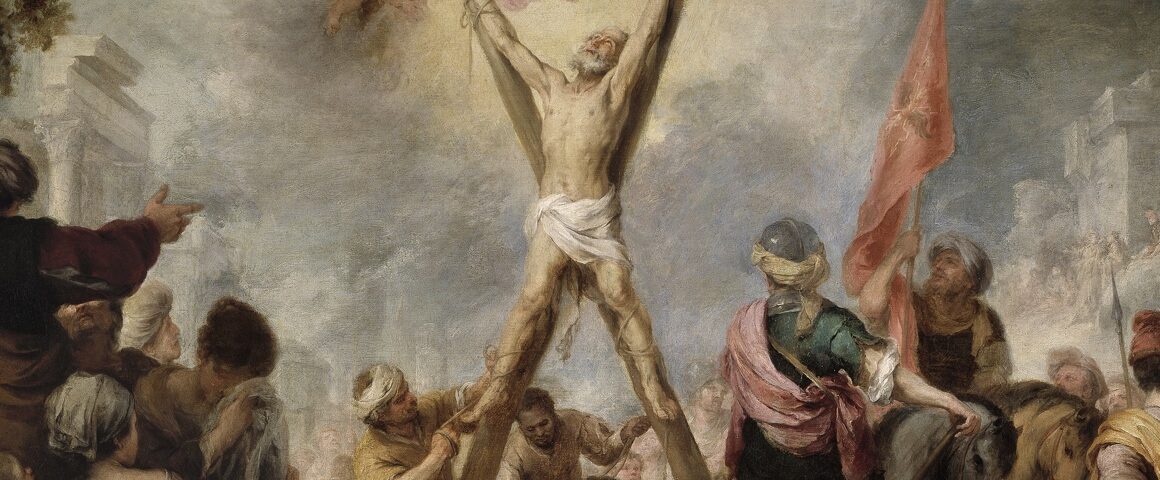
A. After this blessed Apostle had planted the Gospel in several places, and by his indefatigable labours had converted many to the faith, he came at last to Patrea, in Achaia, where, by laying down his life, he confirmed the truths he had taught. For by endeavouring to convert Ægeas, the proconsul of Achaia, and to preserve his new converts from apostacy, whom the governor strove to reduce by all arts to their old idolatry, he enraged the proconsul against him; who commanded him to be scourged and then to be crucified; and that his death might be more lingering, he was fastened to the cross, not with nails, but with cords.
Q. What account is there of the manner of his crucifixion?
A. That as he was led to execution, he shewed a cheerful and composed mind, and that being come within sight of the cross, he saluted it with this kind address: “That he had long expected and desired that happy hour; that the cross had been consecrated by bearing the body of Christ; that he came joyful and triumphing to it, that it might receive him as a disciple and follower of Him who once hung upon it, and be the means to carry him safe unto his Master, having been the instrument upon which his Master did redeem him.” Having prayed and exhorted the people to constancy and perseverance in their religion, he was fastened to the cross, whereon he hung two days, teaching and instructing the people all that time; and when great importunities were used with the proconsul to spare his life, he earnestly begged of our Lord, that he might at that time depart, and seal the truth of religion with his blood, which accordingly he did.
Q. What was the form of St. Andrew’s cross?
A. The instrument of his martyrdom is commonly said to have been something peculiar, in the form of the letter X, being a cross decussate, two pieces of timber crossing each other in the middle: and hence known by the name of St. Andrew’s cross.
Q. What became of his body?
A. Being taken down from the cross, it was embalmed, and decently and honourably interred by Maxamilla, a lady of great quality and estate. Afterwards it was removed to Constantinople, by Constantine the Great, and buried in the great Church, which he had built to the honour of the Apostles.
Q. What may we learn from the observation of this festival?
A. To labour what we can in our stations to make all our relations, friends, and dependents, true followers and servants of the blessed Jesus. To shew our dislike of any evil that reigneth among them, and courageously to reprove what we know deserves it. To venture the promoting their eternal welfare, though at the danger of their displeasure. To lay hold on all favourable opportunities to insinuate the necessity and happiness of being religious. To prepare our minds by mortification and repentance for the receiving of all those heavenly graces, which are enjoined in the Gospel institution. To bear all the afflictions and calamities of this life with a patient and courageous mind, entirely resigned to the will of God. Cheerfully to take up the cross, and to rejoice when we are counted worthy to suffer for the name of Jesus, that when his glory shall be revealed, we may be glad also with exceeding joy (1 Pet. 4:13).
Q. When may men be said to suffer really for the sake of Jesus, or for the cause of religion?
A. Not only when they suffer rather than renounce the Christian religion, or the public profession of it; but when they suffer for any necessary point of faith or practice, wherein the essence or purity of the Christian religion is concerned; and when they suffer rather than disclaim any undoubted truth of God whatsoever.
Q. How does the providence of God bear good men out in such sufferings?
A. Either by securing them from those violent degrees of temptation, which would be too strong for human strength and patience; or in case of extraordinary trials, by giving them the extraordinary supports and comforts of his Holy Spirit; either by not suffering them to be tempted above what they are able, or with the temptation, by making a way for their escape.
Q. When may we, in our sufferings for religion, expect with confidence the particular support of God’s providence?
A. When we are careful to perform our own duty, and do what is required on our part; and when, neither to avoid sufferings, nor to rescue ourselves out of them, we do any thing contrary to our Christian obligations and a good conscience. It is an eternal rule, from whence we must in no case depart: that men must do nothing contrary to the rules and precepts of religion, no, not for the sake of religion itself.
Q. With what temper of mind ought good men to suffer for the cause of religion?
A. With patience, that they may not grow faint and weary: with meekness, that they may not grow angry and bitter against their persecutors: with charity, that they may overcome evil with good: with trust in God’s providence, that they may be supported under their sufferings by his grace, and delivered in his good time: with joy and thankfulness, inasmuch as they are partakers of Christ’s sufferings: and when his glory shall be revealed, they shall be made glad with exceeding joy.
The Prayers
I. For conversion from sin.
Almighty God, who didst give such grace to thy holy Apostle St. Andrew, that he readily obeyed the calling of thy Son Jesus Christ, and followed him without delay; grant unto me and all Christians, that we being called by thy holy Word, may forthwith give up ourselves obediently to fulfil thy holy commandments, through the same Jesus Christ our Lord. Amen.
II. For assistance in adversity.
O God, merciful Father, that despisest not the sighing of a contrite heart, nor the desire of such as be sorrowful, mercifully assist our prayers that we make before thee in all our troubles and adversities, whensoever they oppress us, and graciously hear us, that those evils which the craft and subtilty of the Devil or man worketh against us may be brought to nought, and by the providence of thy goodness they may be dispersed; that we thy servants, being hurt by no persecutions, may evermore give thanks unto thee in thy holy Church, through Jesus Christ our Lord. Amen.
III. For grace to suffer as a good christian.
O blessed Jesus, who, in thy wise providence, thinkest it fit sometimes to call thy faithful servants to bear their cross, and to suffer for thy sake, who didst suffer a most ignominious death for them; bring me not to suffer till thou hast fitted and prepared me for it; and lay no more upon me than thou wilt enable me willingly and thankfully to endure. Let me not rashly expose myself to danger without thy call, nor suffer for my own fancy or folly, or for any wilful or affected error. Give me grace to live according to the rules of my most holy faith, that I may have courage and comfort in suffering for it. Preserve me stedfast in the belief of thy heavenly truths, and undaunted in the profession of them. Give me patience to bear my cross, and meekness to bear with my persecutors; charity to forgive their wrongs, and to pray to thee for their forgiveness. Enable me to trust in thy goodness for support and deliverance, and to fix my faith upon those heavenly joys, with which the sufferings of this life are not worthy to be compared; that being made partaker of thy sufferings, I may be glad with exceeding joy when thy glory shall be revealed. To whom, with the Father and the Holy Ghost, be all honour and glory, world without end. Amen.
IV. For the church under persecution.
O almighty Lord, who hath purchased to thyself a Church with thine own blood, look in mercy upon the same, however distressed, throughout the world. Pity all its calamities, and in thy due time give it a happy deliverance out of them. Keep it in thy truth, and preserve it from heresies and false doctrines, either in faith or practice, and from schisms that tear it in pieces. And when thou art pleased to visit it with tribulations, let them only purge it, but not lay it waste. Revive a suffering spirit among all the members of it when it labours under a suffering state; that they may be ready to quit all worldly interest, and be enabled contentedly and joyfully to take up the cross, and bear it after thee; that carefully avoiding all ways of error and wickedness, for preventing or rescuing themselves from sufferings, they may either be delivered by thy mighty arm, or rewarded in thy heavenly kingdom, where, with the Father and the Holy Ghost, thou livest and reignest one God, world without end. Amen.
Image source: Bartolomé Esteban Murillo, The Martyrdom of Saint Andrew, Museo del Prado, via Wikimedia Commons.