- Festivals and Fasts: Saint Bartholomew (August 24)
- Festivals and Fasts: Ember Days in September
- Festivals and Fasts: Saint Matthew (September 21)
- Festivals and Fasts: Saint Michael and All Angels (September 29)
- Festivals and Fasts: Saint Luke the Evangelist (October 18)
For the feast of St. Luke the Evangelist (October 18), we present this selection from Robert Nelson’s Companion for the Festivals and Fasts of the Church of England. May his account of the beloved physician and his prayers encourage us to receive the Gospel with gratitude, to speak with truth and sincerity, and to stand beside those who suffer for the faith.
Saint Luke the Evangelist—October 18.
Q. What Festival does the Church celebrate this day?
A. That of St. Luke the Evangelist.
Q. What mean you by an Evangelist?
A. The name was at first given to those that preached the Gospel; but afterwards it was confined to those four that wrote the history of the life and preaching of our Saviour Jesus Christ, whose four Gospels make part of the sacred canon of Scripture.
Q. Where was the place of St. Luke’s nativity?
A. Antioch, the metropolis of Syria, pleasant for its situation, fertile for its soil, rich by its traffic, famous for learning; and above all, renowned for this one peculiar honour, that here it was that the disciples of Jesus were first called Christians (Acts 11:26).
Q. What was St. Luke’s particular profession?
A. That of physic; an art in those days generally managed by persons of no better rank than servants.
Q. Was St. Luke one of the seventy disciples?
A. Some of the ancients thought he was, and that he deserted our Saviour upon the unwelcome discourse he made to his disciples; but was afterwards recalled by St. Paul (John 6). And upon no better ground it is said, he was one of the two disciples going to Emmaus: for, besides the silence of Scripture, St. Luke seems to contradict it himself, by confessing he was not from the beginning an eye-witness and minister of the word (Luke 1:2). Most probable it is, he was converted by St. Paul during his abode at Antioch.
Q. How did he bestow his labours after his conversion?
A. He became an inseparable companion and fellow-labourer of St. Paul in the ministry of the Gospel; especially after St. Paul’s going into Macedonia; from which time, in recording St. Paul’s travels, St. Luke always speaks of himself in his own person (Acts 16:10).
Q. How did he endear himself to St. Paul?
A. By attending him in all his dangers; by being present with him in his several arraignments at Jerusalem; by accompanying him in his hazardous voyage to Rome; where he served his necessities, and supplied those ministerial offices which the Apostle’s confinement would not suffer him to discharge, especially in carrying messages to those Churches where he had planted Christianity; and in remaining with him when others forsook him.
Q. Where did St. Luke preach the Gospel?
A. Some say he left St. Paul at Rome, and returned back into the East, and travelled into Egypt and the parts of Lybia, where he converted many to Christianity, and took upon himself the episcopal charge of the city of Thebais; though it is most probable, he did not wholly leave St. Paul till he finished his course with martyrdom.
Q. What account do others give of his labours?
A. That he first preached in Dalmatia and Galatia, then in Italy and Macedonia; where he spared no pains, declined no dangers in the faithful discharge of the trust committed to him.
Q. What account is given of his martyrdom?
A. That he successfully preached the Gospel in Greece, till a party of infidels, making head against him, drew him to execution; and for want of a cross whereon to dispatch him, presently hanged him upon an olive tree, in the eightieth year of his age, though St. Jerome makes it the eighty-fourth.
Q. Where was his body interred?
A. At Constantinople, whither it was removed by the command of Constantine, or his son Constantius, and buried in the great church built in memory of the Apostles.
Q. What writings did he leave behind him?
A. His Gospel, and his history of the Acts of the Apostles, both dedicated to Theophilus.
Q. Who was this Theophilus?
A. Many of the ancients supposed it to be a feigned name, denoting no more than a lover of God, a title common to every Christian; though others, with better reason, conclude it the proper name of a particular person; especially since the title of “most excellent” is attributed to him, the usual form of address in those times to great men. We may probably suppose him to have been some magistrate, whom St. Luke had converted; to whom he dedicates these books, not only as a testimony of respect, but as a means of giving him further assurance of those things wherein he had been instructed (Luke 1:4).
Q. What may we learn from the manner of these dedications?
A. That in addresses of this nature, though authors should not neglect the giving those titles that are due to men’s different qualities, (as “most excellent” seems to be given by St. Luke upon that account, it being the same word in the original which St. Paul applies to the Roman governors, Felix and Festus (Acts 24:3),) yet they should be very sparing in personal commendations, for fear of contracting the guilt of flattery, so pernicious to themselves as well as their patrons.
Q. When was St. Luke’s Gospel supposed to be written?
A. During his travels with St. Paul in Achaia, whose help he is generally said to have made use of in the composing of it. And that this the Apostle primarily intends, when he so often speaks of his Gospel. Besides this advantage, we are assured by the evangelist himself, that he derived his intelligence from those who from the beginning had been eye-witnesses and ministers of the word (Rom. 2:16; 2 Tim. 2:8; Luke 1:2).
Q. Upon what occasion did he write his Gospel?
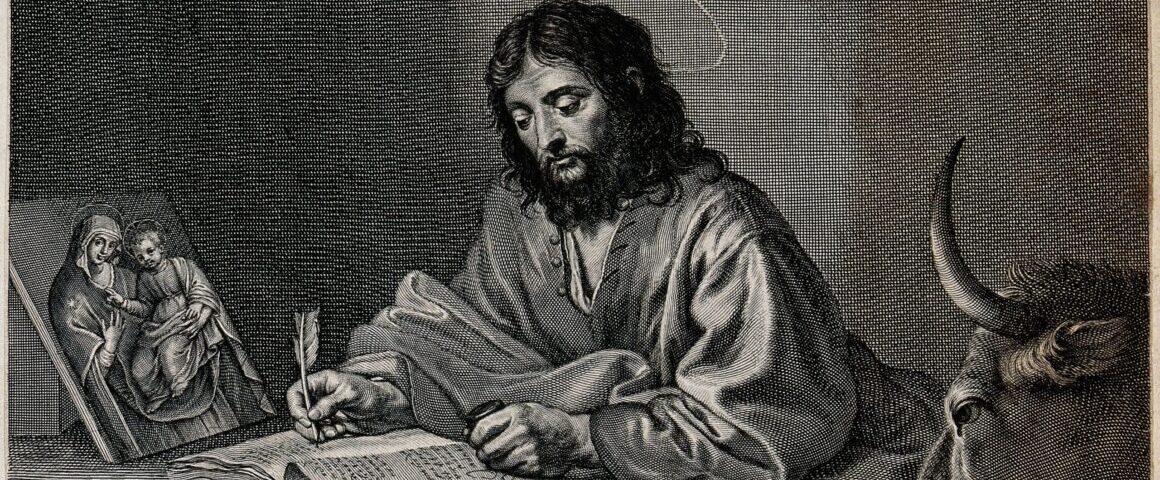
A. Partly to prevent those false and fabulous relations, which even then began to be intruded upon the world; and partly to supply what seemed wanting in those two evangelists that wrote before him, in relation to some particulars concerning our Saviour’s birth, preaching, and miracles. He mainly insists upon what belongs to Christ’s priestly office; upon which account the ancients, in accommodating the four symbolical representments in the prophet’s vision to the four evangelists, assigned the ox or calf to St. Luke (Ezek. 1:10).
Q. When was his history of the Acts of the Apostles written?
A. It is generally agreed, that it was written at Rome, at the end of St. Paul’s two years’ imprisonment, which makes the conclusion of it. In this history he relates not only the actions, but the sufferings of some of the chief Apostles, especially of St. Paul, of whose carriage and most intimate transactions, St. Luke was best able to give a true account, having been his constant attendant.
Q. What is observed of St. Luke’s style and manner of writing?
A. That it was clear, perspicuous, and accurate; which shews how great a share he had in the native genius of Antioch, the place of his birth.
Q. What may we learn from the observation of this Festival?
A. To rejoice in those glad tidings, which this evangelist published to the world; and not only attentively and reverently to read his Gospel, but to practise, as he did, that doctrine which he taught. To be careful to avoid all flattery in our addresses to great men, which is contrary to that truth and sincerity that is so essential to the character of a good Christian. To be exact and faithful in all our relations of matters of fact, without favouring parties and factions. To stick close to the professors of religion, when they are encompassed with variety of persecutions; which is an effect of true charity, since friendship only to persons in power and plenty may be suspected of self-interest.
Q. What duties do Christians owe to their fellow-members, when they are persecuted for righteousness sake?
A. To visit them in their afflictions; and by seasonable advice to encourage them to persevere in the faith. To pray to God for them, that he would be pleased to support them under all their trials, with the assistance and comfort of his Holy Spirit. To vindicate them from the false aspersions of wicked and malicious men. According to our abilities, to administer to their necessities; and by our interest with others, to procure them that relief which our own narrow circumstances cannot supply them with.
Q. Whence arises our obligation to these duties?
A. From that love and zeal we ought to have for religion; whose destruction is sought for by those who oppress the professors of it. From that spiritual union there is among Christians under their head Christ Jesus; so that if one member suffers, all the members suffer with it (1 Cor. 12:26). From the example of our Saviour, who, out of his great grace and kindness, being rich for our sakes became poor (2 Cor. 8:9); emptied himself of his glory, that we, through his poverty, might be made partakers of spiritual and durable riches. From that charity we owe to all that are in want, especially to those that are of the household of faith. And from the sense of being liable ourselves to the same distress; and therefore remembering them that suffer adversity, as being ourselves also in the body (Heb. 13:3).
The Prayers
I. For the Health of Our Minds.
Almighty God, who calledst Luke the physician, whose praise is in the Gospel, to be an evangelist and physician of souls; may it please thee, that by the wholesome medicines of the doctrine delivered by him, all the diseases of my soul may be healed, through the merits of thy Son Jesus Christ our Lord. Amen.
II. For the Love of God.
O Almighty God, who alone canst order the unruly wills and affections of sinful men; grant that I may love the things which thou commandest, and desire that which thou dost promise; that so, among the sundry and manifold changes of this world, my heart may surely there be fixed, where true joys are to be found, through Jesus Christ our Lord. Amen.
III. Thanksgiving for the Gospel.
I yield thee hearty thanks, most merciful Father, for those glad tidings of salvation thy evangelist St. Luke hath published to the world; for all the manifestations of thy holy will, and of that inestimable redemption thou hast graciously condescended to work out for us; and for that thou hast been pleased to regenerate us by thy Holy Spirit, to receive us for thy own children by adoption, and to incorporate us into thy holy Church: and I humbly beseech thee to grant, that I, being dead unto sin, and living unto righteousness, and being buried with Christ in his death, may crucify the old man, and utterly abolish the whole body of sin; and that as I am made partaker of the death of thy Son, I may also be partaker of his resurrection: so that finally, with the residue of thy holy Church, I may be an inheritor of thine everlasting kingdom, through Jesus Christ our Lord. Amen.
Image source: Wikimedia commons.