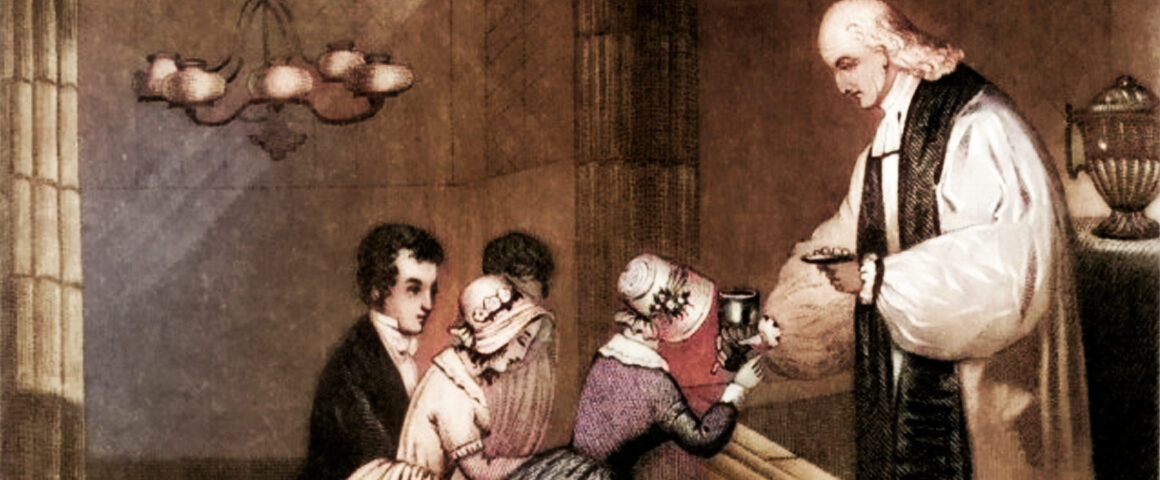
Introduction:
At the outset of this essay, I wish to make my respect for Rev. Ben Jefferies and his scholarship abundantly clear. Jefferies deeply appreciates patristic doctrine and the authority of our Anglican formularies. Not only does this express itself in his three-part essay on real presence, but it is also reflected in his two-part essay on Anglicanism’s rightful rejection of Nicaea II. However, as much as I hate to find myself in disagreement with him, I believe that his contention that the Anglican formularies encompass a Lutheran understanding of real presence, namely that the true body and blood of Christ reside in the elements of bread and wine (uncircumscribedly but definitively), so that it can be said that the true body and blood, rather than merely the sacrament or sign thereof, are received/consumed with the bodily mouth is mistaken. The following essay is a humble attempt to respond to Jefferies’s work by demonstrating that the patristic witness does not preclude the classical Anglican position (the pre-Tractarian view) and that the formularies do not encompass the Lutheran understanding of real presence. It will further argue that the pre-Tractarian Anglican divines whom Jefferies cites in support of such a doctrine either did not hold it or else made statements that inadvertently demonstrate its incongruity with the formularies.
Initially, it might be prudent to provide a short explanation of why the topic of what the formularies teach or permit regarding real presence is important. Besides the emphasis we should place on accurate interpretation of the formularies and a commitment to correctly conveying how they were historically understood, I hold that there are at least three important reasons why this debate matters. Firstly, the doctrine of our formularies is an encapsulation of what our Church understands that the Holy Scriptures teach regarding the sacrament of the Lord’s Supper, which all sides regard as normatively necessary for salvation, making the proper doctrine of real presence of critical importance.
Secondly, the classical Anglican doctrine of real presence (which Jefferies terms the “Jewel School”), whether expressed in its receptionist or virtualist form, constituted arguably the nearest thing to a universal point of doctrinal agreement among the various strands of pre-Tractarian churchmanship, apart from the common essentials of the Christian faith. In the present age, when Anglicans often seem to share little doctrinal common ground, a recovery of the classical Anglican understanding of real presence could serve as a source of greater unity amid theological fragmentation. As Bishop Browne observes in his commentary on Article 28, “It is scarcely necessary to recount the names of Mede, Andrewes, Hooker, Taylor, Hammond, Cosin, Bramhall, Usher, Pearson, Patrick, Bull, Beveridge, Wake, Waterland…all have coincided, with but very slight diversity, in the substance of their belief…[that] ‘the real presence of Christ’s most blessed Body and Blood is not to be sought for in the sacrament (i.e. in the elements), but in the worthy receiver in the sacrament.’” Thus, far from constituting a narrow sectarian dispute between “Episcoterians” and Anglo-Catholics, the present debate concerns a far broader consensus extending across Reformed Conformists, Laudians, Evangelicals, Latitudinarians, and Old High Churchmen on the one hand, and Anglo-Catholics on the other.
Thirdly, although Jefferies rightly disavows the devotional practices of “Benediction” and “Adoration” of the Blessed Sacrament, it remains an unfortunate reality that many Anglicans who have adopted a Lutheran or “Real Objective Presence” view have sanctioned such erroneous devotions. In fact, some of the figures whom Jefferies relies on to make his case, such as Pusey and Alexander Forbes, taught the doctrine of the adoration of Christ in the sacrament.[1] Such practices elevate the importance of the issue from a simple doctrinal error into a matter of idolatry. As Bishop Jeremy Taylor, a Caroline Divine and famous anti-Calvinist, states regarding adoration, “We may not render divine worship to Him as present in the blessed Sacrament according to His human nature, without danger of idolatry, because He is not there according to His human nature, and therefore you give divine worship to a non ens, which must needs be idolatry….He is present there by His divine power, and His divine blessing, and the fruits of His Body, the real effective consequents of His Passion; but for any other presence, it is idolum, it is nothing in the world. Adore Christ in heaven, for the heavens must contain Him till the time of restitution of all things.”[2]
Does the teaching of the “Jewel School” fail to harmonize with the early church fathers?
In the first part of Rev. Jefferies’ series, he provides a host of citations from the early church fathers in an attempt to prove that the teaching of the “Jewel School” doesn’t harmonize with that of the fathers on real presence. For instance, Jefferies cites St. Jerome as saying: “Nought richer than he who carries the Body of the Lord in a wicker basket, His blood in a glass” in opposition to Jewel, who tells us, “The very body of Christ is not in the Holy vessels, but the sacrament of that body is therein contained.” However, this supposed contradiction can be fully & easily resolved when it is understood that the Fathers often call the signs, the elements of bread and wine, by what they signify, namely the body and blood of Christ. For example, St. Cyprian states: “For when the Lord calls bread, which is made up of the union of many grains, His Body, He indicates our people whom He bore, united together: and when He calls wine…His Blood.”[3] Thus understood, classical Anglicans have no qualms affirming, alongside the fathers, that Christ’s blood is in the communion chalice or that he is eaten by all with the bodily mouth sacramentally.[4]
Another argument made in the first article against the Jewel school is that the fathers, such as St. Ignatius of Antioch, employ realist-sounding language against heretics, thereby disproving the classical Anglican position. St. Ignatius of Antioch’s Letter to the Smyrnaeans is quoted: “They abstain from the Eucharist and from prayer because they do not confess that the Eucharist is the flesh of our Savior Jesus Christ.” In context, St. Ignatius is arguing against Docetic heretics, who didn’t believe that Christ had a natural, fleshly body. Tertullian makes the same argument as St. Ignatius: “Having taken bread and distributed it to His disciples, He made it His body by saying, This is my Body, i.e. the figure of My Body. But there would be no figure, if there were no true Body. A mere phantom, without substance, would admit no figure.”[5] The sacramental identification of bread and wine as the flesh and blood of Christ counters Docetism precisely because a figure of Christ’s flesh logically presupposes the reality of His natural, physical flesh. Ironically, the Docetic belief that Christ possessed a phantom body untethered from the natural limitations and physical qualities of material human flesh uncomfortably resembles the body that Lutherans, Romanists, and presumably Jefferies insist we receive into our bodily mouths in the eucharist. But such a body, shorn of its natural qualities, as St. Augustine tells us, is no body at all: “Take away space of places from bodies, and they shall be nowhere, they shall be no bodies. Take the very bodies from the qualities of bodies, and there shall be no place for them to be, and therefore it must needs be that they have no being.”[6]
More could be said regarding Jefferies’ interpretation of the fathers and even of Jewel, but a full patristic defense of the classical Anglican position is not the intention of this essay. It is merely hoped that it has been sufficiently demonstrated that the patristic data is far from a kill shot against the classical Anglican understanding of real presence when terminology and context are properly understood. If one wants to dive deeper into a defense of the classical Anglican position of real presence from the patristics, Daniel Waterland’s Review of the Doctrine of the Eucharist would be a great place to start. For a more thorough refutation of Pusey’s interpretation of patristic teaching on real presence (on which much of Jefferies’ essay on the patristic view relies), Dean William Goode’s The Nature of Christ’s Presence in the Eucharist (vol. I) and Rev. John Harrison’s An Answer to Dr. Pusey’s Challenge Respecting the Doctrine of Real Presence (vols. I & II) both offer persuasive and comprehensive critiques.
Does the Book of Homilies teach or allow for the Lutheran view?
Much is made of the phrase “the due receiving of his blessed Body and Blood, under the form of bread and wine” found appended to the end of the first book of homilies, first published in 1547. Rev. Jefferies makes the case that such language, although used by the papists, can also be found in the Lutheran confessions, which indicates that the Book of Homilies was intended to allow space for those who hold to the “Lutheran-patristic” understanding. Several objections can be made to this argument:
1.1 The advertisement appended to the end of the first book of homilies is not a doctrinally authoritative utterance of the Church of England. Firstly, the advertisement is a notice issued by the government, and did not proceed from convocation, just as the Articles themselves can be found sandwiched between a royal preface and a ratification, yet no one would argue that the royal preface is doctrinally a part of the Articles of Religion.[7]
2.2 Cranmer’s response to Gardiner in 1551 helps to illustrate this point. In answering the claim that the Church of England taught that Christ’s body and blood are present “under the forms of bread and wine,” Cranmer explicitly challenged Gardiner to identify where such language had ever been established as the doctrine of the English Church: “As concerning the form of doctrine used in this Church of England in the holy communion, that the Body and Blood of Christ be under the forms of bread and wine, when you shall show the place where this form of words is expressed, then shall you purge yourself of that which in the meantime I take as a plain untruth.”[8]
3.3 It is highly improbable that the principal architect of the English Reformation, who oversaw the development of its liturgy and doctrinal formularies, would deny the existence of such teaching if the advertisement appended to the Homilies possessed genuine doctrinal authority. The more natural conclusion is that the advertisement was not regarded as a binding doctrinal utterance of the Church.
2. No such homily on “the due receiving of his blessed Body and Blood, under the form of bread and wine” exists. It would be hard to argue that a royal advertisement for a future homily that was never written would have any doctrinal authority, even at the time of its publication. Ironically, the only homily on the topic of real presence that was eventually published in the Second Book of Homilies, entitled “An Homily on the Worthy Receiving and Reverent Esteeming of the Sacrament of the Body and Blood of Christ,” was written by Jewel and distinctly teaches the classical Anglican view as opposed to the “Lutheran-patristic” view championed by Jefferies.[9]
3. The question naturally arises, if the advertisement stands against the classical Anglican view and yet holds no doctrinal significance, why was it retained in later editions? The answer lies in the fact that later Anglican theologians, whom Jefferies readily admits were firmly within the “Jewel School,” began to make use of the phrase “under the form of bread and wine” in a clearly reformed sense. This can be seen in the writings of Foxe, Bilson, and Jeremy Taylor, to name a few.[10] Even Calvin employed such language.[11] It is therefore entirely possible that, because the advertisement was not regarded as carrying doctrinal authority and its language had come to be understood in a manner consistent with classical Anglican Eucharistic theology without its papist or Lutheran connotations, no compelling reason existed for its removal.
The 39 Articles and the Württemberg Confession:
Rev. Jefferies is correct to point out that the revised Articles of Religion produced by Archbishop Parker were influenced by the Württemberg Confession. The implication being that the 39 Articles must be open to a Lutheran reading on real presence if Parker was willing to use a “Lutheran” confession during the revision process. However, this argument runs into two main challenges:
1. The Württemberg Confession was not a distinctly Lutheran confession, but rather a mediating document between Bucerians and the Lutherans, who each held sway in different parts of the duchy of Wurttemberg.[12] Duke Christopher of Wurttemberg, who adopted the confession, was known for the kindness and support he showed to the “Sacramentarians” in the form of the Marian exiles and the French Huguenots.[13] The compromised nature of the confession led strident supporters of the doctrine of real objective presence, like Peter de Soto, to condemn it as vacillating.[14]
2. If the Württemberg Confession on real presence represented a mediating position between the Bucerians and the Lutherans, why didn’t Archbishop Parker just adopt its language on real presence if he intended, as Jefferies argues, to encompass the Lutheran understanding within the Church of England? Archbishop Laurence, who first brought attention to the significance of the Württemberg Confession on the revision of the articles, tells us: “The Articles [of Religion], either partly, or wholly, copied from the Württemberg Confession, are the 2nd, 5th, 6th, 10th, 11th, 12th, and 20th; which, indeed, contain the principal additions and elucidations upon doctrinal points, (that of the Eucharist alone excepted).”[15] Archbishop Laurence’s conclusion is unavoidable once the language of the Württemberg Confession is consulted: “Concerning the substance of the Eucharist, we think & teach that the true body of Christ and his true blood are distributed in the Eucharist…that the body of Christ is truly present together with the bread.”[16] If Archbishop Parker was really intending to incorporate mediating language on real presence in our Articles, it is telling that the language of the Wurttemberg Confession cannot be found in Articles 28 or 29.
Does the alteration of Article 28 from the 42 Articles imply that Convocation sought to accommodate the Lutheran view of Real Presence?
For Jefferies, the “smoking gun” proving that the Anglican formularies are open to a Lutheran-patristic reading of real presence is the alterations made to Article 28 by the Convocation of 1563, which is asserted to have “definitively struck” out the clearly Calvinistic teaching found at the end of Article 28 in the original 42 Articles. However, this argument is fatally weakened by the facts:
1. The paragraph quoted by Jefferies appeared in the Articles approved by the Convocation of 1563, as noted by Bishop Gilbert Burnet, whose work on the English Reformation remains an essential resource for students of the period.[17] Thus, convocation, far from seeking to encompass the Lutheran understanding, actually reaffirmed its commitment to the theology of Archbishop Cranmer and the Jewel School. However, in fairness to Jefferies, it must be admitted that the paragraph, although subscribed to by convocation, was not ultimately published, but rather subsequently replaced by the text that currently appears at the end of Article 28. Bishop Burnet attributes this to the intervention of the Queen, who also temporarily suppressed Article 29 that was likewise approved at the Convocation of 1563. Burnet contends that the Queen did so because she wished to avoid language so explicitly inflammatory to foreign powers as well as the views of many of her subjects, the memory of Bloody Mary & The Pilgrimage of Grace still very much in view in that early period of her reign.[18] Another explanation offered for the omission was the adoption by members of the Jewel School of the phrase “real presence” detached from its earlier Lutheran and Papist associations. Yet Burnet is careful to observe that the paragraph eventually substituted in its place was understood to be “the same in sense,” differing only in expression.[19] The omission, therefore, is better understood not as a weakening of earlier Reformed Eucharistic theology but as a change in wording, motivated by political prudence and shifting theological vocabulary, rather than as a substantive doctrinal revision.
2. The language found in the original Article 28, namely: “For as much as the truth of man’s nature requireth that the body of one and the self-same man cannot be at one time in divers places, but must needs be in one certain place, therefore the body of Christ cannot be present at one time in many and divers places, and because (as Holy Scripture doth teach) Christ was taken up into heaven and there shall continue unto the end of the world..”, which Jefferies accurately regards as definitely Calvinistic and opposed to the Lutheran understanding, can also be found in the 1662 Book of Common Prayer, regarded as authoritative by all confessional Anglicans. The 1662 Book of Common Prayer states: “…the natural Body and Blood of our Saviour Christ are in Heaven, and not here; it being against the truth of Christ’s natural Body, to be at one time in more places than one.”[20] Thus, if it is admitted that the original Article 28 rules out the Lutheran-patristic understanding due to such language, it must also be admitted that our current formularies do so as well.
Is it true that “standard reformed language about the Eucharist is palpably absent” from our authorized formularies?
Jefferies’ next argument is that “standard reformed language about the Eucharist is palpably absent” in our authorized formularies. In support of his argument, he mainly compares the teachings of our formularies with the Consensus Tigurinus of 1548, which represents the lowest of the Reformed confessions on real presence, making it difficult to treat as the normative expression of Reformed sacramental theology by the 1560s and 1570s. However, a careful analysis of our Anglican formularies will reveal that they don’t reject standard Reformed doctrine or terminology on real presence but rather teach such doctrine in language commonly understood to exclude the Lutheran view.
Firstly, some friendly push-back on supposed contradictions between the Consensus and our formularies:
1. Article 11 of the Consensus Tigurinus teaches: “…that the sacraments separated from Christ are but empty shows.” In context, the article is condemning the notion that sacraments convey grace independently when used outside of Christ’s institution, such as during benediction of the blessed sacrament (“This refutes the error of those who stand gazing on the elements, and who attach to them their confidence of salvation; the sacraments, separated from Christ.”) The Consensus goes on to argue in Article 13 that the sacraments, when used according to Christ’s institution, are employed by God through his holy spirit and therefore become “instruments by which God acts efficaciously.”
1.1 Our articles appear to teach the same doctrine. Article 25 states, “The Sacraments were not ordained of Christ to be gazed upon, or to be carried about, but that we should duly use them. And in such only as worthily receive the same they have a wholesome effect or operation.” Article 26 tells us that sacraments are effectual “…because of Christ’s institution and promise.” Finally, Article 28 teaches that “The Sacrament of the Lord’s Supper was not by Christ’s ordinance reserved, carried about, lifted up, or worshipped.” Bishop Browne notes in his commentary on Article 25 that “whereas the doctrine that Sacraments have no efficacy of their own nature [in contrast to the Roman view], but are ordinances of God, which He is pleased to honour, and by which He has promised to work, will lead to a reverent esteem and diligent use of them, but not to a superstitious veneration of the mere instruments.”
2. Article 19 of the Consensus Tigurinus states “…without their [the sacraments] use believers receive the reality which is represented there.”
2.1 The rubric at the end of the communion of the sick, found in the 1662 and the 1928 BCPs, to name a few, distinctly teaches that “…without their [the sacraments] use believers receive the reality which is there figured.” The rubric states: “…the Minister shall instruct him, that if he do truly repent him of his sins, and stedfastly believe that Jesus Christ hath suffered death upon the Cross for him, and shed his Blood for his redemption, earnestly remembering the benefits he hath thereby, and giving him hearty thanks therefor, he doth eat and drink the Body and Blood of our Saviour Christ profitably to his soul’s health, although he do not receive the Sacrament [or sign] with his mouth.”
3. Article 35 of the Belgic confession teaches: “Yet we do not go wrong when we say that what is eaten is Christ’s own natural body and what is drunk is his own blood— but the manner in which we eat it is not by the mouth, but by the Spirit through faith” and “We receive these [the true body and blood of Christ] by faith, which is the hand and mouth of our souls.”
3.1 Article 28 affirms the same by stating that “The Body of Christ is given, taken, and eaten, in the Supper, only after an heavenly and spiritual manner. And the mean whereby the Body of Christ is received and eaten in the Supper is Faith.” It should be noted that an argument has been made that the Belgic Confession is actually higher than the 39 Articles on real presence.[21]
4. Article 25 of the Consensus states “…yet just as the body of Christ bearing the nature and mode of a human body, is finite and is contained in Heaven as its place, it is necessarily as distant a place from us in point of space as Heaven is distant from Earth.”
4.1 The rubric at the end of the communion office: “and the natural Body and Blood of our Saviour Christ are in Heaven, and not here; it being against the truth of Christ’s natural Body to be at one time in more places than one.”
Secondly, Jefferies argues that Article 25 of the 39 Articles, which states “Sacraments ordained of Christ be not only badges or tokens of Christian men’s profession,” was intended as a “direct jab” at the “standard reformed formulation” found in the Consensus Tigurinus, which states “The ends of the sacraments are to be marks and badges of Christian profession and fellowship or fraternity, to be incitements to gratitude and exercises of faith and a godly life.” Jefferies’ argument on this front is weakened in at least two ways:
1. The Consensus doesn’t state that the sacraments are only badges or tokens of a Christian man’s profession but goes on to assert “…among [the] other ends [of the sacrament] the principal one is, that God may, by means of them, testify, represent, and seal his grace to us.” Calvin in his exposition of the Consensus tells us “…although the sacraments are marks and badges of Christian profession or fellowship, and likewise incitements to gratitude, in short, exercises of piety, and mutual contracts obliging us to the worship of God, they have, however, this principal end amongst others, viz., to testify, represent, and seal the grace which the Lord bestows upon us: moreover, that they are not mere shows presented to our eyes, but that therein are represented the spiritual graces, the effect of which believing souls receive.”[22] Such language sounds remarkably similar to Article 25: “Sacraments ordained of Christ be not only badges or tokens of Christian men’s profession, but rather they be certain sure witnesses, and effectual signs of grace, and God’s good will towards us, by the which he doth work invisibly in us, and doth not only quicken, but also strengthen and confirm our Faith in him.”
2. The terminology quoted by Jefferies to imply that the Articles were directly condemning the “standard reformed formulation” is also found in the 42 Articles, which directly teaches the reformed view of real presence. Additionally, other solidly reformed confessions on real presence also condemn those who regard the sacraments as merely badges or tokens. For example, the Scots Confession of 1560, written by the famously passionate John Knox, states “we utterly damn the vanity of those that affirm sacraments to be nothing else but naked and bare signs.”[23] It would be absurd to conclude from such language that Knox thereby abandoned a distinctly Reformed doctrine of the Eucharist or intended to condemn the “standard reformed formulation.”
Next, Jefferies argues that the term “effectual sign” found in Article 25 and the phrase “given, taken, and eaten” found in Article 28 convey a “distinctly Lutheran notion” and are absent from “then extant Reformed Confessions.” However, a cursory overview will demonstrate that such language is not distinctly Lutheran or absent from contemporaneous Reformed writers or confessions.
1. Effectual Signs
I. The exact expression “effectual signs” does not occur in the principal Lutheran confessions of the period, so even if the expression was absent from the Reformed confessions, its absence would not prove anything either way.
II. The Reformed confessions do use the term or extremely similar terminology. To name a few that predate the 39 Articles:
A) Article 26 of the 42 Articles composed by Thomas Cranmer contains the term “effectual signs” exactly while explicitly denying the Lutheran understanding of real presence.
B) Article 21 of the First Helvetic Confession of 1536 is entitled: “The Power and Efficacy of the Sacraments”
C) Chapter XIX of the Second Helvetic Confession of 1562 states: “Neither do we approve of the doctrine of those who speak of the sacraments [or sacramental signs] just as common signs, not sanctified and effectual.”
D) Chapter 21 of the Scot’s Confession, written by John Knox in 1560: “But all this, we say, comes by true faith, which apprehendeth Christ Jesus, who only makes his Sacraments [or sacramental signs] effectual unto us; and, therefore, whosoever slandereth us, as that we affirmed or believed Sacraments to be only naked and bare signs, do injury unto us, and speak against a manifest truth.”
III. The term “effectual signs” was used by our reformers and foreign reformers who all rejected the Lutheran view:
A) Archbishop Sandys (who was the Bishop of Worcester at the time of the Convocation of 1563):
– “A natural body doth not occupy sundry places at once. Here we have a sacrament, a Sign, a memorial, a commemoration, a representation, a figure effectual of the body and blood of Christ.”[24]
– “As the graces of God purchased for us by Christ are offered unto us by the word, so are they also most lively and effectually by the sacraments.”[25]
B) Archbishop Whitgift (the Lady Margaret’s Professor of Divinity at the University of Cambridge at the time of the Convocation of 1563):
– “You know very well that we teach far otherwise, and that it is a certain and true doctrine of all such as profess the gospel, that the outward signs of the sacrament do not contain in them grace, neither yet that the grace of God is of necessity tied unto them, but only that they be seals of God’s promises, notes of Christianity, testimonies and effectual signs of the grace of God, and of our redemption in Christ Jesus, by the which the Spirit of God doth invisibly work in us, not only the increase of faith, but confirmation also.”[26]
C) Heinrich Bullinger (Antistes of Zurich, whose Decades were dedicated to Edward VI and appointed to be studied by the English clergy):
– “But if they call them [the sacramental signs] void or empty, and mean profane or unholy things, that is to say, which differ nothing from profane signs; if by bare they understand things of no force; we openly profess, that we have sacraments which are holy, and not profane; effectual, and not without force; garnished from above, not naked; and therefore full, not void or empty.”[27]
– “… Sacraments have a greater and more effectual force than any sealed charters can have.”[28]
2. Does the phrase “given, taken, and eaten” in Article 28 convey a distinctly Lutheran notion?
I. The idea that the body and blood of Christ is given in holy communion is present in the reformed confessions of the period:
A) The Tetrapolitan Confession composed by Martin Bucer (later Regius Professor of Divinity at the University of Cambridge during the reign of Edward VI): “And hence with singular zeal they always publish this goodness of Christ to his people, whereby no less today than at that last Supper, to all those who sincerely have given their names among his disciples and receive this Supper according to his institution, he deigns to give his true body and true blood to be truly eaten and drunk for the food and drink of souls, for their nourishment unto life eternal, so that now he may live and abide in them, and they in him, to be raised up by him at the last day to new and immortal life, according to his words of eternal truth.”
B) The Second Helvetic Confession: “For which cause they put a difference, the administration of the Sacraments, between the Lord himself and his Minister; confessing that the substance of the Sacraments is given them of the Lord, and the outward signs by the Ministers of the Lord.”
II. The idea that the body and blood of Christ is given in holy communion is unmistakably present in the writings of our reformers, who also clearly denied the Lutheran view of real presence:
A) Alexander Nowell’s Catechism:
– “For bread and wine, the signs, is assured unto us, that as the body of Christ was once suffered a sacrifice for us to reconcile us to favour with God, and his blood once shed, to wash away the spots of our sins, so now also in his holy supper both are given to the faithful.”[29]
– “The body and blood of Christ, which in the Lord’s Supper, are given to the faithful, and are by them taken, eaten, and drunken, only in a heavenly and spiritual manner, but yet in truth.”
B) Archbishop Thomas Cranmer: “He giveth His own flesh spiritually to feed upon.”[30]
C) Bishop John Jewel: “Our doctrine, grounded upon God’s Holy Word, is this, that as certainly as Christ gave His body upon the cross, so certainly He giveth now the selfsame body unto the faithful.”
D) Bishop Hooper: “I believe this receiving is not done carnally or bodily, but spiritually, through a true and lively faith; that is to say, the body and blood of Christ are not given to the mouth and belly for the nourishing of the body, but unto our faith, for the nourishing of the spirit and inward man.”
III. Does the phrase “The Body of Christ is given, taken and eaten” relate, as Jefferies contends, primarily to what the priest is giving to the communicants?
A) The Article states that the “Body of Christ is given…only after an heavenly and spiritual manner.” The article’s statement would therefore preclude the idea that the article is relating to what the priest is giving to the communicants, as such a giving would necessarily be after a bodily and earthly manner, which would make the bodily hand rather than faith the means. As explained by the Scottish high church opponent of the Tractarians, Rev. William Shaw, “They [the true body and blood of Christ] are given, because Christ, through the Holy Spirit communicates them.”[31] The minister therefore truly gives the sacrament or sign, while Christ alone, through the operation of the Holy Spirit, gives the reality signified. Article 28 attributes the latter gift not to the bodily action of the priest but to the heavenly operation of Christ through the Holy Spirit received by faith.
Is it true that Archbishop Matthew Parker, the chief architect of our revised articles, was sympathetic to Lutheran views of real presence?
A significant part of Jefferies’ case that Archbishop Parker was sympathetic to the Lutheran view of real presence rests on him being slandered as a “papist” or “Lutheran” by Puritan critics and by a letter written by Bishop, later Archbishop, Grindal in which Jefferies claims that Grindal describes Parker’s ministry as “Lutherano-papist.”
1. Firstly, it must be admitted that Parker was described by Puritan extremists as a “great Papist,” although they appear not to have labelled him a Lutheran. The Puritans slandered Parker as a papist due to his devotion to conformity by enforcing the use of vestments (surplice, cap, and tippet) in the Church of England, which the Puritans regarded as “papistical vestments.”[32] As noted by Dimock, Archbishop Whitgift and other Bishops were also slandered by the Puritans for their zeal in suppressing nonconformity.[33] Notably, the Puritans, who were always willing to decry anything they felt had the faintest whiff of popery, never accused Parker of being a Lutheran or a Papist on the doctrine of real presence.
2. The next piece of evidence that Jefferies musters is a letter sent by Bishops Grindal and Horn to Heinrich Bullinger in which Jefferies mistakenly claims that Grindal accuses the Parker ministry of being “Lutherano-papistical.” In context, Grindal is discussing the vestiarian controversy. He states “But if we were to acquiesce in the inconsiderate advice of our brethren [the Puritans], and all unite our strength illegally to attack the habits by law established, to destroy and abolish them altogether, or else, all lay down our offices at once; verily we should have a papistical, or at least a Lutherano-papistical ministry, or none at all.”[34] Far from accusing Parker of being a Lutherano-papist, Grindal is stating that a mass rebellion against lawful authority over the matter of religious vestments could eventually result in a Lutherano-papistical ministry, not that they already had one. In fact, Archbishop Parker strikes a very similar tone in a letter to Cecil: “Does your Lordship thinke, that I care either for cap, tippet, surplis, or wafer-breade, or any such? But for the lawes so established, I esteme them, and not more for exercise of contempt against lawe and authoritie, which I se wil be the end of it: nor for any other respect.”[35]
3. Therefore, neither the Puritan denunciations of Parker nor Grindal’s hypothetical warning concerning a “Lutherano-papistical ministry” provide evidence that Parker was sympathetic to the Lutheran understanding of the real presence. Both arise from the vestiarian controversy and concern questions of conformity rather than sacramental theology.
Regarding Parker’s views on real presence, there is ample evidence that he was not sympathetic to the Lutheran understanding:
1. As stated earlier, although Parker used the Württemberg Confession in his revision of the 39 Articles, he decidedly refused to use its language in revising Article 28.
2. Archbishop Parker played an instrumental role in inserting Article 29 into the 39 Articles, which unequivocally teaches that the wicked “eat not the body of Christ in the use of the Lord’s Supper” but merely “…eat and drink the sign or Sacrament of so great a thing.”
3. Next, we have the testimony of the Apology of the Church of England by John Jewel, published at the same time as our Articles of Religion with the consent of the bishops and the license of the Queen. In the preface to the 1564 edition, translated by Lady Anne Bacon, Parker states that the work “…hath singularly pleased my judgement and delighted my mind.” Parker goes on to say, “…the chief author of the Latin work [John Jewel] and I, severally perusing and conferring your whole work [translation], have without alteration allowed of it.” Considering the unique authority of Jewel’s Apology and Parker’s unequivocal approbation of it, it shall be seen that it stands against the Lutheran view by asserting that Christ’s real body must be sought in heaven rather than earth before going on to deny the twin Lutheran doctrines of the manducatio oralis and the manducatio impiorum:
A) “For although we do not touch the body of Christ with teeth and mouth, yet we hold him fast, and eat him by faith, by understanding, and by the spirit.”
B) “And Augustine, ‘How shall I hold him,’ saith he, ‘which is absent? How shall I reach my hand up to heaven, to lay hold upon him that sitteth there?’ He answereth, ‘reach thither thy faith, and then thou hast laid hold on him.”
C) “We affirm, together with the ancient fathers, that the body of Christ is not eaten but of the good and faithful, and of those that are endued with the Spirit of Christ. Their doctrine is that Christ’s very body effectually, and, as they speak, really and substantially, may not only be eaten of the wicked and unfaithful men, but also (which is monstrous to be spoken) of mice and dogs.”
4. Nowell’s catechism also sheds some light on Parker’s lack of sympathy for the Lutheran view of real presence. The author of the catechism, Alexander Nowell, served as the chosen prolocutor of the Convocation of 1563 and “took an active part in the proceedings of that assembly.”[36] Nowell’s catechism was approved by the Convocation of 1563 and the sanction of the canons of 1571.[37] Notably, Parker played a role in editing the catechism and ensured its publication.[38] A consultation of the catechism will demonstrate that it clearly stands against the Lutheran view:
A) “M. Sith we be in the earth, and Christ’s body in heaven, how can that be that thou sayest [that we partake of Christ’s body and blood in the Lord’s Supper]?
S. We must lift our souls and hearts from earth, and raise them up by faith to heaven, where Christ is.”[39]
B) “M. Are then the only faithful fed with Christ’s body and blood?
S. They only. For to whom he communicateth his body, to them, as I said, he communicateth also everlasting life.”
C) “M. Why does thou not grant that the body and blood of Christ are included in the bread and cup; or that the bread and wine are changed into the substance of his body and blood?
S. Because that were to bring in doubt the truth of Christ’s body; to do dishonour to Christ himself; and to fill them with abhorring that receive the sacrament, if we should imagine his body either to be enclosed in so narrow a room, or to be in many places at once, or his flesh to be chawed in our mouth with our teeth, and to be bitten small, and eaten as other meat.”
5. Next, we have Archbishop Whitgift’s Defense against Thomas Cartwright, arguably the foremost Puritan radical of the period. As noted by Dimock, Whitgift’s Defense was “written by Parker’s appointment, and was submitted to him for approval and correction.”[40] The English church historian, John Strype, states that the work “…had the careful inspection of the archbishop and other bishops and learned men, before it passed abroad.” It shall be seen that Whitgift’s Defense explicitly rejects the Lutheran view of real presence in the name of the English church with the approval of the Archbishop:
A) “I never heard that any learned man as yet misliked this place of Augustine, but I know they have used it as a most manifest testimony against transubstantiation and the real presence, and as a true declaration wherefore the sacramental bread and wine be called the body and blood of Christ, being but the sacraments [or signs] of the body and blood of Christ. And now you, with unwashed hands, not understanding the place, presume to give a blind and unlearned censure upon so worthy and learned a father, even there where he speaketh most soundly and learnedly.”[41]
B) “Thomas Cartwright: Peter Martyr…saith that the Lutherans must take heed lest, whilst they cut off many popish errors, they follow Jehu by retaining also many popish things. For they defend still the Real Presence in the Bread of the Supper…’
Whitgift: Mr. Martyr nameth the popish things which the Lutherans observe to be the Real Presence, images, all the popish apparel which they used in their Mass, (for so doth he mean); which this church has refused.”[42]
6. Archbishop Parker’s interest in the Colloquy of Poissy presents another perspective into the views of Parker on real presence, which found expression in the text of Article 28. The Colloquy of Poissy was a council held by King Charles IX which served as a forum to discuss disputed points between the Roman Catholics and Huguenots in France, with a significant focus on the doctrine of real presence. Importantly, the colloquy was held two years before Parker revised the 42 Articles in 1563. Parker had a keen interest in the colloquy and closely followed its proceedings. He wrote to Cecil: “Upon hearing of the diet for a conference of learned men appointed in France, I wished that Mr. Martyr or Calvin, or both, could be procured thither…It could not but turn out to our own quiet at home to have more friends in conjunction in religion.”[43] Although Calvin was unable to attend the colloquy, Peter Martyr, who is best known for his articulation of the reformed doctrine of real presence and his role in the English Reformation, was joined by Theodore Beza.
A) As noted by Upton, the language found in the third paragraph of our Article 28 closely mirrors that of the reformed representatives at Poissy: “The Reformed representatives had contended that the partaking of the body and blood of Christ in the Supper is effected in a ‘spiritual manner,’ ‘spiritually,’ that is to say by the Holy Spirit uplifting the souls of the faithful to Heaven, ‘faith being the mean,’ and causing them there to feed upon Christ, for which reason they called the Supper ‘a heavenly thing.’ Article XXVIII takes up the words in the phrase ‘heavenly and spiritual manner’ with the decisive addition of ‘only’; and it exactly hits off ‘moyennant la foy’ in the sentence ‘The mean whereby the body of Christ is received and eaten in the Supper is faith.’ Here and in the (Latin) title to Article XXIX are the only places where our Articles employ the Protestant Gallicism of calling this Sacrament ‘the Supper.”[44]
B) The Romanist Faculty of Divines at the Sorbonne condemned the reformed because “They do place (the presence) only in the usage of the sacrament, as this word Supper doth declare, and some words following, to wit, proffereth, presenteth, giveth, receive, eat.”[45] The Romanist Divines also condemned them for making “faith” the mean rather than a mean by which Christ is received in the Eucharist.[46] The same criticisms could be applied equally to the language ultimately adopted in Article 28 by Lutherans, and as we shall see, were applied by them.
Taken together, the evidence, to which more could be added, presents a consistent picture. Parker repeatedly approved, edited, promoted, or was closely associated with formularies, quasi-formularies like Jewel’s apology, and other theological works that explicitly reject the defining characteristics of the Lutheran doctrine of real presence: including a presence within the elements, the oral manducation of Christ’s real body, and the reception of that body by unbelievers. In the case of Whitgift’s Defense, Parker even approved a work that condemns the Lutheran doctrine of real presence on behalf of the Church of England explicitly. Thus, even if it is granted that Parker was in sympathy with certain Lutheran doctrines or practices, the totality of evidence clearly suggests that he did not sympathize with, or seek to tolerate, the Lutheran understanding of real presence. A fact that at least seriously undermines any attempt to interpret Articles 28 & 29 in line with the Lutheran view.
Gheast, Cheney, Parker, and the Articles of Religion:
Jefferies’ strongest argument in favor of the notion that the Articles of Religion, or at least Article 28, is open to a Lutheran reading rests on a private letter, unpublished until the 19th century, written by Bishop Edmund Gheast to Cecil. Gheast was writing in response to Bishop Richard Cheney of Gloucester, a Lutheran, who refused to subscribe to the Articles of Religion in 1563 because of its teaching that, “The Body of Christ is given, taken, and eaten, in the Supper, only after an heavenly and spiritual manner. And the mean whereby the Body of Christ is received and eaten in the Supper is Faith.” Cheney’s rejection of the phrase due to his Lutheran understanding of real presence is also reflected in the Book of Concord, which explicitly condemns the teaching found in Article 28: “That in the Holy Supper the body of Christ is not received orally with the bread; but that with the mouth only bread and wine are received, the body of Christ, however, only spiritually by faith.”
Cheney’s Lutheran leanings and refusal to subscribe to the Articles as agreed to at the Convocation of 1563 drew upon him the ire of Archbishop Parker and the other Bishops. In a letter to Bullinger, Bishop Jewel states, “One alone of our number, the bishop of Gloucester [Cheney], hath openly and boldly declared in parliament his approval of Luther’s opinion respecting the eucharist; but this crop will not, I hope, be of long continuance.”[47] Jewel’s hope was fulfilled by the actions of Archbishop Parker, who, as previously shown, was not sympathetic to a Lutheran understanding of real presence. Archbishop Parker, who disliked Cheney, revoked his commission as Vicar General after becoming more acquainted with his views.[48] In 1571, at the final revision of the Articles, Cheney refused to appear before the convocation and subscribe, resulting in his excommunication by Parker.[49] Although the excommunication was eventually rescinded upon Cheney’s submission, he remained under an indefinite suspension until he died in 1579.[50]
To satisfy the conscience of Cheney, Bishop Gheast, according to the private letter quoted by Jefferies, claimed to be the author of Article 28 and argued that the phrase “only after an heavenly and spiritual manner” actually meant that Christ’s body was received by the mouth “corporally, naturally, really, substantially and carnally,” just not sensibly. Firstly, it must be noted that whatever, if any, role Gheast had in the revision process, he was certainly not the “very author of Article 28.” As noted by W. Griffith Thomas, the vast majority of Article 28 derives from the 42 Articles written by Thomas Cranmer. Griffith Thomas also points out that the phrase “only after an heavenly and spiritual manner” can be found in “Archbishop Parker’s own handwriting, quite complete in that original draft which Parker brought with him to the Convocation of 1563.”[51] However, even if it were granted that Gheast authored the entire article, the sense in which the Convocation adopted it would determine its proper interpretation rather than the sense attributed by Gheast, and it is an undeniable fact that the Convocation of 1563 subscribed to the Articles of Religion with Article 29 (before its suppression by the state) and the paragraph found at the end of Article 28 in the original 42 Articles, both of which provide the true, and clearly reformed, sense in which the revised article was taken.[52]
Cheney found Gheast’s contrived interpretation of Article 28 unconvincing and continued to refuse subscription. Thus, in a later letter to Cecil, Gheast begs the state to intervene and alter Article 28 to encompass Cheney’s Lutheran view. Gheast requests that the word “only” be removed from the Article and that the word “profitably” be added before the word “received” in the phrase, “The mean whereby the body of Christ is received and eaten in the supper is faith.”[53] Gheast goes on to beg Cecil to continue the suppression of Article 29, which Archbishop Parker had been laboring to publish. Gheast condemned Article 29 as “quite contrary to the scripture and to the doctrine of the fathers.”[54] Luckily, Gheast’s attempt to circumvent convocation and amend the Articles in favor of Cheney entirely failed. It should be noted that Gheast also refused to subscribe to the Articles alongside Cheney in 1563 and only subscribed in 1571 when subscription became mandatory. Although the reason for Gheast’s eventual willingness to subscribe is unknown; some have attributed it to a genuine change in conviction regarding real presence and others to a desire to maintain his position.[55]
In conclusion, the Gheast controversy, which at first appears to provide compelling evidence for the permissibility of a Lutheran reading of the Articles on real presence, ultimately proves to be an argument against such an interpretation. Cheney, the sole bishop in the Church of England openly committed to the Lutheran doctrine of the Eucharist, remained unconvinced by Gheast’s highly strained reading of Article 28 and refused to subscribe to the Articles in either 1563 or 1571. Gheast himself, bypassing convocation, unsuccessfully sought both to amend the wording of Article 28 in favor of a Lutheran interpretation and to suppress Article 29. Archbishop Parker, far from accommodating Lutheran understandings of the Eucharist, suspended Cheney for his views and overcame Gheast’s private opposition to the publication of Article 29.
These considerations led the Privy Council in the Sheppard v. Bennett case, presided over by Archbishop William Thomson, to observe with respect to Gheast:
“Gheast does not say that he was the ‘compiler’ of the Twenty-eighth Article, all but one sentence of which had been in the Articles of 1552; and the context shows that he used the word ‘Article’ only of this sentence, which, he says, was ‘of mine own penning’. Upon the faith of this letter, genuine or not, avowedly written for a personal purpose (‘for mine own purgation’) is founded an exposition of the words ‘only after a heavenly and spiritual manner,’ as meaning that though a man ‘took Christ’s Body in his hand, received it with his mouth, and that corporally, naturally, really, substantially, and carnally … yet did he not for all that see it, feel it, smell it, nor taste it.’ Upon this alleged exposition their Lordships feel themselves free to observe that the words, ‘only after a heavenly and spiritual manner,’ do not appear to contain or involve the words ‘corporally, naturally, and carnally,’ but to exclude them; and that it is the Article, and not the questionable comments of a doubtful letter written for personal motives, which is binding on the clergy and this Court.”
The decisive question, therefore, is not whether Bishop Gheast privately believed that Article 28 could bear a Lutheran interpretation, but whether the Church of England, acting through Convocation and speaking through her authorized formularies, intended to permit such an interpretation. The evidence points decisively in the opposite direction. The only publicly Lutheran bishop in the English Church rejected the Articles even after receiving Gheast’s explanation; Gheast himself unsuccessfully attempted to alter their wording; and Parker enforced subscription to them in their existing form, ultimately securing the publication of Article 29 and thereby confirming the Reformed sense in which the Articles had been received.
Does Article 29 Rule out the Lutheran View?
The next hurdle that Rev. Jefferies finds himself required to overcome to establish the permissibility of the Lutheran view of real presence within the Anglican formularies is Article 29. Jefferies argues that the article might “suggest a Reformed view,” but actually only precludes the idea that the wicked receive the spiritual benefits of Christ’s body and blood while allowing for the Lutheran doctrine of the manducatio impiorum, which is the doctrine that the wicked eat (or orally receive) the true body and blood of Christ, just not to their benefit. To buttress his claim, Jefferies provides three main pieces of evidence, which will be addressed in turn:
1. Since Article 29 cites Augustine as an authority, and since he (according to Jefferies) held to the Lutheran doctrine of the real presence, the Article must therefore permit a Lutheran interpretation.
The problem with this argument is that it misunderstands the question at issue. As Archdeacon Denison, one of the foremost figures in the early Tractarian movement, states, “The question for us is not what S. Augustine taught, but in what sense the framers of the Article have adopted his words as expository of the doctrine of the Church of England.” And unfortunately for advocates of a Lutheran interpretation within Anglicanism, the framers appropriated Augustine’s words in a distinctly Reformed sense. As Bishop Jewel states in his Defense of the Apology of the Church of England: “Again he [St. Augustine] saith: ‘Whoso abideth not in Christ, nor Christ in him, out of doubt he eateth not spiritually His flesh, nor drinketh His blood; notwithstanding carnally (that is to say, with the bodily mouth) and visibly he do press with his teeth the Sacrament of the body and blood of Christ; and rather eateth and drinketh (not Christ’s very body and blood, but) the Sacrament of so great a thing, unto his judgment.’ These words, M. Harding, be so plain, that I cannot imagine what ye should more desire. They are guilty of the blood of Christ, for that they despise the price wherewith they were saved, not for that they receive it really into their mouth.”[56] Calvin, in his 1554 commentary on the Consensus Tigurinus, shares the same interpretation of Augustine’s words: “You see how he [Augustine] concedes to the profane and impure nothing but a visible taking of a sign.” The later Caroline Divines maintained the same view as evidenced by Jeremy Taylor, who in commenting on Article 29 states, “He [St. Augustine] calls that which the wicked eat nothing but signum corporis et sanguinis…all the wicked do but eat the sign of Christ’s body.”
Although the interpretation of Article 29 does not depend upon the totality of St. Augustine’s teaching on the real presence, and a proper treatment of that subject lies beyond the scope of this brief article, there is nevertheless ample evidence to suggest that Augustine would belong to what Jefferies terms the “Jewel School.” For instance, Augustine explicitly teaches that the wicked don’t receive res sacramenti but only the sacramentum (or sign): “The sacrament of the Body and Blood of Christ is taken by some to life, by some to destruction; but the thing itself of which it is a sacrament is to every man for life, to none for destruction, whosoever may be a partaker of it.”[57] Augustine states, “The sign that a man has eaten [the flesh of Christ] and drank [his blood] is this, if he abides in Christ and Christ abides in him, if he dwells in Christ and Christ dwells in him, if he cleaves to him so as not to be forsaken of him.”[58] As quoted previously in his letter to Dardanus, St. Augustine states that a body that doesn’t take up space has no being. In relation to the quotes provided by Jefferies in support of the notion that Augustine held to the manducatio impiorum, William Goode provides an excellent analysis of Augustine’s statements that would appear to favor such a doctrine in his work on real presence.[59]
2. Jefferies contends that Matthew Parker, in a letter to Cecil, limits the meaning of Article 29 to merely a denial of the communio impiorum.
Jefferies argument based on this letter relies on the notion that Archbishop Parker was sympathetic to a Lutheran understanding of real presence and sought to encompass it within the Church of England’s formularies. However, as has already been demonstrated, Archbishop Parker, among others, was seeking to exclude the Lutheran view of real presence, and his letter to Cecil provides another piece of evidence of this fact. Lord Burghley (Cecil) in a previous letter had informed Parker that some malcontents had been complaining about Article 29, questioning if the quotation from Augustine proved “that the wicked eat not the body of Christ.” Strype attributes these complaints against Article 29 to papists, but the later discovery of Bishop Gheast’s letter condemning Article 29 suggests that Cecil was forwarding Gheast’s private complaints.[60] In response to Cecil, Parker reaffirms that Augustine’s quote was used appropriately in refuting the manducatio impiorum and references two additional quotations from St. Augustine as compiled by Prosper:[61]
1. Of the Body of Christ: “The flesh of Christ is the life of the faithful, if they neglect not to be his body. Therefore let them become the body of Christ, if they would live by the Spirit of Christ: by which none lives but the body of Christ.”
2. Who Eat the Body of Christ: “He who dwells in Christ, and in whom Christ dwells, receives the food of life and drinks the cup of immortality. For he who is discordant from Christ, neither eats his flesh, nor drinks his blood, although he may daily invariably receive the sacrament of so great a thing to the condemnation of his presumption.”
It should be noted that if Parker understood Article 29 to merely teach against the communio impiorum and not the manducatio impiorum, then he would have no reason to defend his article against “those who vary from it” because every sect of Christian from Papist to Calvinist would affirm it. Likewise, why would Queen Elizabeth have temporarily suppressed Article 29 to avoid upsetting Lutherans and papists if it merely taught a doctrine all sides agreed with?
3. If Article 29 had intended to exclude the Lutheran view, it reasonably could have done so in much more specific terms (could have just said that the Body is not received by the wicked).
Frankly, Jefferies’ argument at this point is perhaps the weakest in his series. In support of his position, he cites the Lutheran Smalcald Articles, which declare: “Of the Sacrament of the Altar we hold that bread and wine in the Supper are the true body and blood of Christ, and are given and received not only by the godly, but also by wicked Christians.” Jefferies then argues that, had Article 29 intended to exclude the Lutheran doctrine, it would have stated plainly that “the Body of Christ is not received by the wicked,” rather than declaring, “Of the wicked which eat not the Body of Christ in the use of the Lord’s Supper,” and, “The wicked, and such as be void of a lively faith, although they do carnally and visibly press with their teeth (as Saint Augustine saith) the Sacrament of the Body and Blood of Christ, yet in no wise are they partakers of Christ: but rather, to their condemnation, do eat and drink the sign or Sacrament of so great a thing.”
Jefferies’ interpretation raises considerable problems. It is difficult to see how those who “eat not the Body of Christ,” who merely press with their teeth upon the “sign or Sacrament,” and who are “in no wise … partakers of Christ,” can nevertheless be said to receive orally Christ’s true Body and Blood. Jefferies attempts to resolve this tension by distinguishing between the oral reception of Christ’s true body and the eating or partaking of Christ spoken of in Article 29. The latter of which he denotes as saving participation in Christ and His benefits. Yet this subtle distinction contradicts the language of Article 28, which states that “the mean whereby the Body of Christ is received and eaten in the Supper is Faith.” The Article does not distinguish between receiving Christ’s Body and eating Christ’s Body; rather, it joins the two together and identifies faith as the sole means by which both occur. If, therefore, faith is the mean by which Christ is both received and eaten in the Supper, then the notion of an oral reception of Christ’s true Body is excluded.
The broader context of Article 29’s reception confirms that it was understood to exclude the Lutheran doctrine of Real Presence. As noted above, Elizabeth would have had little reason to suppress the Article out of deference to the sensibilities of her papist and Lutheran-leaning subjects if it were merely directed against the communio impiorum, a doctrine that no Christian sect has ever professed. Likewise, Bishop Cheney, the sole bishop openly committed to Lutheran eucharistic theology, consistently refused to subscribe to the Articles. Bishop Gheast, who was at the very least sympathetic to the Lutheran position, explicitly condemned Article 29 in a private letter to Cecil and unsuccessfully sought to prevent its publication. Indeed, the language of Article 29 was so widely regarded as incompatible with the Lutheran doctrine of the Eucharist that, for nearly three centuries after the final revision of the Articles in 1571, every published exposition of the Thirty-Nine Articles either explicitly or implicitly rejected the Lutheran understanding of Real Presence. The first commentator to publish a full exposition of the Articles adopting a Lutheran interpretation was Bishop Alexander Forbes in 1868. His views, however, provoked proceedings for heresy within the Scottish Episcopal Church (a body renowned for its High Church sympathies) and ultimately resulted in his censure for erroneous teaching. With such a clear record of interpretation over the centuries, one wonders if any formulary or confession commonly regarded as Reformed on real presence could withstand the interpretive ingenuity of the Puseyite school.[62]
Do the views of certain Anglican divines prove the permissibility of a Lutheran understanding of real presence within Anglicanism?
The next argument advanced in favor of the permissibility of a Lutheran interpretation of the Articles of Religion on the real presence appeals to certain Anglican divines who supposedly held a “Lutherano-patristic doctrine” while nevertheless subscribing to the Articles. This line of reasoning rests upon two questionable assumptions. First, it assumes that a theologian’s subscription to the Articles necessarily implies that his theological opinions were wholly consistent with them. Were this premise sound, one would be compelled to admit an array of doctrines into the Anglican tradition, ranging from the Arianism of Samuel Clarke to the stark memorialism of Bishop Benjamin Hoadly, both of whom subscribed to the Articles and yet faced no ecclesiastical censure for their heterodox views. Second, Jefferies’s argument presupposes that the figures he identifies as adherents of a supposed “Lutherano-patristic” view genuinely belonged to that school of thought. As will become evident, however, the available evidence suggests that these divines are more accurately understood as representatives of the mature Jewel School. Relating to Bishop Gheast, his views have been sufficiently addressed earlier in this article.
Lancelot Andrewes:
To prove that Bishop Andrewes was a Lutheran on real presence, Jefferies quotes his Answer to Bellarmine. In the Answer, Andrewes states that the difference between Anglicans and papists relates to the mode or manner of Christ’s presence and that Anglicans believe in a true presence just as much as the papists do. For Jefferies, the fact that Andrewes affirms a presence “no less true” than Bellarmine means that he must have been a Lutheran on the Lord’s Supper, as a member of the Jewel School could never use such language. The core problem is that those who hold to a Reformed view of real presence have used the exact same language in dialogue with papists. One example is renowned Italian reformer and Calvinist, Girolamo Zanchi, who states: “I take this word, body, for the true Body of Christ, as Christ Himself doth interpret, who addeth, which is given for you. And therefore, there is no controversy among us, whether in the lawful use of the Supper, the Bread be truly the Body of Christ; but we dispute only of the manner, by which the Bread is the Body of Christ.”[63] Later, in the very same passage, Andrewes goes on to compare Christ’s presence in the Lord’s Supper to the presence of Christ’s blood in baptism. As Archbishop Wake explains, “[Andrewes insinuates] that the presence of Christ in the Eucharist was much the same as in Baptism…which since our adversaries can neither deny, nor yet say is so real as to be essential or corporeal, they must of necessity allow, that there may be a true presence (which is all the bishop affirms) without such a substantial one as this author [Bellarmine] contends for.”[64] Thus, Andrewes’ response to Bellarmine, understood in context, tends against him holding a Lutheran understanding of real presence.
Yet more evidence suggests that Andrewes was a member of the mature Jewel School. In his sermon on the resurrection, Andrewes teaches that in the Lord’s Supper, “we are in this action not only carried up to Christ (Sursum corda), but we are also carried back to Christ, as he was at the very instant, and in the very act of his offering” and that the Eucharist concerns “…not Christ’s body as it now is, but as then it was, when it was offered, rent, and slain, and sacrificed for us.”[65] Archbishop Wake remarks on the passage: “Whatsoever real presence then this bishop believed, it must be of his crucified body, and as in the state of his death…either figuratively in the elements; or spiritually in the souls of those who worthily receive them.”[66] Another piece of evidence can be found in Andrewes’ Answer to Perron, written towards the end of his life, in which he condemns the belief that Christ’s body is “sub speciebus” in the sacrament.[67] More evidence could be provided that Andrewes was a member of the Jewel School on real presence, but the above should be enough to satisfy the purposes of this essay.[68]
John Overall:
Jefferies rests the case that Bishop Overall was a Lutheran on real presence on a series of “additional notes appended to the fifth edition of Nicholl’s Commentary on the Book of Common Prayer.” As Dean Goode has demonstrated, the notes referenced by Jefferies were not written by Bishop Overall, negating their usefulness in proving that he was a member of the “Lutherano-patristic” school on real presence.[69] However, we do have a genuine account of his confrontations with Puritan zealots during his time as Vice-Chancellor of Cambridge, in which Overall states “They [the Puritans] pretended that I should affirm…[that] the body and blood of Christ is really and substantially present in the Eucharist.”[70] Later in Overall’s account, he explains “In the sacrament of the Eucharist the body and blood of Christ, and thus the whole Christ, is applied to those who receive worthily, not by way of transubstantiation, nor by the way of consubstantiation, but by the Holy Spirit working through faith.” Does not such language fall squarely within the Jewel School of the period?
The Catechism:
Next, Jefferies asserts that the Prayer Book Catechism teaches a Lutheran understanding of real presence because it was authored by Overall, explains the Lord’s Supper in three parts (sacramentum, res, and virtus), and sounds more like Luther’s catechism than Reformed articulations. The true views of Bishop Overall having already been addressed, it is important to examine the words of the catechism itself.
1. The catechism defines the word “sacrament” in relation to the sacramental substances on the altar as an “outward and visible sign of an inward and spiritual grace given unto us.” The catechism’s definition closely follows Article 29, which teaches that the wicked merely press their teeth into the “sacrament or sign” in the use of the Lord’s Supper.
2. The catechism teaches that bread and wine are the outward part or sign (sacramentum) of the Lord’s Supper, the inward part (res) is the “body and blood of Christ,” and the benefit (virtus) is “The strengthening and refreshing of our souls by the Body and Blood of Christ.” However, doesn’t this imply that the catechism contradicts itself when it states earlier that there are only “Two [parts of a sacrament considered as a rite]; the outward visible sign, and the inward spiritual grace.” The conundrum is resolved upon a closer study of the catechism, which teaches that the res (the inward part) and the virtus (benefit) are both received only by the faithful as if they were one: “The Body and Blood of Christ [the res], which are spiritually taken and received by the faithful in the Lord’s Supper.” Therefore, our catechism teaches directly against the Lutherans who hold that the res is received by everyone who partakes of the sacrament. It should also be noticed that the catechism states that the body and blood are spiritually taken and received in the rite of the “Lord’s Supper” and not “under the bread and wine.”
3. Next, Jefferies attempts to prove the dissonance between our catechism and the Reformed, by quoting the Heidelberg Catechism in its denial of Transubstantiation: “Q. Do the bread and wine become the real body and blood of Christ? A. No. …the holy bread of the Lord’s Supper does not become the actual body of Christ, even though it is called the body of Christ in keeping with the nature and language of sacraments.” Ironically, this statement could probably unify all Protestants in its rejection that the bread and wine literally become the real body and blood of Christ, which all sides would rightly condemn.[71]
4. It may be valuable to consult how the catechism’s teaching on the Lord’s Supper was understood just after its publication. For this we turn to Rev. John Mayer’s “The English Catechism,” which represents the first exposition of the catechism ever written and was published by royal command during the tenure of Archbishop Laud:[72]
“The inward part of the Lord’s Supper is the Body and Blood of Christ which are present to all the faithful. In handling whereof three questions arise. First, how is the Lord’s body and blood there? For that he is received by the faithful is plain, both because he saith, ‘This is my body,’ and, ‘My body is meat indeed, and my blood drink indeed;’ and from the doctrine of the Apostle, ‘The cup of blessing which we bless is it not the communion of the blood of Christ The bread which we break is it not the communion of the body of Christ?’ But how is his body there to be communicated? Not by Transubstantiation as hath been already showed; nor by Consubstantiation, so as that his body is in, under, or about the bread, as the Lutherans teach; but only in a spiritual and sacramental manner faith making him present unto the worthy receiver: even as hereby we possess everlasting life, according to that, ‘He that believeth in me hath everlasting life.’ For as faith is an eye unto which things to come are present, so it is a hand holding them, a mouth feeding upon them, and a stomach receiving them, and uniting them unto the person that believeth.”[73]
Adrien Saravia:
Saravia’s treatise on the Eucharist is the strongest piece of evidence in favor of the existence of a Lutherano-patristic school within pre-Tractarian Anglicanism. The treatise, originally in Latin, was presented to King James I “probably in the year 1604 or 1605” and was then promptly placed in the Royal Library, never to see translation or publication until unearthed in the British Museum by a Tractarian in the 1850s.[74] Now, why a treatise, written by a foreign divine, so manifestly prepared for publication, was left to rest undisturbed and unknown for over two and a half centuries raises serious questions as to the extent to which its teachings can be considered reflective of our Anglican formularies. Saravia’s goal in the treatise was to bridge the divide between Lutherans and the Reformed/Anglicans on the Lord’s Supper. In fact, Saravia explicitly states that he is passing over the formularies of our Church and intends to “…resume the matter at the point at which it stood in 1536.” The treatise represents a hodge-podge of Lutheran and Reformed theological terminology.[75] At one point, Saravia asserts, “Indeed, the Doctrine of the Sacraments, and the Eucharist Itself, as we receive It, hath nothing which Zuinglius did not allow before his death, and which Oecolampadius hath not approved.”[76] If such evidence could establish the validity of a Lutheran interpretation of our formularies on real presence, then a much stronger case could be made for the validity of a memorialist interpretation. Bishop Benjamin Hoadly, who had the favor of King George II, actually published a treatise teaching the doctrine of memorialism and was never censured for his views.[77]
Herbert Thorndike:
Thorndike, a high church divine from the period of the Carolines, certainly held a unique doctrine of real presence, often using language remarkably like Lutheran divines. However, although Thorndike’s language might be Lutheran-sounding, it shall be seen that his doctrine of real presence was anything but. As Archbishop Wake explains, “This learned person seems to have had a particular notion in this matter…He [Thorndike] thought that the elements by consecration were united to the Godhead of Christ, much after the same manner as his natural body was by incarnation; and that so the very elements [of bread and wine] became after a sort his body.” Thus, for Thorndike, rejecting the notion that Christ’s true body and blood are present within the elements after consecration, believed that Christ’s divine nature, in a sense, incarnated the elements, making them his sacramental body. Thorndike explains what he means by calling the elements Christ’s body and blood:
“Now it is executed, and hath always been executed, by the act of the Church, upon God’s word of institution, praying, that the Holy Ghost, coming down upon the present elements, may make them the Body and Blood of Christ. Not by changing them into the nature of flesh and blood, as the bread and wine that nourished our Lord Christ on earth, became the flesh and blood of the Son of God, by becoming the flesh and blood of his manhood, hypostatically united to his Godhead, saith St. Gregory Nyssene; but, immediately and ipso facto, by being united to the Spirit of Christ, that is, his Godhead. For, the flesh and blood of Christ by incarnation, the elements by consecration, being united to the Spirit, that is, the Godhead of Christ, become both one sacramentally, by being one with the spirit, or Godhead of Christ to the conveying of God’s spirit to a Christian.”
From this point, Thorndike explains how his doctrine rules out the Lutheran understanding that the true flesh and blood of Christ must exist in, with, and under the elements:
“It condemns the error of Transubstantiation, making the change mystical and immediate, upon the coming of God’s Spirit to the elements; the nature of them remaining. But it condemns Consubstantiation for no less. For, what needs the flesh and blood of Christ fill the same dimensions, which the substance of the elements possesseth, both being united to the Spirit? And truly they that invite the Lutherans to their communion, professing consubstantiation, must not make transubstantiation an error in the foundation of faith, if they will weigh by their own weights and mete by their own measures.”
For those who would like to delve further into Thorndike’s view of real presence, volume 2 of both Goode’s Nature of Christ’s Presence in the Eucharist and Dimock’s Papers on the Doctrine of the English Church Concerning the Eucharistic Presence both provide excellent overviews.
Conclusion:
In volume one of the Oxford History of Anglicanism, Stephen Hampton concludes, “The sections of the Thirty-Nine Articles which address the Lord’s Supper offer no leeway for a Lutheran understanding of the sacrament.”[78] Peter Nockles, in his excellent work, The Oxford Movement in Context, states, “Prior to the rise of Tractarianism there was a near consensus between Orthodox and Evangelical churchmen regarding eucharistic doctrine [the main difference arising from the nature of the sacrifice in the Eucharist]. This consensus survived the early stage of the Oxford Movement, but thereafter, the Tractarians diverged.”[79] Later, Nockles goes on to claim: “Neither the Laudians nor even the Nonjurors had held Robert Wilberforce’s or Pusey’s later eucharistic doctrines of an objective presence or eucharistic adoration.”[80] The evidence provided in this essay fully supports their conclusions.
Ultimately, the claim that the Anglican formularies accommodate a Lutheran understanding of the real presence depends upon strained interpretations, unprinted private correspondence that failed to shape official policy, an unpublished treatise that remained buried in the British Museum for nearly three centuries, and misreadings of historic divines. Far from advancing an alternative to the “Jewel School,” Archbishop Parker actively sought to exclude the Lutheran doctrine of the real presence, a policy reflected both in the restoration of Article 29 and in the suspension of the Church of England’s only openly Lutheran bishop. The teaching of the Anglican formularies on real presence was therefore neither vague nor ambiguous. Rather, it remained remarkably consistent in its opposition to the Lutheran position until Tractarian writers, nearly three centuries later, attempted to recast the tradition.[81] Indeed, one need only consult any published expositions of the Articles of Religion from the first by Thomas Rogers in 1585 to the first Tractarian commentary, written by Alexander Forbes in 1867 (for which he was formally censured) to see the clear continuity of the classical Anglican understanding.
My plea to Anglo-Catholics who take the Anglican formularies seriously, sharing a deep appreciation for the theology of the Caroline Divines, Nonjurors, and later Old High Churchmen, is to return to an authentically and classically Anglican doctrine of real presence, rather than the novel interpretations of Forbes, Newman, and Pusey crafted in the mid-19th century. In following the eucharistic theology of Hammond, Waterland, Cosin, Brett, Bull, Taylor, and Bilson, to name a few, I am confident that you will find a deeply patristic, reverent, and spiritually fulfilling doctrine of real presence without sacrificing any high church distinctives or succumbing to the dreaded connotations of “Calvinism” or “Puritanism.” Instead of finding yourself forced to re-interpret or obfuscate the teachings of our formularies and historic divines, you can become their champions as we seek to pursue doctrinal unity in the chaotic wake of the 20th century.
Notes
- Peter Nockles, The Oxford Movement in Context, p. 242. ↑
- Jeremy Taylor, Whole Works, vol. 6, p. 669. ↑
- Cyprian, Epistles of S. Cyprian (Oxford: John Henry Parker, 1844), 223–24. ↑
- Jeremy Taylor, Whole Works, vol. 6, 14. Taylor approvingly summarizes Gregory de Valentia’s understanding of the Anglican position: “…Although Christ be corporally in heaven, yet is He received of the faithful communicants in this sacrament truly, both spiritually by the mouth of the mind, through a most near conjunction of Christ with the soul of the receiver by faith, and also sacramentally with the bodily mouth.” Note that by sacramental eating, Taylor understands the eating of the sanctified elements, common to the faithful & faithless (p. 30). ↑
- As quoted by Bishop E. Harold Browne in his Exposition of the Thirty-Nine Articles. ↑
- Letter 187 to Dardanus as quoted by Heinrich Bullinger in his Decades (vol. IV, Dec. 5, p. 444). John Jewel discusses the letter in his Defense of the Apology of the Church of England against Harding, which can be found in The Works of John Jewel, vol. 3, 258-259. ↑
- Tomlinson, Prayer Book Articles and Homilies, 236-237. ↑
- Cranmer, Writings and Disputations Relative to the Lord’s Supper, 53. ↑
- Tomlinson, 244. ↑
- Dimock, Papers on the Doctrine of the English Church, vol. 1, 149-156. Dimock provides a host of citations from Anglican divines recognized as firmly within the “Jewel School.” ↑
- Inst., IV., 17, sec. 32. ↑
- W. Prescott Upton, “The Wurtemburg Confession and the Thirty-Nine Articles,” The Churchman 34, no. 1, p. 34. ↑
- Ibid, p. 36. It should be noted that Archbishop Grindal’s familiarity with the authorities and reformed theologians in Wurttemberg is probably attributable to the use of that confession in the revision process. However, Grindal was no friend of the Lutheran understanding of real presence as admitted by Rev. Jefferies. ↑
- Ibid, p. 35-36. ↑
- Laurence, Attempt to Illustrate Those Articles (Oxford: J. H. Parker, 1838), p. 233-34. ↑
- Upton, “Wurtemburg Confession and the Thirty-Nine Articles,” p. 39. ↑
- Burnet, Exposition of the Thirty-Nine Articles (London: Tegg, 1833), p. 368. It may be found interesting to note that Burnet’s exposition of the Articles of Religion was the standard in the early PECUSA. ↑
- Ibid. By the time of the publication of the 1559 prayer book, the majority of English Bishops were still Romanists. The safety and stability of the reformed Church of England was far from secure. ↑
- Ibid. ↑
- On the change in terminology from “real and essential” to “corporal” in the Black Rubric not impacting its meaning, refer to Tomlinson, 264-266. ↑
- Rev. J. W. Nevin in The Mystical Presence, which helped to ignite the Mercersburg movement, states “The Confession of the Reformed Dutch Church, in particular, is decidedly more high-toned here than the formulary of the Church of England; and we may say as much also even of the Westminster Confession itself.” ↑
- Ibid, p. 226. ↑
- Chapter 21 in the Scot’s Confession ↑
- Dimock, Papers on the Doctrine of the English Church, vol. 2, 408. ↑
- Ibid ↑
- Ibid ↑
- Decades, vol. IV, Dec. 5, p. 314. ↑
- Ibid, p. 321. ↑
- Nowell, A Catechism, p.215. ↑
- As quoted by Dimock, Papers on the Doctrine of the English Church, vol. 2, p. 495. ↑
- William George Shaw, Analysis and Refutation of Certain Erroneous Views, p.24. ↑
- Soames, Elizabethan History, p. 19. Parker states: “Does your Lordship thinke, that I care either for cap, tippet, surplis, or wafer-breade, or any such? But for the lawes so established, I esteme them, and not more for exercise of contempt against lawe and authoritie, which I se wil be the end of it: nor for any other respect. If I, you, or any other, named great Papistes, should so favour the Pope, or his religion, that we should pinch Christ’s true Gospel, woe be unto us all.” ↑
- Dimock, vol. 2, p. 426. ↑
- Zurich Letters, vol. 1, p. 177. ↑
- Quoted in full above ↑
- Nowell, A Catechism, p. iii. ↑
- Ibid, p. v-vi. ↑
- Goode, vol. 2, p. 728. ↑
- Found in Nowell’s catechism as published by the Parker Society. ↑
- Dimock, vol. 1, p.12. Dimock provides the citations to back up his claim. ↑
- Whitgift, Defense, vol. 3, p. 113. ↑
- Ibid, p. 550. ↑
- Correspondence of Matthew Parker, Parker Society, p. 147. ↑
- W. Prescott Upton, “The Doctrine of ‘The Presence,” The Churchman 35, no. 1, p. 17-18. ↑
- Upton, “The Presence,” p. 16. ↑
- Ibid, p. 18. ↑
- Zurich Letters, vol. 1, p. 185-186. ↑
- Dimock, vol. 2, p. 433. ↑
- Ibid ↑
- Ibid, p. 432. ↑
- W.H.G. Thomas, The Principles of Theology, found in his exposition of Article 28. ↑
- Burnet, History of the Reformation, vol. 1, p. 433. ↑
- Quoted as found in Goode’s Supplement to his work on the Eucharist. ↑
- Ibid ↑
- For the former contention, see Bennet’s Essay on the Articles of Religion, p. 187. For the latter view, see Goode’s supplement. ↑
- Dimock, vol. 2, p. 458. ↑
- Goode, vo. 1, p. 354. ↑
- Ibid, p. 355. ↑
- See Goode’s Review of the Doctrine of the Eucharist, pp. 350-365 & 515-525 specifically. ↑
- Dimock, vol. 2, p. 440. ↑
- Goode, vol.2, p. 662-663. ↑
- Anecdotally, it has been the author’s experience that no Lutheran whom he has ever shown Articles 28 and 29 has ever concluded that they encompass a Lutheran understanding, quite the opposite in fact. It seems that only certain flavors of Tractarians have ever been able to convince themselves that a Lutheran reading on real presence is an allowable one. ↑
- Henry Groves, The Teaching of the Anglican Divines, p. 34. ↑
- A Preservative Against Popery, vol. 10, p. 69. ↑
- Andrewes, Ninety-Six Sermons, vol. 2, p. 301-302. ↑
- A Preservative Against Popery, vol. 10, p. 69. ↑
- Andrewes, Two Answers to Cardinal Perron, p. 34-35. ↑
- For more evidence and discussion of Andrewes’ views on real presence, see Goode, vol. 2, pp. 814-822; Archbishop Wake in the Preservative, vol. 10, pp. 68-71; and Groves, The Teaching of the Anglican Divines, pp. 30-34 & 54-60. ↑
- Goode, vol.2, p. 827. ↑
- Ibid, pp .829-830. ↑
- See Dimock, vol. 1, pp. 206-209 for the similarities between our catechism on the Lord’s Supper and those of other reformed churches. ↑
- Goode, vol. 2. p. 697. ↑
- Ibid, p. 699. ↑
- Denison, Saravia on the Holy Eucharist, p. iv. “Now printed for the first time.” ↑
- Dimock, vol.2, pp. 535-536. ↑
- Denison, p. 143. ↑
- See Hoadly’s A Plain Account of the Nature and End of the Sacrament of the Lord’s Supper ↑
- Oxford History of Anglicanism, vol.1, p. 216. ↑
- Nockles, p. 235. ↑
- Ibid, p. 243. ↑
- Nockles quoting Keble points out that the Tractarians were not averse to one-sided quotations from Anglican divines in support of their new doctrine (p. 244): “I [Keble] see no disingenuousness in adopting the words, from Ridley (e.g.) or any other [Anglican Divine], to express one’s own view without stopping to inquire whether, on other occasions, the same author might not have employed different or even contradictory language.” ↑