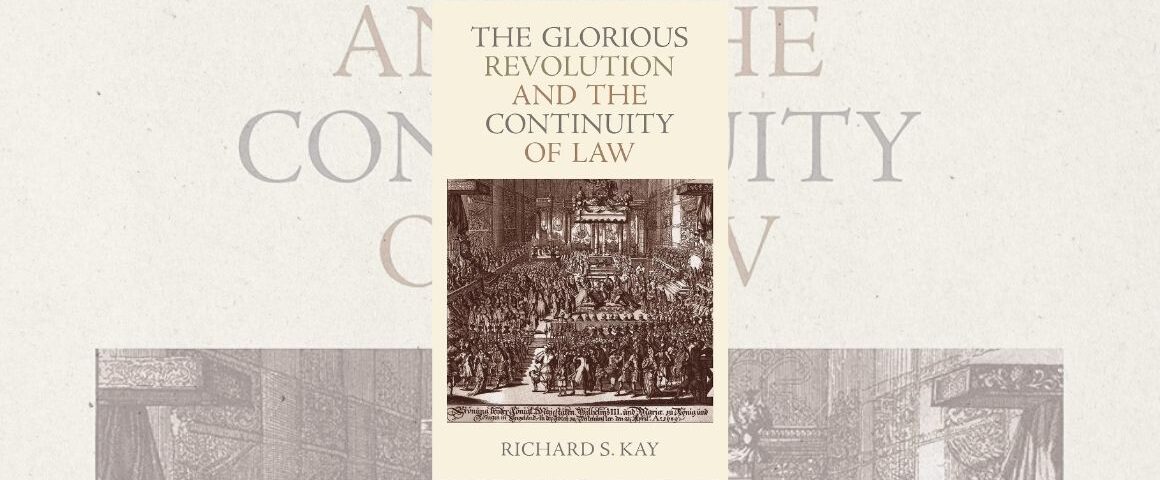
The Glorious Revolution and the Continuity of Law. By Richard S. Kay. Washington, D. C.: The Catholic University of America Press, 2014. 312 pp. $29.95 (paper).
In the century-and-a-half following the English Reformation, the Church of England cemented its reputation for being markedly averse to political resistance and rebellion, laying great stress on the duty of obedience owed by all subjects to their monarch. Works of resistance theory were written during this period, but most of them were authored by Nonconformist Puritans and Presbyterians. So it happened that when King James II was replaced by William and Mary, those who engineered this unusual transfer of power were faced with the difficulty of justifying what they had done.
As the title suggests, Richard Kay’s The Glorious Revolution and the Continuity of Law is a careful study of how the architects of the revolution claimed that their actions were in keeping with legal precedent, with an additional focus on the myriad constitutional issues that subsequently arose. Chapter 1 surveys the “political and value differences” that undergirded disputes over the constitution throughout the seventeenth century, eventually culminating in the Glorious Revolution (19); Chapter 2 examines “the attempted ‘legal’ arguments on behalf of the decisions of 1689” (56); Chapter 3 discusses legal questions that resulted from the joint monarchy of King William and Queen Mary; Chapter 4 explores comparable difficulties that affected the English judicial and ecclesiastical systems; and Chapter 5 covers the anomalous period of time between James II’s departure and the coronation of William and Mary, during which, according to the Revolution’s own architects, England had “no king or queen” (234).
The legal issues explored here are fine-grained and intricate, perhaps too much so to hold the average reader’s attention. For those, however, who have a special interest in the various constitutional rationales for the Revolution (as well as their attendant problems), this work is an erudite treatment of the subject, well sourced in the official records and private writings of the time. Returning to the question raised in the opening paragraph of this review, Kay shows that in explaining their actions, the Revolution’s architects did not claim to have violently resisted James II at all. Instead, they maintained that he had—partly by “breaking the original contract between king and people,” and partly by “having withdrawn himself out of this kingdom”—in some fashion “abdicated the government” (76). These men were likely aware of Grotius’s suggestion in his De Jure Belli that resistance might be justified in rare cases, particularly when “the ‘sovereign power is held in part by the king [and] in part by the people or senate’ and the king attempts to ‘usurp that part of the sovereign power which does not belong to him’” (87). But the idea that English sovereignty was so divided in its “ancient constitution” was “a proposition still profoundly controversial even among those united in their desire to be rid of James II” (87–88). Hence, an accounting of the Revolution in the vein of resistance theory was declined at the time.
Yet in an interesting coda to the rest of the book, Kay observes that just such an accounting was offered by the English government only two decades later. The occasion was the state trial of Henry Sacheverell, a clergyman charged in 1709 with “malicious, scandalous and seditious libels” (273) who had preached an incendiary sermon titled “The Perils of False Brethren Both in Church and State.” In this sermon, Sacheverell affirmed “the utter illegality of resistance upon any pretence whatsoever” (273), while also condemning those who suggested that the Glorious Revolution was itself an example of resistance. Kay points out that Sacheverell’s characterization of the Revolution was “perfectly consistent with the view that prevailed at the time of the Revolution itself,” but despite this, the prosecution accused Sacheverell of wrongdoing for suggesting that “to impute resistance to the said revolution is to cast black and odious colors upon his late majesty and the said revolution” (274). In short, Kay writes,
The Commons declared…that at its center the Revolution was not a simple application of accepted legal rules to unusual circumstances but an exercise of justified resistance against an oppressive king. Therefore, when Sacheverell had condemned resistance he had necessarily condemned the Revolution and, derivatively, the regime that it had brought into being. His impeachment and trial, on this reading, put into explicit contest two conflicting theories of the Revolution—the legalist theory emphasized in this volume and expressed by Sacheverell, and the resistance theory implicit in the Commons’ accusation. (274)
The Glorious Revolution was therefore an important episode in the development of English attitudes toward resistance, as exemplified by the Sacheverell trial. Although Sacheverell’s opponents spoke favorably of resistance in the abstract, some of them made clear that “only the absolute necessity of the action at the time of the Revolution…was being defended” (277). In the words of Horace Walpole, resistance “ought never to be thought of, but when an utter subversion of the laws of the realm threaten the whole frame of a constitution and no redress can otherwise be hoped for” (277). Meanwhile, notwithstanding Sacheverell’s declaration in his sermon that resistance was not to be carried out “upon any pretence whatsoever,” his legal counsel clarified that “the defendant’s condemnation of resistance…must be understood as including an implied exception for occasions of extraordinary necessity, such as that facing the nation in 1688” (278). By the early eighteenth century, then, it appears there was an emerging Anglican consensus that political resistance is never justified, except when it is.
It should be made clear that while Kay’s engagement with resistance theory as it relates to the Glorious Revolution comprises a small percentage of the book, it nevertheless serves as an illustrative example of the insights the author brings to light. Readers will thus find the book to be a gratifyingly informative work of scholarship on this fascinating event in English history, and one that I warmly recommend.