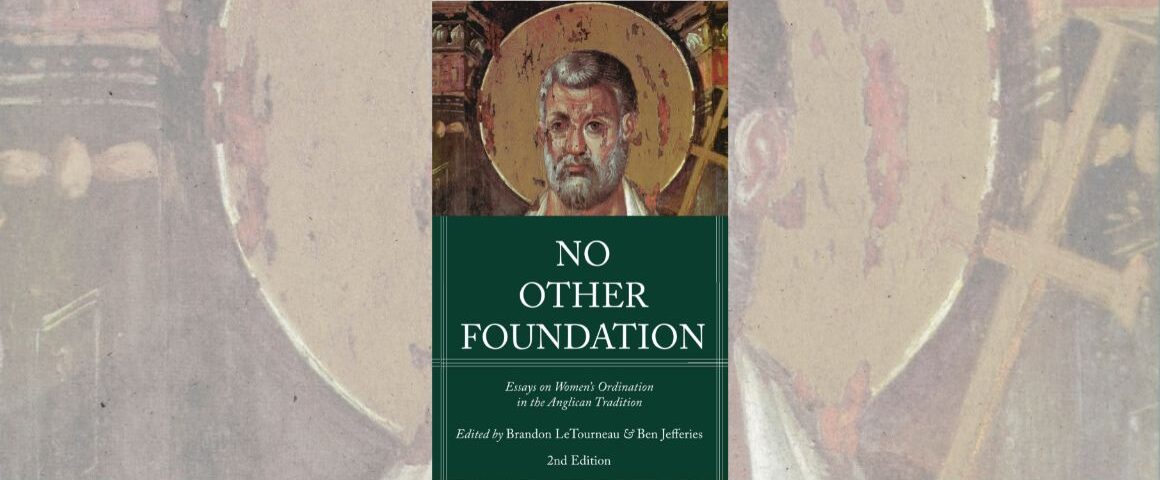
No Other Foundation: Essays on Women’s Ordination in the Anglican Tradition, 2nd Edition. Edited by Brandon LeTourneau and Ben Jefferies. Prolego Press. 463 pp. $25 (hardback), $14.99 (paper).
Prolego Press has issued a second edition of the work No Other Foundation, edited by Brandon LeTourneau and Ben Jefferies – both priests coming out of Nashotah House. The book is a collection of essays affirming the traditional view that only men can be ordained. It can be considered a collection of “greatest hits” because it includes eighteen essays, written by fifteen authors, from 1933 down to 2025. Some of these essays are famous in the Anglican tradition, such as C.S. Lewis’ “Priestesses in the Church?” of 1948. The editors also included seven documents appended to the end of the work. In total, the book runs to 435 pages, with the essays making up over 300 of those pages. In this review, I will be discussing the essays, though it should be said here that the curated appendices are themselves a good reason to purchase the book.
The essays have a general tendency, though there is no perfect agreement. For example, the editors are anxious to avoid being called misogynists or patriarchal, while the authors of another essay go so far as to claim that “God invented patriarchy” (Gauthier and McDermott, 97). The argument of the book runs something like this: women cannot be priests. It’s impossible. The ordination of women is contrary to the Anglican tradition; indeed, it is contrary to the Christian tradition. These traditions are neither arbitrary nor unjust. The Bible teaches that only men can be ordained. Theological investigation confirms the exegetical investigation. Practically speaking, the universal church is healthier, and everyone is happier, when the true ordinances of God for the priesthood are maintained. There are different roles for men and women in the church, but it is a mistake to think the roles have unequal values. The work of women in the church is as valuable as the work of men. The traditional position affirms women and is not anti-woman, i.e., not “sexist,” “misogynistic,” or even “patriarchal.” The essays flesh out this position in a wide variety of ways, overcoming a wide variety of obstacles. Any reader wishing to deepen his understanding of the sacramental character of the priesthood should read this book.
My main criticism of the book is that I think this position, having been produced under the pressure of leftist critique, has accepted some basic leftist claims. Specifically, my hunch is that the authors do not believe they would be allowed to exclude women from the priesthood if there were not a prohibition from God on women in the priesthood. This view puts the traditionalists in an impossible position: they have to prove that God has issued a clear command against priestesses for all time in all places and circumstances, whereas pro-priestess innovators have only to say that “it is not clear.” The whole premise of the debate is that if it is not clear whether or not God positively forbids women from being priests, then we are morally obligated to not only ordain women, but consider them as good as men at being priests.
I do not see any good reason to concede so much ground. The traditionalists could easily concede the substance of the innovators’ claims: perhaps God has not issued a blanket prohibition that covers all times and places. Even so, Christians are still allowed to exclude women from the priesthood if they judge it best. But the innovators cannot give an inch without being forced to admit their moral framework is not biblical. For example, let it be the case that Paul’s statement “I suffer not a woman to teach, nor to usurp authority over the man, but to be in silence” can be massaged in a variety of ways such that it is not a universal statement of Paul’s, or even a statement of God’s own design, but of Paul’s own judgment for his time. The traditionalists can concede this and still say, “and we too, exercising our own judgment, think we ought to restrict the priesthood to men.” Egalitarian Christians cannot admit that we today are allowed to say the same words Paul said. They have to relegate that part of the Bible to the dustbin of history. What Paul said then is, according to them, forbidden today.
The egalitarian always begins his argument by drawing into question the clearness of the prohibition and ends with the claim that we must therefore accept women in the priesthood and consider them as able (if not better) than men. Indeed, there is always a moment in an egalitarian book when the demand for equality spills over into the belief of superiority of the formerly oppressed. Women have had to persevere through history, i.e., they have had to struggle against injustice. This struggle elevates women above their oppressors. Furthermore, none of the evils of history can be blamed on women, because men were in charge. Maybe it is time to elevate women above men and try something new? Egalitarian eyes are twinkling.
I understand that men should not publicly criticize women. It shows a lack of taste and perhaps a lack of charity. On the other hand, people in general (women included) should not put themselves forward for roles they are unsuited to fill. Such pushiness is also in bad taste. Women are not suited to the priesthood; the men who realize this are trying to protect the priesthood but feel constrained.[1] The traditionalists do not want to publish another embarrassing Blast of the Trumpet, because they would be “punching down” rather than fighting off a Monstruous Regiment of Women.
Take for example the second essay, by E.L. Mascall, written in 1977. Mascall contends that it is simply not “possible for women to be priests.” As a result, some questions are irrelevant. Mascall lists two: “Is it not unjust to withhold the priesthood from women?” and “Will not women perform the traditional duties and functions of the priesthood just as efficiently as men?” (Mascall, 9–10) I wish Mascall would have discussed these very questions, but he believes himself exempt because they are irrelevant. These uncomfortable questions are avoided. If ordained women were possible, if God had allowed such a thing (perhaps very rarely), then Mascall might feel constrained to admit women to the priesthood, because women “are just as capable of undergoing a course of training as men” (Mascall, 11). Thankfully, for Mascall, the sacramental quality of the priesthood means that, for a mysterious reason, only men can perform the Eucharistic ceremony. Since the prohibition is mysterious, the strengths and weaknesses of women do not need to be discussed. Mascall leans heavily on the exclusion of women being perfectly compatible with “absolute equality,” and seems to think that, if it were not for the sacerdotal loophole, the exclusion of women from the priesthood would show a disdain for women (Mascall, 19, 20, and 28). He wishes to “make it plain” that he “is not motivated by any anti-feminist bias” (Mascall, 41). If he had said “anti-feminine,” he would have spoken more reasonably.
I say this position of Mascall’s (and others) is an impossible position. Is it really so obvious that women cannot ever, under any circumstances, perform the function of a priest? I think we should be wary whenever we multiply the commands of God. This book No Other Foundation certainly seems to exhaust all the possible ways of finding a commandment in the Bible regarding the ordination of women, but I do not believe any of the essay writers, or any of the book’s readers, can honestly say that such a command is perfectly clear and beyond dispute. There are much clearer commands in Scripture about other things. God punishes people who cross his commands. Are we really willing to say he is going to punish everyone who supports the ordination of women?
Ben Jefferies says, “I believe the ‘other side’ holds their beliefs in good faith. They are every bit as educated and wise as the scholars on ‘my side’” (Jefferies, 221). This sentiment is widely shared by the authors in this book. But this view must certainly draw into question either the book’s thesis or God’s justice; it would be hard to believe that God had set down a very fundamental command and yet men of good will, all scholars and highly educated, could still disagree!
Consider the problem once Jefferies’ claim is admitted, namely, that equally educated and equally sincere people can disagree about whether the Bible allows for the ordination of women. If highly educated and sincere people can disagree, then to insist that no deviation can be allowed is a dangerous thing to do. It is dangerous to stamp a human decision with God’s authority, and it would be unjust for God to have exercised authority in such a way that highly educated and undoubtedly sincere people could really disagree. So either your side becomes unjust or you draw into question God’s justice. Currently, both sides do this. Both sides claim that God forbids something when he has not clearly done so. Our side, the right side, claims that God forbids women ever being ordained as priests. Their side, the wrong side, claims that we are not allowed to exercise human authority to forbid women from becoming priests. They claim that the Bible is unclear and that, because of this lack of clarity, the exclusion of women would be sexist, and therefore unjust, and therefore forbidden by God.
I do see a way, however, out of this difficulty. Let it be the case that a male-only priesthood is a command of God, but a command of perfection rather than a command regarding the bare minimum. “Commands of perfection” seem to me to be revealed ideals; ideals we are compelled to pursue. Since they involve perfection, they are difficult to accomplish (and maybe to understand). If they are difficult to accomplish and understand, then it would make sense that highly educated scholars of goodwill might disagree. If they are difficult to obtain, well, we may not be able to attain them. A command of perfection is not the same thing as a command not to steal or murder: good people often fail to be perfect, but they do avoid being positively bad. For example: it is not the case (or very rarely the case) that we allow anyone to say he tried really hard not to steal the money or murder his friend but found it too hard to do the right thing. There are some things a decent person has no trouble avoiding, but perhaps having the right opinion about feminism and the priesthood is not one of those things.
Gauthier and McDermott hint at this kind of position when they write, “So while there are difficult and extraordinary situations where women must exercise spiritual headship, the home and Church should always try to return to the biblical order. Hard cases make bad law, and abnormal situations should not dictate regular order” (Gauthier and McDermott, 87–88). The point being: if the command is one of perfection, or at least one of general normalcy that sometimes is difficult, then there is no need to prove that God has absolutely forbidden the ordination of women. Maybe there are some exceedingly bad situations where the men cannot do the job; maybe there are some exceedingly rare situations where a Deborah or Camilla arises. Whatever the case is, there is no need to make the ordination of priestesses a generally accepted practice much less seek to accomplish a 50-50 parity the way the Church of England did (Linsley, 127). Women are less suited to the role of priest. Wherever a church lets women become priests, the church veers to the left and away from the faith. Women should generally not seek out the role, much less be encouraged or affirmative-actioned into it. No doubt exceptions of various kinds might occur, but they are exceptions rather than grounds for false equality.
To sum up this argument: Christians are permitted to exclude women from the priesthood even if there is no command from God that they do so. Even if there is no command to exclude women, there is obviously not a prohibition against excluding them, otherwise Christ and Paul would have been in error. If there is a command, it would have to be what I am calling a command of perfection. Whether there is no command or only a command of perfection, there is no biblical preference for feminism or the abolition of gender roles and the hierarchies those roles support. The proponents of women’s ordination are, typically, unable to countenance these facts. A church that said it was limiting the priesthood to men because it thought men better preachers and church leaders would, I suspect, be far more offensive to the proponents of women’s ordination than the church that said it simply believed in a mysterious command from God that settled the issue.
I have spent most of this review wrestling with what I take to be the central thesis of No Other Foundation. I have not been able to do justice to the individual authors. It is hard to do justice to eighteen different essays and say anything definitive. The authors in the book all bring a great deal of nuance to their positions, not to mention clear goodwill. I think the pervading sense of the book is that conservatives want to be understood. They do not want leftists or feminists to think they are bad people. Conservatives understand that their opinions are out of favor in the academy and in “enlightened circles,” but they have a loyalty to truth and a hope for the future that has led them to seek out some explanation for what they believe to be true.
This posture has produced, in this book, excellent observations about men and women in the priesthood, and I would like to finish this review drawing your attention to a few of these observations. V. A. Demant’s “Why the Christian Priesthood is Male” (pp. 46–73) contains a lengthy digression on what he called (it was the 70s) “sexology,” where he discusses “polarity and aptitude of the sexes.” He starts from the premise that “where each sex has characteristics which are more valuable than those of the other in one respect, it will be defective in other respects.” (61) He then draws some good observations from this. For example, he seems simply right to me when he says that “woman puts up with man at his worst or lesser good” but will not do so with other women. (70) This observable fact must be ignored by proponents of priestesses. We are often told that observations like this merely show a “structural injustice” that needs to change. But these things do not change. And the unnatural contortions made while trying to change them lead to worse social problems.
A. Linsley’s “Ten Objections to Women Priests” (pp. 116–128) is one of the hardest hitting chapters because it is a woman writing about women. She points out what is at stake: “those who applaud women priests acknowledge that women at the altar change the way we think about God.” (123) She explains the motivations: “They invent narratives to work around Scripture and Tradition since they have dismissed the received Faith as sexist, patriarchal, and outdated” (124). She describes the outcome we always see: “To accomplish parity means pushing women forward and denying some men” (127). And above all she points to what is lost in this change: “The priest’s office is unique, deeply rooted in archaic religion, and stands as an ensign of the hope for immortality” (127).
C. Erlandson, in his “Male Headship in the Old Covenant” (pp. 161–187) sets out the proper framework for carrying the exegetical argument to a sensible conclusion. “If God had somehow radically changed the means by which He chose to redeem His creation, the writers of the New Testament would have had to clearly and forcefully overturn the Old Covenant understanding of male headship” (162–163). Opponents of priestesses should never cease pointing out how ridiculous it is to believe that Christ, his disciples, and the Apostle Paul could loudly denounce old gods but felt the need to merely hint at overturning “outdated gender norms.”
A. Wilgus’ “Imago Dei, Persona Christi” (pp. 203–209) contains an admirably clear and masculine way of putting the issue: “In short, matter matters. Changing the image changes what it does” (204). It helps us to remember when in 2020 some churches replaced the bread with Skittles. Wilgus ends with a punchy series of questions that help frame the issue correctly: “How can it be that Christ, the perfect image of our genderless God, appeared as a male? Is it simply that he needed to pick one out of necessity and decided to flip a coin? Was he constrained by the cultural precepts of his time? Or does his revelation as the bridegroom coming for his bride carry deep significance?” (209)
These high points are among many others that make this collection a useful addition to the debate. I believe this debate will come to a close once the opponents of priestesses realize they do not need to demonstrate a clear command from God to keep the priesthood male. They have permission from God to exclude women from the priesthood. They are not sinning if they do what Christ and his disciples did. The Christian religion does not suggest, much less require, a feminist or “anti-patriarchy” moral orientation.
Editor’s Note:
In order to dispel any potential confusion, I wish to clearly restate the TNAA editorial line on the subject of ordained ministry. The public, ordained ministry of the Christian church is male in nature. There is ministry in the church that properly belongs to women, but it is not ordination to Bishop, Priest, or Deacon. I believe Mr. Simmons raises important and helpful points in his review that stand to guide the conversation over the open scandal of female ordination (especially the ACNA) in a helpful way, so I am obliged to leave the text relatively untouched, even if I am not quite convinced that his distinction of a “command of excellence” applies to the present issue. —J.N.
Notes
- Indeed, the least restrained essay in No Other Foundation is by a woman. ↑