Gerlach Flicke’s Cranmer as an Image of the Reformed Catholicism of the English Church
~
A Collect for Archbishop Thomas Cranmer, a Reformer of the Church
O God, by your grace your servant Archbishop Thomas Cranmer, kindled by the flame of your love, became a burning and shining light in your Church, turning pride into humility and error into truth: Grant that we may be set aflame with the same spirit of love and discipline, and walk before you as children of light; through Jesus Christ our Lord, who lives and reigns with you, in the unity of the Holy Spirit, one God, now and for ever. Amen.[1]
CONTEXT AND ORIGINS
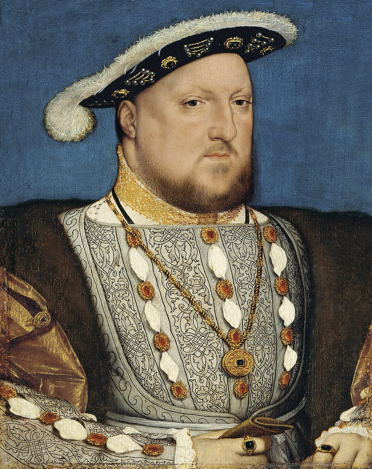
The third and fourth decades of the sixteenth century were a time of significant change for the English Church and people. The 1534 Act of Supremacy made King Henry VIII the head of the Church of England in place of the Pope, thus making the English Church governmentally independent from the rest of Roman Catholicism. Following this, monasteries were closed, and many were destroyed. 1539 saw the publication of the Act of Six Articles, a thoroughly Catholic statement on the doctrines and practices that would remain intact for the newly independent English Church, namely transubstantiation, communion in one kind, clerical celibacy, and private masses, among others. In 1547, King Henry VIII died, and his son Edward VI took the throne. Under the authority of King Edward VI, the English Church took greater steps toward Protestantism. The first Book of Common Prayer was published in 1549, solidifying the liturgy and worship of the English Church.
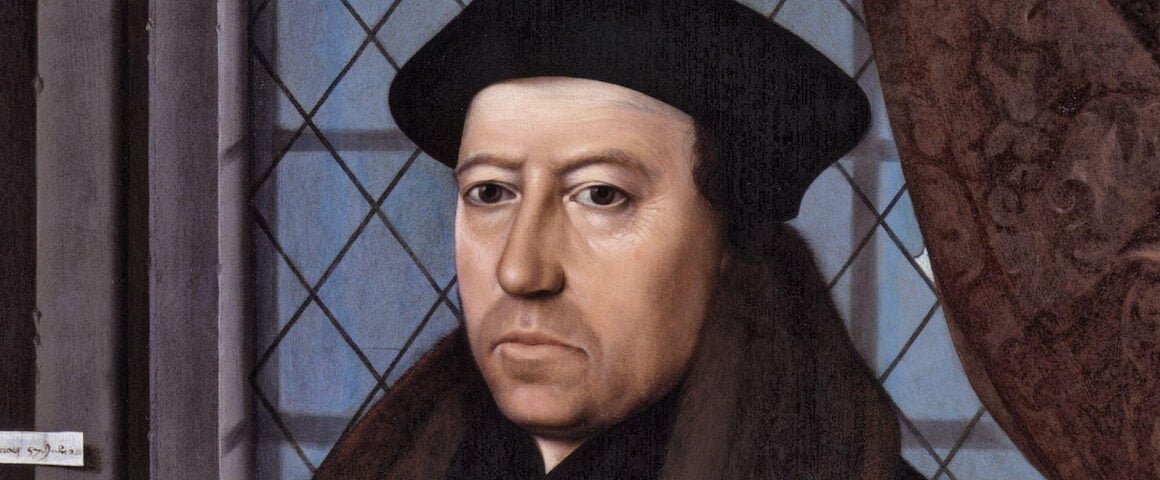
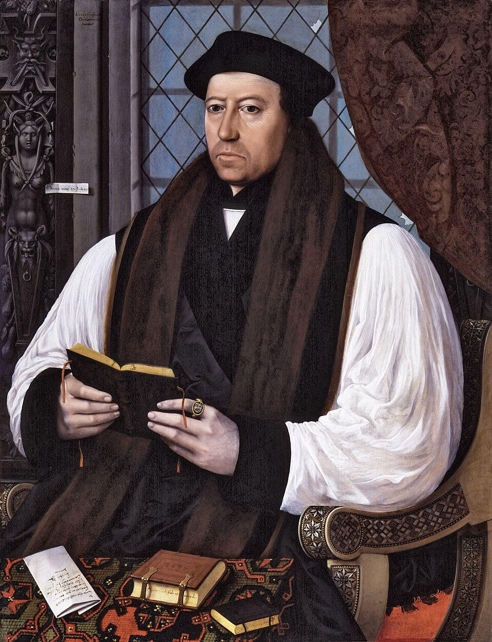
Throughout these two decades, amidst monarchical and ecclesial change, one figure remained constant: Archbishop Thomas Cranmer. When studying a period as tumultuous as the early years of the English Reformation, it is helpful to examine what didn’t change. Archbishop Thomas Cranmer appears to be the core element of consistency in this specific period in the history of the English Church and people. This article examines a particular artifact of this consistent figure to gain insight into the deeper story of what was truly occurring in those early years of the English Reformation: Gerlach Flicke’s portrait. A thorough examination of this portrait reveals Archbishop Thomas Cranmer’s pursuit of catholicity through the process of reformation that led the Church of England to embody a distinct form of “Reformed Catholicism.”
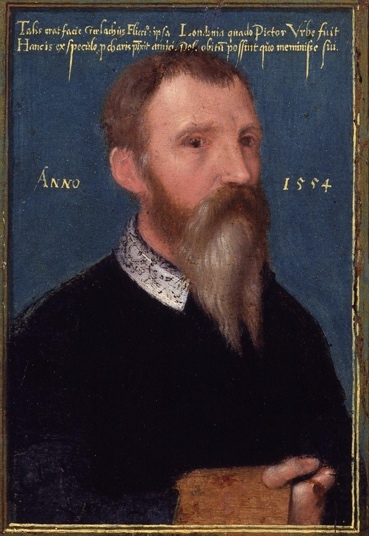
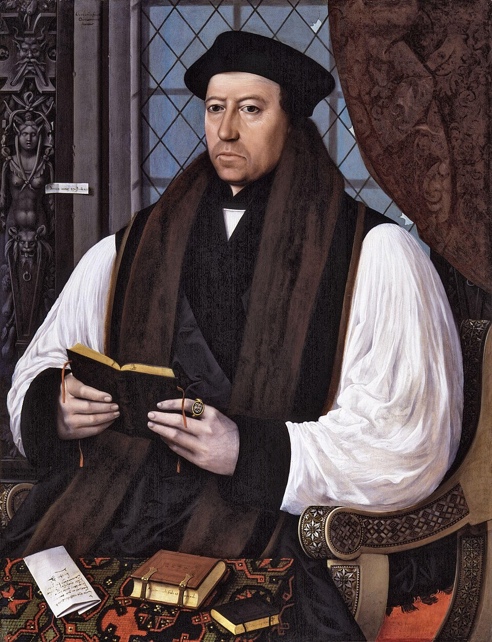
At Cranmer’s commission, German portrait painter Gerlach Flicke began painting the archbishop.[2] The fact that Cranmer himself commissioned this piece reveals something about his state. Diarmaid MacCulloch, writing on the backstory of the painting, says, “the context of the picture is one of self-confidence and hope, not of the sudden acute anxieties amid the fresh conservative onslaught in Henry VIII’s last summer of life.”[3] First, it is worth noting that Flicke was a Roman Catholic.[4] Why would a Protestant Reformer seek out the artistic efforts of a papist? A thorough examination of this piece reveals that the key intention was differentiation. This portrait differentiates Cranmer from other religious figures and, in turn, differentiates the English Church’s reformational approach from those of other parties. Flicke’s piece depicts Archbishop Thomas Cranmer, both explicitly and symbolically, as both like and different from his Roman Catholic predecessor and his continental contemporaries. Through the artistic abilities of this Roman Catholic portraitist and the reformational sensibilities of Archbishop Cranmer, a portrait of differentiation emerged.
CONTRA THE ROMANS
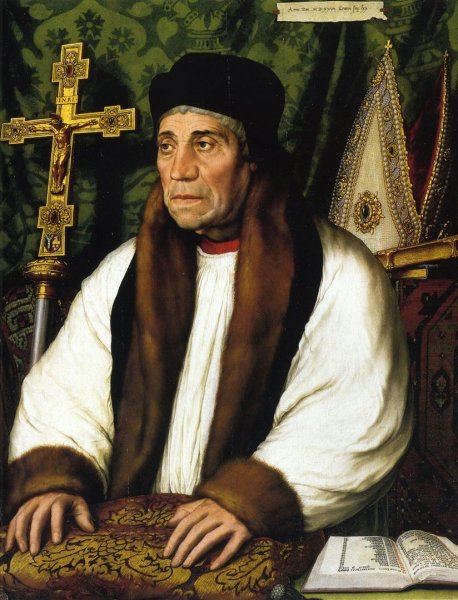
Regarding the Roman Catholic forbear, MacCulloch notes, “There is little doubt that the picture was conceived in relation to the image of Cranmer’s predecessor as Archbishop, William Warham.”[5] Both portraits were painted by Germans (Warham’s portrait by Hans Holbein the Younger, the portraitist of King Henry VIII and Erasmus of Rotterdam, among others), and they appear quite similar. Mary Hervey writes, “The execution is, however, careful, so far as copious repaint permits an opinion; and betrays obvious imitation of certain outward symbols of the style of Holbein, whose name and fame would naturally have met the painter on all sides.”[6] Both archbishops wear similar clerical garb. Both paintings feature a small slip of paper with specific information about the painting and the subject. MacCulloch notes, “Thus far, the Flicke portrait is saying, the office of an archbishop is the same as it always was. There the resemblance ends.”[7] In the Warham portrait, his eyes are cast away, looking beyond the painting. Next to him is a copy of a litany of the saints. Over each of his shoulders lay “the symbols of the ancient power and magnificence of his office, an intricately chased processional crucifix and a bejewelled mitre.”[8]
Archbishop Cranmer, on the other hand, looks directly at the viewer, holding a book—the Epistles of Paul—while two more books lie before him. One of them is Saint Augustine’s De Fide et Operibus, “Of Faith and Works.” The other is unknown. While many are frustrated by the difficulty of identifying the second book, Ashley Null claims it could be “The Testament of Erasmus.”[9] He believes Erasmus would be a “natural choice” for Cranmer.[10] Null concludes, “For together, these three books [The Epistles of Paul, “Of Faith and Works,” and “The Testament of Erasmus”] represent the crucial intellectual steps that Cranmer took to his mature position on justification, the key issue for a Protestant Reformer.”[11] While this theory may be interesting, it is not widely accepted.
Considering the two known books, MacCulloch concludes that Cranmer’s calling differs from that of his predecessor, Archbishop Warham. Archbishop Cranmer’s task is “to expound scripture with the aid of the best of patristic scholarship.”[12] He continues, “His office is not to be symbolized by liturgical books, or traditional ecclesiastical magnificence of cross and mitre.”[13] The absence of these items—symbols of authority—does not mean his role lacks authority; rather, it reflects a different form of authority. The letter before him reads “To the right reverent Father in God and my singular good Lord my Lord the Archbishop of Canterbury his Grace, be these delivered.”[14] His authority remains, but it takes a different form. Catharine MacLeod sums it up well: “The emphasis here is on the archbishop’s scholarly, theological interests rather than on the rich trappings of ecclesiastical life.”[15] This comparison of Holbein’s Warham and Flicke’s Cranmer reveals that Cranmer was still Catholic, but of a different kind and calling. He was a Catholic in the process of reformation.
CONTRA THE CONTINENTIAL REFORMERS
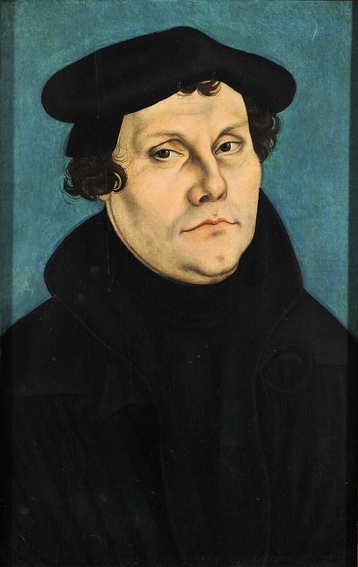
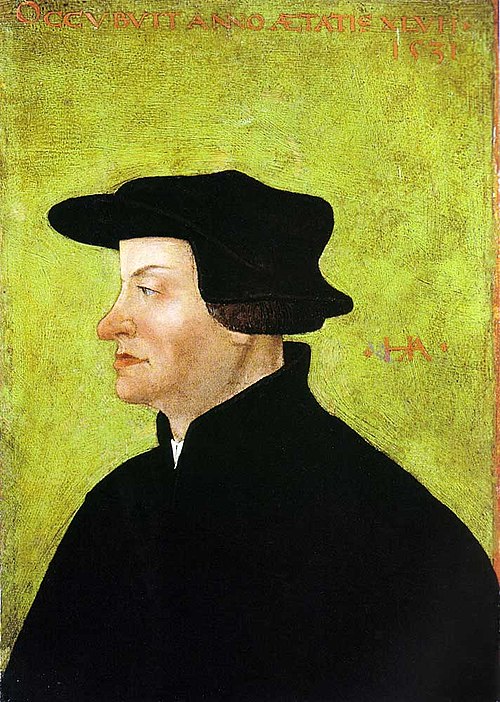
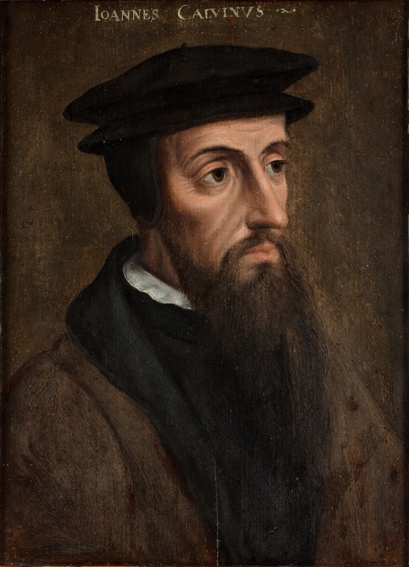
When compared with the portraits of notable Protestant reformers, the theme of differentiation persists. Martin Luther, Ulrich Zwingli, and John Calvin all have relatively similar portraits: simple, one-dimensional, and lacking ornamentation. Beyond that, it appears that no portraits of Zwingli were made during his lifetime. The piece displayed above was made in the year of his death, so it could be supposed that it was made before his death, but the inclusion of the text points to the other option: “He died at the age of 47.” How bleak. If the portraits are at all reflective of their subjects and their approaches to their work, it becomes clear that the Continental Reformation, though pursuing catholicity, involved much simplification and stripping away. Contrast this with Cranmer’s portrait, which is a multi-dimensional piece full of ornamentation and story. This raises a question. If Cranmer were still Catholic, yet reforming, to what degree would he be Protestant?
The presence of St. Augustine’s work in the portrait reveals and confirms much about Archbishop Cranmer’s Reformed Catholic theology. When addressing the question of whether Cranmer wished to be known as a Protestant, Null responds:
Not if one means by that term someone whose religious sensibilities were nurtured to maturity by a self-confidant Protestant culture… the first generation of English reformers did not leap from the pages of Scripture fully formed and armed like some Christian version of Athena springing from the pounding head of Zeus. Early English evangelicals were as much late medieval Catholics as they were early modern heralds of a new religious era. Even if Cranmer’s commitment to solifidianism is given pride of place in the portrait, its setting is thoroughly traditional… He does have Paul in his hands, but a book by St. Augustine of Hippo (354–430) lies on the table, as well as a letter addressed to him in his capacity as archbishop of Canterbury. In an age of self-fashioning, Cranmer is also presenting himself as a faithful ‘mixed-life’ bishop in the tradition of Pope Gregory I.[16]
Null goes on to say that Cranmer’s solifidianism was not a rejection of “his medieval English spirituality, but as the only possible means for attaining its fulfilment.”[17] According to Null, Cranmer’s doctrine of justification did not nullify his Catholicity; rather, it completed it.
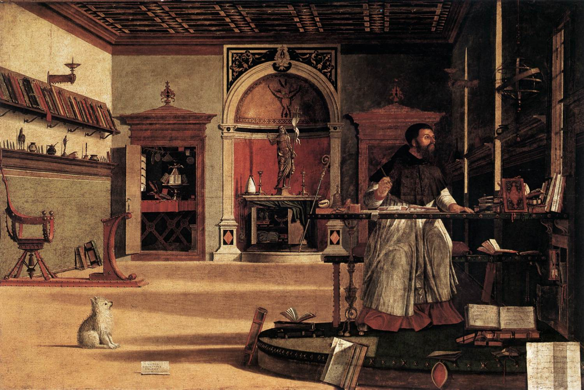
He concludes that two main points emerge from the inclusion of Of Faith and Works: “the central role of the affections in salvation and sanctification, as well as his deep Humanist commitment to confirm his understanding of Scripture through sincere and thorough research in the writings of the Church Fathers.”[18] He claims that for the English Reformers and the Church that followed, the heart of the matter was right desire, not right doctrine. Null writes, “Doctrine, rightly taught, would give birth to desire, but desire would enable that doctrine to be embraced inwardly and expressed outwardly in behaviour.”[19] According to Null, that is the heart of St. Augustine’s Of Faith and Works. For St. Augustine, justification occurred before and independently of good works, but those same works would follow as signs of it. Therefore, “the hallmark of true Christian faith was a spirit-enabled love for God visibly expressed in godliness.”[20] Thus, the reorientation of the affections leading to a life of good works was at the very heart of English theology and spirituality. Thus, Cranmer aligned with reformational thinking.
It is abundantly clear that Archbishop Cranmer grounded much of his theology in the historic interpretation of the Scriptures as seen in the Fathers. This is evident in works such as A Defence of the True and Catholike Doctrine of the Sacrament of the Body and Bloud of our Saviour Christ: With a Confutation of Sundry Errors Concerning the Same Grounded and Stablished Upon God’s Holy Word, and Approved by the Consent of the Most Ancient Doctors of the Church. Beyond its 49-word title, this work includes more than 300 pages of quotes from over 40 theologians, with over half from the patristic era.[21] For Cranmer and the English Reformers, Scripture and tradition went hand in hand. Both held authority so long as the latter upheld what was properly expounded from the former. This basic yet profound reality is evident in Flicke’s portrait of Cranmer, through the presence of St. Paul’s Epistles and St. Augustine’s Of Faith and Works. Thus, Cranmer was catholic in the patristic sense of the word.
As MacLeod puts it, “Cranmer wished the painting to convey a clear message about his belief in the importance of Christian teaching, and of faith and good works, with the authority of both St. Augustine and St. Paul behind him.”[22] Null writes, “Hence, Cranmer proved to be no new Athena. While clearly a herald for a new religious era, he rooted his reform of the doctrine of the recently independent Church of England in the medieval pursuit of right desire as determined by the ancient wisdom of Scripture and guided by the insights of the Fathers, just as his portrait by Flicke had suggested—for those with eyes to see and hearts to embrace.”[23] In this way, Thomas Cranmer was a Reformed Catholic archbishop who led the English Church and people into a distinct form of Reformed Catholicism within the English spiritual tradition.
Through the lens of portraiture, one notes that the English Reformation and the future of the English Church and people would be quite different from those of the Roman Catholic Church and the churches of the Continental Reformation. The Church of England would indeed pursue a via media, a middle way, between the extremes of Medieval Roman Catholicism and the Protestant Reformation, anchoring itself as a “Reformed Catholic” tradition. Avid readers of The North American Anglican will know Fr. Charles Erlandson’s explanation of Reformed Catholicism:
There are, of course, two parts to this definition: “Reformed” and “Catholicism.” “Reformed” is the adjective which modifies the noun “Catholicism.” The fact that the “Catholic” part of Anglicanism is the noun means that it is the essential thing that is being reformed. In this sense, although Anglicanism is also Protestant, it is a Catholic Christian tradition, keeping the doctrine, discipline, and worship of the Church as practiced by the one, undivided Church in the early centuries after Christ. And yet it’s not only Catholic because in the Western Church it became necessary to reform some of the abuses and errors of the medieval Roman Catholic Church.[24]
OTHER NOTABLE FEATURES
Three other features of Flicke’s Cranmer are worth noting: the engraved iconography on the window jamb over Cranmer’s right shoulder, Cranmer’s ornate ring, and the various breaks in the glass of the window behind him.
Engraved Iconography
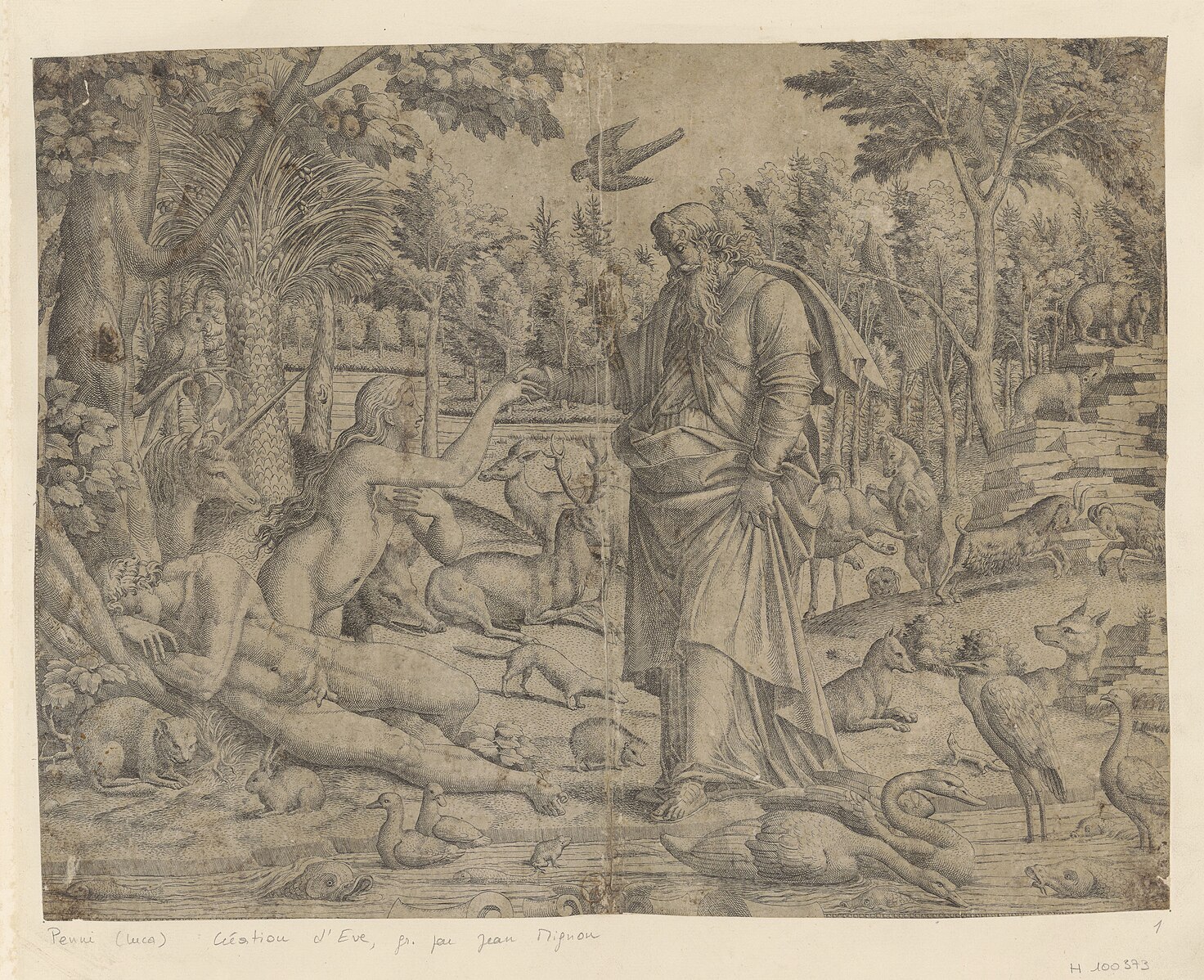
The carving depicts a nude woman standing beneath a horned face. Anthony Wells-Cole claims this imagery alludes to two works by Jean Mignon: Metamorphosis of Actaeon and The Creation of Eve, with the horned face originating from the former and the woman from the latter.
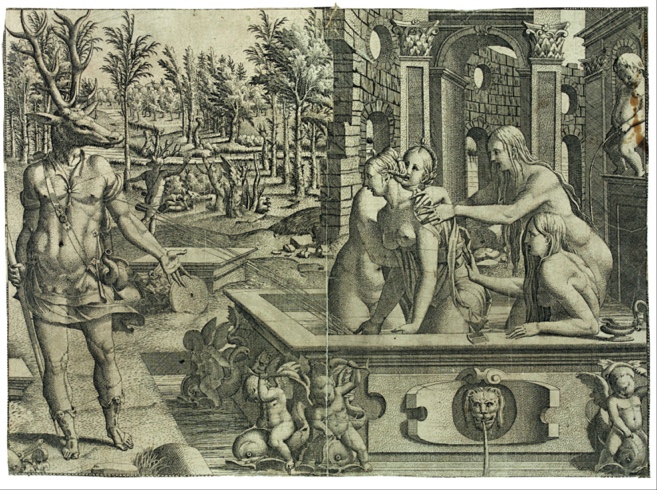
Metamorphosis of Actaeon depicts an abuse of power, and, in turn, the horned face in Flicke’s portrait may communicate “the proper extent of royal power.”[25] The legend of this print translates to “Know your lord.” Null proposes, “This precept was at the very heart of Cranmer’s Protestant doctrine of the Godly Prince and the reason for his secret repudiation of papal authority prior to his consecration as archbishop. Consequently, the mask would seem a subtle allusion to the importance Cranmer’s Erastian views on church government had for his Protestant convictions.”[26]
The Creation of Eve depicts Adam’s wife, Eve, coming to life in a garden teeming with creatures that appear in pairs. In this piece, Mignon depicts Genesis 2:18, “It is not good that the man should be alone; I will make a helper fit for him.” Null concludes, “In a painting designed to indicate the Protestant faith of this archbishop of Canterbury, referring to his marriage in this manner was, at the least, clever and sophisticated. In the light of Margaret Cranmer’s enforced absence from her husband’s side for a time after The Six Articles, it was also pointed and poignant.”[27] As a leader seeking to reform the Catholic Church in England, Archbishop Cranmer prioritized the restoration of married clergy.
Cranmer’s Ring
On Cranmer’s left hand, a signet ring is visible. The coat of arms on the ring depicts three pelicans. In earlier years, the Cranmer coat of arms showed three cranes. According to MacLeod, King Henry VIII ordered the coat of arms be changed to depict pelicans because “Cranmer ought to be ready to shed his blood for the good of his flock; the pelican was believed to shed her own blood for the nourishment of her brood.”[28] Little did Cranmer know that this would foreshadow his eventual martyrdom under the reign of Mary I.
Shattered Glass
Lastly, the window behind Cranmer shows three areas where the glass is broken. Not much has been said about this feature, though many speculations could be drawn. MacLeod has noted that “the sky which appears through the holes has been painted with expensive ultramarine pigment, unlike the rest of the sky, seen through the glass, for which he has used the more common azurite.”[29] Ultramarine pigment was extremely costly. Importing the raw material, lapis lazuli, and the difficult process of preparing the pigment made the final product as expensive as gold. In religious art, “the highest quality was often reserved for the robe of the Virgin.”[30] While the cracks in Cranmer’s windows are not being compared to the robe of the Blessed Virgin, it is important to note the use of this costly pigment on this specific detail in the portrait. For some unknown reason, Flicke chose to use paint as expensive as gold to depict a sense of brokenness in the setting.
CONCLUSION
Through an in-depth, contextual study of Gerlach Flicke’s portrait of Archbishop Thomas Cranmer, it becomes abundantly clear that, at a pivotal moment, the English Church was envisioned as a via media of distinct Reformed Catholicism, seeking to bridge the best of Roman Catholicism and the Protestant Reformation while simultaneously rejecting the worst of their respective extremes. Again, Fr. Erlandson puts it this way:
Anglicans are Catholics because our ecclesial structures, theological method and content, and practices are but reformed versions of the Catholic faith of the early Church. We are also Protestants because the Catholic faith once delivered to the saints has, in the English Church tradition, been shaped decisively by the English Reformation.[31]
As Reformed Catholics, Anglicans should join Archbishop William Laud, one of Cranmer’s successors, in praying for the development and wholeness of Christ’s holy Church in her various needs, especially her need to be strengthened in catholicity through the work of reformation. Archbishop Cranmer would have given a wholehearted “amen” to Laud’s prayer:
Gracious Father, we pray for your holy Catholic Church. Fill it with all truth, in all truth with all peace. Where it is corrupt, purify it; where it is in error, direct it; where in anything it is amiss, reform it. Where it is right, strengthen it; where it is in want, provide for it; where it is divided, reunite it; for the sake of Jesus Christ your Son our Savior. Amen.[32]
NOTES
- The Anglican Church in North America, The Book of Common Prayer and Administration of the Sacraments with Other Rites and Ceremonies of the Church according to the Use of the Anglican Church in North America: Together with the New Coverdale Psalter. (Anglican Liturgy Press, 2019), 639. ↑
- Diarmaid MacCulloch, Thomas Cranmer: a Life (Yale University Press, 1998), 338. ↑
- MacCulloch, Thomas Cranmer, 338. ↑
- Mary F.S. Hervey, “Notes on a Tudor Painter: Gerlach Flicke,” The Burlington Magazine for Connoisseurs, May 1910, JSTOR, https://www.jstor.org/stable/858334, 71. ↑
- MacCulloch, Thomas Cranmer, 339. ↑
- Hervey, “Notes on a Tudor Painter: Gerlach Flicke.” 76. ↑
- MacCulloch, Thomas Cranmer, 339. ↑
- MacCulloch, Thomas Cranmer, 339. ↑
- Ashley Null, Thomas Cranmer’s Doctrine of Repentance (OUP Oxford, 2001), 84-85. ↑
- Null, Thomas Cranmer’s Doctrine of Repentance, 85. ↑
- Null, Thomas Cranmer’s Doctrine of Repentance, 85. ↑
- MacCulloch, Thomas Cranmer, 339. ↑
- MacCulloch, Thomas Cranmer, 339. ↑
- MacCulloch, Thomas Cranmer, 341. ↑
- Catharine MacLeod, Dynasties, ed. Karen Hearn (Tate Publishing, 1995), 48. ↑
- Ashley Null. Reformation Reputations. David Crankshaw and George Gross, eds., (Springer Nature, 2020), 191. ↑
- Null, Reformation Reputations, 194. ↑
- Null, Reformation Reputations, 194. ↑
- Null, Reformation Reputations, 195. ↑
- Null, Reformation Reputations, 195. ↑
- Null, Reformation Reputations, 201. ↑
- MacLeod, Dynasties, 49. ↑
- Null, Reformation Reputations, 208. ↑
- Erlandson, Charles. 2019. “Tract I: What Is Anglicanism?” The North American Anglican. September 11, 2019. https://northamanglican.com/tract-i-what-is-anglicanism/. ↑
- Null, Thomas Cranmer’s Doctrine of Repentance, 96. ↑
- Null, Thomas Cranmer’s Doctrine of Repentance, 97. ↑
- Null, Thomas Cranmer’s Doctrine of Repentance, 119. ↑
- MacLeod, Dynasties, 49. ↑
- MacLeod, Dynasties, 49. ↑
- Gerald W R Ward, The Grove Encyclopedia of Materials and Techniques in Art (Oxford University Press, 2008), 503. ↑
- Erlandson, Charles. 2023. “Is Anglicanism Catholic or Protestant?” The North American Anglican. September 8, 2023. https://northamanglican.com/is-anglicanism-catholic-or-protestant/. ↑
- ACNA, The Book of Common Prayer, 646. ↑