A Homily on the 3rd Article of the Apostles’ Creed
Today we will finish up our series on the Apostles’ Creed with the Third Article, the section of the Creed on the Holy Spirit and the Church, before moving on to the Ten Commandments in the next installment. Here is that Third Article of the Creed:
I believe in the Holy Ghost: The holy Catholic Church; The Communion of Saints: The Forgiveness of sins: The Resurrection of the body: And the Life everlasting. Amen.[1]
In our Office of Instruction, we say that the chief thing we learn from this Third Article is to believe “in God the Holy Ghost, who sanctifieth me, and all the people of God.”[2] It is because the ministry of the Holy Spirit is focused on our sanctification that the Creed includes the beliefs about the Church with the belief in the Holy Ghost.
Indeed, the Creed says very little about the Holy Ghost himself, other than acknowledging him as a member of the Trinity! Building off the Nicene Creed, Article V of our 39 Articles of Religion fleshes things out a bit:
The Holy Ghost, proceeding from the Father and the Son, is of one substance, majesty, and glory, with the Father and the Son, very and eternal God.[3]
That is, we affirm in Creeds and Articles that the Holy Spirit is indeed a distinct Person of the Godhead. That is, while the Holy Spirit makes God the Father and God the Son present to us, he is neither the Father nor the Son. Nevertheless, there is perfect unity and equality of the Three Persons such that we have “but one living and true God.”[4] The Holy Spirit is God, and he is a Person. He is not an impersonal force or impersonal presence. He is indeed a “he” and not an “it.”
We describe the relationship between the Holy Spirit and the other two Persons of the Holy Trinity as that of “procession.” This is language from the Nicene Creed, which is borrowed from Jesus’ description of the Holy Spirit in John 15:26: “But when the Comforter is come, whom I will send unto you from the Father, even the Spirit of truth, which proceedeth from the Father, he shall testify of me.”
Now, we won’t get too deep into the weeds on this, but you may have noticed that John 15 only explicitly describes the Spirit as proceeding from the Father, and this is indeed how the Spirit is described in the original version of the Nicene Creed. But the version of the Creed we just sung, echoed in Article V, says that the Spirit proceeds from the Father and the Son. This “double procession” is a uniquely Western or Latin description that comes from the Council of Toledo around the turn of the 7th century. The clause was added to combat a resurgence of the Arian heresy that considered the Son and the Holy Spirit to be lesser divinities or lesser gods than the Father. Unfortunately, the theology behind the addition was misunderstood in the Greek-speaking East, and the addition helped contribute to the East/West Schism in the 11th century.[5]
Perhaps the best way to describe the two theological perspectives is to say that the East was concerned about retaining the Father’s primacy in the Trinity as the “source” or “font” of the Godhead, while the West wanted to make sure that we don’t lose sight of the interrelationship of all three Persons. That is, the Spirit and the Son relate to each other as well as each to the Father. We might say that the Eastern description is “causal,” while the Western description is “relational.”[6] Both perspectives are important, and it has long been the custom for Anglicans and other Western Christians to drop the clause, “and the Son,” when praying with Eastern Christians.
Sometimes folks will ask why our liturgy and the King James Bible use the term “Holy Ghost” rather than the more common “Holy Spirit” to speak of the Third Person of the Trinity. The short answer is that “Holy Ghost” comes from the more Germanic influence on the English Language, while “Holy Spirit” comes from the Latin influence. Until a few decades ago, most English Speakers used “Holy Ghost” when referring to the Third Person as described in the New Testament, with “Holy Spirit” used in a less personal or more generic sense of God’s Spirit, like you would more often find in the Old Testament. But, really, that’s often a distinction without an explicit biblical difference, which is why the shift to only using “Holy Spirit” became more common. That shift also coincided with a shift in common English usage of the word “ghost” to refer to the spirit of a dead person, which is not what we mean when we speak of the Holy Ghost. Though “Holy Ghost” is more old-fashioned, it means the same thing as “Holy Spirit.”
We also find other names for the Holy Spirit in the New Testament. In John’s Gospel, Jesus describes him with the Greek word Paraclete, a legal term meaning “one who comes alongside.” Paraclete is translated in different ways in different English versions of the Bible, such as “Comforter,” “Advocate,” “Helper,” “Guide,” or “Counselor.” In other places in the New Testament the Holy Ghost is also called, the “Spirit of Christ,” the “Spirit of your Father,” the “Spirit of God,” and the “Spirit of Truth.”[7]
All of these different names or titles of the Holy Spirit help us see what he does for us in the life of Sanctification. That is, he comes alongside us, he makes the Lord Jesus and the Father present to us, and he brings us into all truth as the one who is active in the Word and Sacrament. Indeed, we receive the Holy Spirit in our regeneration, our new birth, when we are joined to Christ by faith and Baptism. And it is the Holy Spirit who causes us to participate in Christ’s Body and Blood when we partake of Holy Communion.
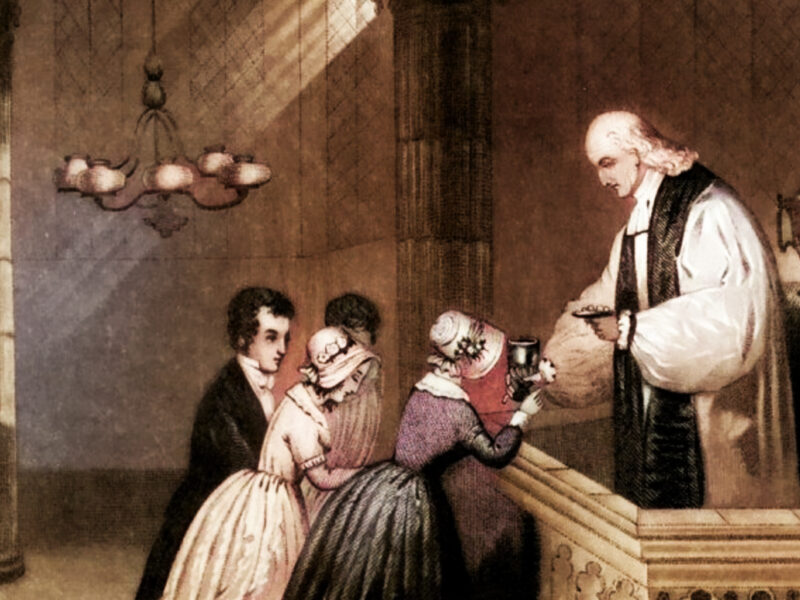
So, if you are ever wondering if you have truly received the Holy Spirit, simply ask yourself: Am I Baptized? Do I have faith in, do I trust, the Lord Jesus for my salvation? If so, then you have the Holy Spirit indwelling you. And then, if you haven’t yet done so, come to be catechized and Confirmed the next time our Bishop visits; Confirmation is that apostolic laying on of hands for the strengthening of the gifts of the Spirit as you publicly affirm your faith before the Church.
Galatians 5 describes the fruits of the Spirit in the life of a Christian: love, joy, peace, longsuffering or patience, gentleness, goodness, faith, meekness or kindness, and temperance or self-control. This is what the Christian life looks like when you are walking in the Spirit (22-26). By contrast, when we are walking by the flesh, our lives are characterized by the works of the flesh (also described in Galatians 5): sexual immorality, impurity, sensuality, idolatry, sorcery, enmity, strive, jealousy, fits of anger, rivalries, dissensions, divisions, envy, drunkenness, revellings, and things like this (19-21).
If you are a baptized Christian and find your life looks more like the works of the flesh than the fruits of the Spirit, repent of those sins and return to walking with God. The Holy Spirit’s indwelling means that you can indeed overcome sin with his help. Despite what you may be feeling, despite the seductive nature of sin, the Holy Spirit is stronger than the World, the Flesh, and the Devil. You do not need to be enslaved by the works of the Flesh. Remember the words of the Scriptures, “greater is he that is in you, than he that is in the world” (1 John 4:4). St. Cyril of Alexandria describes this transforming work of the Holy Spirit in his commentary on John 10:
Only by his presence within us in this way could he give us the confidence to cry out, “Abba, Father,” and enable us to grow in holiness and, through our possession of the all-powerful Spirit, strengthen us to become invincible against the traps of the devil and the assaults of our fellow human beings … You see that the Spirit changes those in whom he comes to dwell and alters the whole pattern of their lives … With the Spirit within them it is quite natural for people who had been absorbed by the things of this world to become entirely other-worldly in their outlook and for cowards to become people of great courage.[8]
You cannot grow in holiness without the Holy Spirit, nor can you grow in holiness without the Church, for the Holy Spirit uses the Church in his work of sanctification, his work of making us holy.
In the Apostles’ and Nicene Creeds, we get the description of the Church as “One, Holy, Catholic, and Apostolic.” The Second Office of Instruction in our Prayer Book explains these four characteristics or “four marks” of the Church:
We mean that the Church is
One; because it is one Body under one Head;
Holy; because the Holy Spirit dwells in it, and sanctifies its members;
Catholic; because it is universal, holding earnestly the Faith for all time, in all countries, and for all people; and is sent to preach the Gospel to the whole world;
Apostolic; because it continues steadfastly in the Apostles’ teaching and fellowship.[9]
Article XIX of our 39 Articles of Religion describes what the Church looks like on the ground:
The visible Church of Christ is a congregation of faithful men, in the which the pure Word of God is preached, and the Sacraments be duly ministered according to Christ’s Ordinance, in all those things that of necessity are requisite to the same.[10]
The Holy Scriptures proclaimed and preached, and the Sacraments administered are often called the “ordinary means of grace.” That is, the Holy Spirit uses Word and Sacrament in the Church as his means of transforming your life and giving you the grace of God. In the Word, we hear the Gospel message, we are taught what it means, and how we should live in light of its truth. As the Nicene Creed says, the Holy Ghost “spake by the Prophets.” In the Sacraments we are given the visible and tangible signs of the Gospel, through which we commune with our Lord. That’s why it’s so important to be in Church. Indeed, after describing the Four Marks of the Church, our Office of Instruction describes what it looks like for us to be dutiful members of the Church:
My bounden duty is to follow Christ, to worship God every Sunday in his Church; and to work and pray and give for the spread of his kingdom.[11]
And then the Office describes Confirmation as the gift of the Church for the strengthening of the gifts of the Holy Spirit so that we may live after this duty.
The Apostles’ Creed gives us four beliefs that are intrinsically attached to our belief in and membership in Christ’s church: the Communion of Saints, the Forgiveness of Sins, the Resurrection of the Body, and the Life Everlasting.
The Communion of Saints speaks to that catholicity of the Church. It refers to the universal fellowship we have with Christians across time and space. When we are united to Christ, we are united to each other. Indeed, in New Testament terms, as a baptized Christian you are already a member of that communion of saints. We can liken the Communion of Saints to one huge spiritual family tree with Christ as its head.
Traditionally, we describe the saints who have gone before us as the “Church Triumphant.” That is, those who have died in Christ are before his throne and enjoying their rest. We who are currently alive are the “Church Militant.” That is, we are currently on the front lines of the battle against sin and against the World, the Flesh, and the Devil. Nevertheless, Scripture tells us that those who have gone before us still pray for us. That fellowship is not essentially parted when they go to their glorious reward. It is indeed still one Church. It is still one family in Christ by the Holy Spirit. Our worship here on earth is joined with theirs in heaven.
The Communion of Saints also means that the Church’s tradition, while not infallible, is important. When the Church’s historic practices and beliefs are in line with godliness and the Holy Scriptures, we should heed them. Our spiritual forefathers still get a voice and vote in the Church today. This is part of our particular charism at my own congregation, All Saints, San Antonio. At All Saints want to keep that connection alive, not for its own sake, but because the faith of our fathers and mothers is still living and important.
As for the Forgiveness of Sins, this is essential to the life of the Church. The Church is here for sinners. It’s here for folks like you and me. The Church is here to redeem sinners through the ministry of the Gospel, and it’s here to strengthen redeemed sinners for God’s glory. We recognize the seriousness of sin. That’s why we offer forgiveness rather than simply brushing it aside. Indeed, because sin is so serious, only Christ within us by the power of his Spirit could be greater than our sins. In our Justification, he declares us righteous by his blood and his own righteousness. And in our Sanctification, the Holy Spirit works with us to transform our lives into lives of holiness. This process of sanctification will be ongoing until we’re before the Lord in Glory. But we know that we will eventually have full sanctification because we have already received the judge’s verdict of “not guilty.” And so, the life of a Christian is a life of constant repentance, constant turning from sin and from ourselves, and turning back to God. Declaring forgiveness and absolution in the Church is one of the greatest responsibilities and privileges of being a priest of Christ’s Church.
We talked about our own Resurrection in the last installment, so we won’t go into much detail now. But the Creed’s emphasis on the Resurrection of the Body is a reminder that we will rise as Christ has risen. And that means that our bodies matter. We are whole human beings, both spiritual and physical. That’s how God made us, and that’s how we will be in the final Resurrection. Our bodies will be glorified, but they will still be human bodies.
This also means that our hope in the World to Come and in the Resurrection is not escapism. Our eternal destiny is not to escape the world that God made, but to forever inhabit a world that he has restored and renewed. He will fix this world, not destroy it. And this means that we should care about his creation now and strive to be good stewards of it.
This brings us to the final clause of the Creed, our belief in the “Life Everlasting.” Life Everlasting naturally flows out of our belief in the Resurrection of the body. We were created for eternal fellowship with God and with each other. Death is an enemy whose curse has been broken by Christ’s resurrection. For the Christian, death is but sleep; we have eternity to look forward to.
The Holy Ghost is indeed our Comforter and Advocate, for it is through his ministry and indwelling that we have this hope and this promise. We have the hope of finally conquering sin. We have the promise of forgiveness. We have the hope and promise of the Resurrection. We have the hope and promise of eternal fellowship with God and with each other.
So let us walk in the Spirit. Let us live lives of holiness with his help. Let us come to the throne of grace, empowered and indwelt by the Holy Ghost.
❦
In the Name of the Father, and of the Son, and of the Holy Ghost. Amen.
- BCP 1928, 284. ↑
- Ibid., 285. ↑
- Ibid., 603. ↑
- Ibid., Article I. ↑
- Kevin DeYoung, The Nicene Creed: What You Need to Know about the Most Important Creed Ever Written, Wheaton: Crossway (2025), 62-63. ↑
- Ibid., 68-69. ↑
- Anglican Church of North America, To Be a Christian: An Anglican Catechism (Approved Edition), edited by J.I. Packer and Joel Scandrett, Wheaton: Crossway (2020), 47. ↑
- Cyril of Alexandria, Commentary of the Gospel of John 10.2, quoted in ACCS.NT.4b, 198.
↑ - BCP 1928, 291. ↑
- Ibid., 606. ↑
- Ibid., 291. ↑