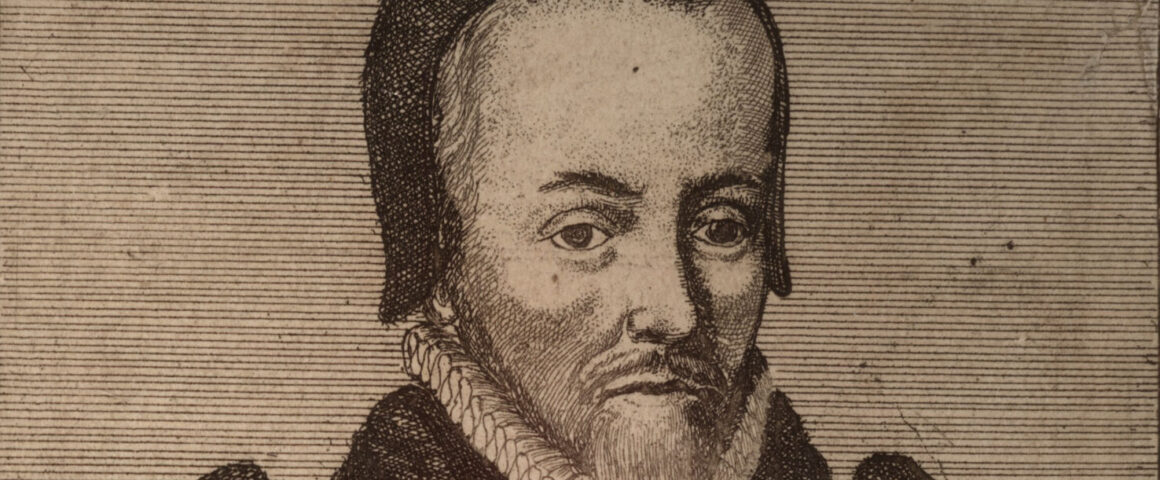
A House for the Word: A Treatise on Public Worship from Hooker’s Laws. By Richard Hooker. Modernized and edited by Patrick Timmis and Brad Littlejohn. Davenant Press, 2025. 188pp. Paperback, $12.95.
About a month ago I was pleasantly surprised to receive a message from the Davenant Institute that another volume in their project to modernize Richard Hooker’s Laws of Ecclesiastical Polity was not only in the works, but soon-to-be released! I have been following this modernization project since its first release in 2016, eagerly buying and reading each volume as it became available. Longtime readers of the North American Anglican may be familiar with my reviews of the third and fifth individual volumes in the series from 2018 and 2024, respectively.
At the risk of retreading material from my earlier reviews, Richard Hooker is arguably the most important Anglican theologian of the Elizabethan age due to his Laws of Ecclesiastical Polity. The Laws effectively staked out the position of the post-Reformation English Church against more radical reformers that were agitating for further reforms. Two monarchs later, the ideological descendants of these radicals would execute the king and archbishop, igniting the English Civil War. Upon the Restoration of the monarchy (and episcopal governance of the Church), Hooker’s wisdom proved to be prescient. Indeed, in his Laws, Hooker provides a rationale for the established Church’s more conservative approach to reform, an approach that marks much of what we know as Anglicanism today.
At one time, any educated English speaker would have been familiar with at least some part of Hooker’s Laws. Yet his prose was difficult even for his day, let alone for modern readers. As such, Brad Littlejohn, Patrick Timmis, and others from the Davenant Institute began a project to “translate” the Laws into more modern English. For details as to the editorial approach, see any of the volumes in the project; much of the introductory material in each is identical in each release.
As I discussed in last year’s review of The Word Made Flesh for Us, Hooker’s Laws were originally published as eight books. Reprints of Hooker’s works usually put the Preface through Book IV as a single volume, Book V as its own volume, and the rest of the Laws in a third volume along with other miscellaneous writings. The size of the fifth book meant that the editors would be approaching the modernization as several smaller volumes, omitting much of the material that would only be of specialized academic interest. The Word Made Flesh for Us covered chapters 50 through 67 of Hooker’s Book V. A House for the Word covers chapters 1 through 23.
It would be reasonable for the reader to wonder why a later section of Book V was modernized before the beginning section covered in this most recent volume. Why did the editors choose to publish The Word Made Flesh before A House for the Word? As noted in last year’s review, scholarly evidence suggests that Hooker’s original intent for the fifth book was to discuss the Christology and sacramental theology covered in the chapters represented by The Word Made Flesh. However, the pressure from both friends and opponents to address ancillary issues required a much larger volume. So, when tackling the fifth book, the editors chose to begin where Hooker originally began.
One could argue that the Christology and sacramental theology of The Word Made Flesh for Us is the underlying theology of worship for the reformed Church of England and her Anglican descendants. By contrast, A House for the Word discusses the external expressions of this theology in public worship.
After a “dedicatory epistle” to the Archbishop of Canterbury, Hooker begins Book V (and this present volume) with a discussion of the appropriate relationship between the civil government and the Church. Hooker sees a civil authority that does not promote true religion as effectively promoting atheism as its default civil religion. Though formal atheism would have been all but unknown in 16th century England, Hooker uses this reasoning to emphasize the importance of the civil government promoting proper religion.
Hooker’s opponents would have agreed with this reasoning. Indeed, much of their argument is that the established Church is promoting superstition rather than true religion. As such, Hooker spends the rest of A House for the Word arguing that the Church of England as established with its Book of Common Prayer, Thirty-Nine Articles of Religion, bishops, and cathedrals, does indeed conform to the Scriptures, reason, and the historic Christian tradition rather than superstition. Indeed, it is from chapter eight of Book V that Hooker has been misquoted in support of the “three-legged stool” analogy. As modernized in A House for the Word, Hooker writes:
In either matters of doctrine or practice, belief and obedience are due first of all to whatever Scripture plainly declares, then to whatever any man can necessarily conclude by force of reason, and finally, after that, to whatever the voice of the church teaches. That which the church by her ecclesiastical authority judges and defines as probably true obviously must overrule all other inferior judgments (61, emphasis in the original).
Rather than three equal sources of authority (as alleged in the three-legged stool analogy), Hooker gives us a ranked principle of how doctrine and practices are to be established. Reason and church tradition are methods of interpreting and applying Scripture, not equal sources of authority to Scripture.
To navigate controversies over interpretation of doctrine and proper practice, Hooker proposes four guiding principles for public worship: dignity, tradition and historic continuity, proper ecclesiastical authority, and prudence. These four principles are set against private judgement. In Hooker’s view, his radical opponents are simply exalting private judgement over all other concerns.
Next, Hooker argues in support of church buildings, ordered liturgical prayer, and the public reading of both Scripture and homilies. Hooker’s opponents were arguing that the only true means of grace is extemporaneous preaching. That is, God will only use (non-scripted) preaching to convert and save souls. In a marvelous example of reductio ad absurdum, Hooker’s opponents criticized the Church of England for reading too much Scripture on Sunday mornings! Indeed, Hooker’s portrayal of his opponents’ reasoning becomes something of a “horseshoe theory” picture of arguments against Scripture, with these “proto-Puritans” sounding remarkably like the original Roman Catholic opponents of the Reformation. That is, both believed that regular Christians could not be trusted with the Bible unless its message was mediated through professional religionists. Hooker’s arguments supporting the public and private reading of Scripture make up the longest and most satisfying chapter in A House for the Word.
That said, Hooker is a firm supporter of preaching. He agrees with his opponents that good preaching is essential for the Christian life. Yet, he also recognizes that there were too few university-educated preachers in his day, and thus he supports the then-still-current use of the two Books of Homilies in the many parishes where the ministers were neither well-educated nor could be trusted to preach on their own. Historically, this was largely a holdover from the pre-Reformation era when priests were primarily liturgical officiants who were not expected to preach. Yet, even in Hooker’s Day, such a state of affairs was waning. Within a generation the Books of Homilies were rarely read in public worship. Indeed, by the end of Queen Elizabeth’s reign, England had gained a reputation for having some of the best-educated clergy in the world (150-151, footnote).
While some of these topics may seem to be of more historical curiosity than directly applicable to today’s church, there are indeed some important parallels. One of the endorsements included in the book is by Nashotah House professor Hans Boersma, in which he says “Today, more than ever, we need Richard Hooker’s refutation of Puritanism.” When I first read this statement, I initially laughed, as I simply cannot imagine Puritanism as a serious threat to modern Anglicanism (especially when the term “Puritan” is so difficult to define with precision). Rather, I find theological progressivism and radical revisionism to be much more concerning. Yet Hooker’s arguments with the “proto-Puritans” of his day can indeed yield some important lessons for today’s theologically conservative Anglicanism.
First, Hooker’s promotion of proper authority and ecclesiastical boundaries is still relevant. The tendency of Hooker’s opponents to rely on private judgment is still a live threat. The irony is that private judgment can appear in both traditionalist and revisionist forms. The Anglican tradition does indeed have boundaries; it is not a cafeteria for those who want to mix-and-match what they see as the best from Evangelicalism, Roman Catholicism, Pentecostalism, and Eastern Orthodoxy. While today’s Anglicanism will certainly be wider than Hooker’s Church of England with respect to things like vestments and music style, it is still governed by the same Scriptures, Formularies, and historic traditions. For example, echoing Article VI of the Thirty-Nine Articles of Religion, Hooker’s chapter on the Apocrypha can be used as an illustration of both why we ought to retain its use in our lectionary and why we should not conclude its reading by saying “The Word of the Lord.”
Second, Hooker presents a good defense of the Anglican approach to tradition, liturgy, and worship in the face of criticisms by those outside our tradition, specifically some coming from greater Evangelical Protestantism. For example, the reactions from some Baptist leaders to seminary professor Matthew Barrett recently announcing his decision to join the Anglican Church in North America sound remarkably similar to the kinds of criticisms coming from Hooker’s opponents. Hooker helps to frame our own tradition as Scriptural, reasonable, and historically rooted.
Like the other volumes in this series, I cannot recommend A House for the Word highly enough. While not as theologically significant as last year’s The Word Made Flesh for Us, A House for the Word has been my most enjoyable theological read of 2025. With each publication in the Davenant Institute’s modernization project of Richard Hooker’s Laws of Ecclesiastical Polity, I am further convinced of the need to recover this foundational Anglican text for today’s Church.