The Church, the Soul, and the Return of the Unseen
Walk into almost any bookstore today, and you will find shelves devoted to witchcraft, angels, ghosts, ancient spiritual practices, and various forms of mysticism. Podcasts discussing near-death experiences routinely receive millions of views. AI researchers now speak openly about consciousness, personal identity, and the possibility of creating something that appears almost human. Billionaires fund research into mystical experiences, altered states of consciousness, telepathy, longevity, and the nature of the mind. Young people increasingly describe themselves as “spiritual but not religious.”
None of this should surprise Christians.
What should surprise us is how little the Church has to say about it—or, at least, how little it has to say of a meaningful nature.
The surrounding culture is becoming more openly spiritual at the same time that many churches have become functionally less so. People are still asking whether consciousness can survive bodily death. They are still trying to understand visions, deathbed encounters, moments of transcendence, and that persistent intuition that the visible world is not the whole world. The spiritual hunger has not disappeared. It has been redirected.
And increasingly people are going somewhere else for answers.
The Church’s Quiet Materialism
I have become convinced that modern Christians have quietly accepted many of the assumptions of modern materialism. We may affirm the existence of God. We may confess that Christ was raised from the dead. We may speak of angels, demons, Heaven, Hell, the soul, and the resurrection of the body. Yet we frequently live, think, preach, and conduct our ministries as if the material world were the only world that matters.
We confess an invisible world while inhabiting an almost exclusively visible one.
For generations, we have trained Christians to think almost exclusively in terms of propositions, apologetic arguments, and private belief. All of those have their proper place. Christianity makes truth claims. Christians should be able to give reasons for what they believe. Christian faithfulness certainly has moral consequences. But we have often neglected something equally important: the Christian imagination.
The imagination is not simply the capacity to make things up. It is the capacity to see the world as part of a meaningful whole. It concerns the categories through which we recognize reality. It determines what we are capable of noticing, how we interpret what we experience, and what kind of world we believe ourselves to inhabit.
If our imagination has already been trained by materialism, then even our Christian beliefs can become thin. God becomes a distant explanation added to an otherwise self-contained universe, while the soul is reduced to a vague religious word for our emotions and Heaven to an abstract destination after death. Angels and demons become embarrassing remnants of a premodern world. Prayer becomes psychological self-regulation, worship inspirational information, and the sacraments mere symbols of ideas already located somewhere in the mind.
We may continue to use Christian language, but the world described by that language has slowly disappeared from view.
When a Culture Loses the Categories
Dale C. Allison Jr. brings this point home in his work on religious experience, memory, and the way cultures teach people what they may legitimately perceive. Reflecting on the decline of ghost reports after the Reformation, Allison notes that when many Protestant divines rejected the medieval understanding of apparitions—insisting instead that ghosts were either hallucinations or demonic deceptions—the reports themselves began to disappear.
His point is not that unusual experiences suddenly ceased. The interpretive framework by which such experiences could be received, narrated, and remembered had largely disappeared. Without a congenial theological grammar, people became less likely to report what they had experienced. Some doubted themselves. Others remained silent. Still others gradually forgot.
Human beings never encounter the world as isolated observers. We perceive reality through inherited patterns of interpretation. Every civilization teaches its people what counts as plausible, what deserves attention, what should be ignored, and what kinds of explanations are acceptable. We might say that every culture provides a metaphysic before it provides arguments. It furnishes a symbolic universe in which experiences become meaningful.
Modernity did not simply persuade Christians to reject a few old beliefs. It trained us to see differently. We inherited a universe that, perceptively at least, became flatter, more mechanical, and less mysterious. Science, bureaucracy, capitalism, and the extraordinary successes of modern life brought real goods. But the habits accompanying them also made it increasingly natural to explain reality in terms of mechanisms, triggers, neurons, systems, and material bits in motion.
Science itself presents no difficulty here; the difficulty comes when its particular mode of knowing is made the measure of everything that can be known.
The Crisis Is Anthropological
The true modern crisis is anthropological. We no longer know what a human being is because we no longer know what kind of world the human person inhabits.
Modern materialism tells us that human beings are biological organisms produced by impersonal processes. Consciousness is generated by the brain. The self becomes an evolving collection of memories, desires, social relations, and neural activity. Meaning is something we project onto an otherwise indifferent universe.
Yet this account continually fails to satisfy us. It struggles to make sense of the first-person reality of consciousness, rational agency, enduring personal identity, moral responsibility, love, worship, mystical experience, and our longing for communion. It can explain a great deal about mechanism. It has much more difficulty explaining why any of it means something to us.
It offers us a world that is too small for the human person.
The Return of the Unseen
The renewed fascination with consciousness, near-death experiences, and mystical encounters is not a collection of disconnected cultural curiosities. All of them reveal a search for an adequate account of what it means to be human.
Are we more than our bodies?
When researchers ask whether consciousness can be reproduced artificially, they are asking what consciousness actually is. When people listen to accounts of deathbed visions or out-of-body experiences, they are asking whether the person can persist when ordinary bodily functions have diminished or ceased. When people turn to witchcraft, manifestation, psychedelics, or neo-pagan practices, they are often looking for some way to participate in a reality larger than the visible and measurable world.
Even the recent interest in AI is, in part, an indirect inquiry into the soul. If a machine can imitate language, emotion, creativity, and perhaps even personality, what remains distinctive about human beings? The possibility forces us to ask whether mind is reducible to computation and whether a person could, even in principle, be uploaded, copied, or technologically reconstructed. Is there an ‘I’ that cannot be reduced to data?
These are theological questions even when they are not described as theological questions.
Recovering the Soul
This is one reason I have devoted much of my work to retrieving the doctrine of the soul. The soul is not an outdated object attached to the human body. Nor is it a ghost trapped inside a machine. The soul names something far more fundamental. It gives us an account of the human person as a living, conscious, rational, morally responsible center of agency and communion.
The soul is the “I” who thinks, loves, remembers, suffers, worships, and hopes. It is bound up with our living unity and personal persistence. Recovering the soul therefore requires a Christian anthropology capacious enough to account for embodiment, consciousness, agency, communion, death, resurrection, and the final vision of God.
Without the soul, Christianity does not merely lose one doctrine among many. It loses something fundamental to its anthropology. Prayer, rationality, freedom, personal identity, moral responsibility, communion with the saints, the intermediate state, resurrection continuity, and the Beatific Vision all become harder to hold together.
The question of the soul is not a speculative side issue. It is near the center of the Christian account of reality.
Neither Dismissal nor Sensationalism
Unfortunately, when churches encounter questions about the unseen world, they often move toward one of two extremes.
The first is dismissal. Every unusual experience is reduced to psychology, neurological activity, grief, emotional instability, or superstition. Near-death experiences become random firing in a dying brain. Deathbed visions become hallucinations. Questions about angels, demons, dreams, visions, or mystical experience are quietly redirected toward subjects that appear safer and more respectable.
That may protect people from gullibility. But it can also concede far too much to a materialist account of reality. It implies that the mature Christian response to mystery is embarrassment.
The second response is sensationalism. Every dream becomes a message. Every coincidence becomes supernatural direction. Every emotional impression becomes the voice of God. Every strange experience is accepted because it appears to confirm the existence of the spiritual world.
Neither response is sufficient.
The Christian response is discernment. We should examine the evidence and distinguish among near-death experiences, out-of-body experiences, deathbed visions, psychedelic states, and other purported encounters with the unseen. They are not all the same thing.
The question is not only, “Did this experience happen?” It is also, “Toward what kind of life does this experience direct us?” Does it produce humility, truthfulness, love, repentance, and communion with God? Or self-absorption, fear, secret knowledge, manipulation, and the desire for power?
Christianity does not simply affirm that an invisible world exists. It tells us what kind of world it is: a created world, ordered toward God, wounded by sin, sustained by divine grace, and destined for renewal in Christ.
Learning to See Again
The Church does not need to become stranger for the sake of appearing culturally interesting, much less chase every paranormal claim or spiritual trend. What it needs is a deeper recovery of its own account of creation, the soul, spiritual beings, sacramental participation, bodily resurrection, and the vision of God.
The opportunity before us is immense. The renewed cultural fascination with the unseen is not merely a threat. It is also an opening. Materialism has not satisfied the human longing for transcendence, meaning, participation, and a world larger than the one we have been given.
But diagnosis is not enough. We do not need to manufacture a more enchanted Christianity. We need to recover the Christian world we have forgotten how to see.
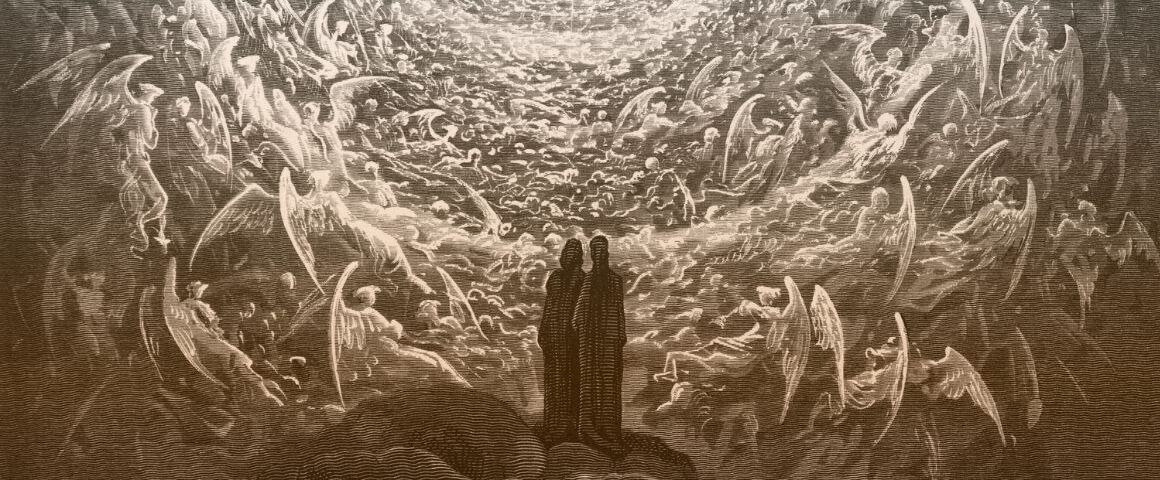
To recover that Christian world, we might begin with one of its greatest guides: Dante. He inhabited a cosmos that was moral, sacramental, personal, spiritual, and alive with divine significance. His world was not an escape from reality. It was an attempt to teach Christians how to perceive reality rightly.
If our problem is that we have forgotten how to see, then perhaps part of the recovery begins by learning again from those who saw more clearly.
The world itself has not ceased to be mysterious. The Christian task is not to manufacture that mystery. It is to learn how to see again.