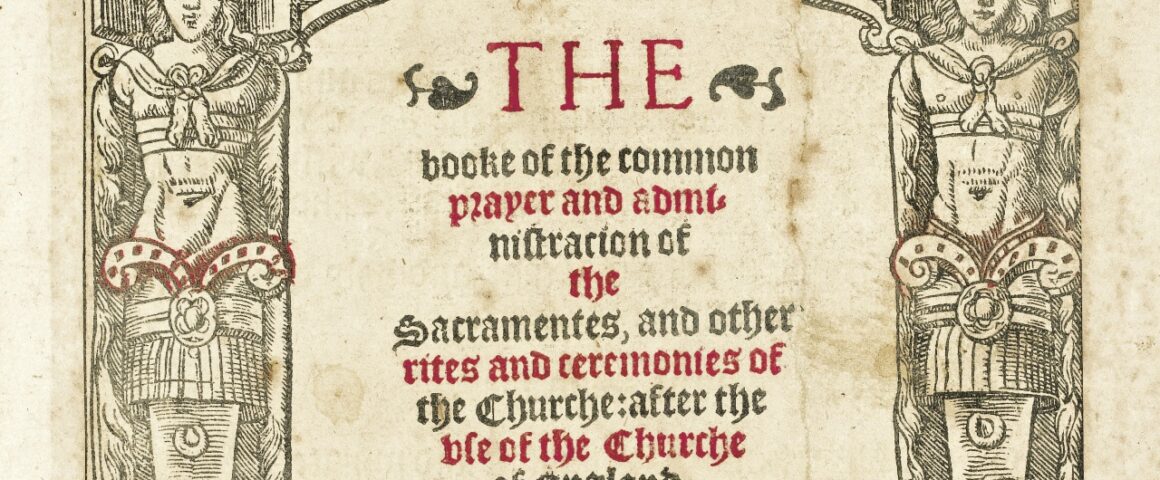
Pursuing Christ through the Prayerbook Life: A Catechetical Resource
North American Anglicanism has long faced an identity crisis. Anglicanism has reinvented itself into three streams, old catholicism, Presbyterianism with prayerbooks, etc. Trendy soundbites are the extent of the theology of clergy and laity alike, typically ranging from an ambiguous and muddy “via media” between Rome and the Lord-knows-what to “ancient worship, modern faith,” or worse. I would like to return to a phrase that commonly pops us but is useful in rooting ourselves upon a firmer foundation:
lex orandi lex credendi lex vivendi
This phrase can be translated as the law (or rule) of prayer (is) the law of belief (is) the law of life. It’s a succinct and helpful rubric for treading cautiously when creating new or amending old liturgies, rites, services, and hymns. The phrase in its original form dates back to St. Prosper of Aquitaine, a disciple of St. Augustine, who carried the fight against the Semi-Pelagians. St. Prosper argued over and against the Semi-Pelagians by citing and quoting not only Scripture and the Fathers, but also the very liturgy as proof of orthodoxy contra the heretics.
Therefore, what we pray is important. How we worship is crucial to our own formation. The Psalter warns us, if we worship idols, we become like them. The Scriptures warn that strange fire will kill. So when we approach our worship, we should approach in humility and rejoice that God communes with us and transforms us by His Spirit through the very words we pray every Sunday, Holy Day, and the daily offices.
But wait, there’s more! as the classic TV pitchman Billy Mays was prone to say. Our theology is found within every part of the worship we enter into. The liturgy is not the “work of the people,” it is the theology of the Bride of Christ, the Church. Every baptism, every wedding, and every funeral shapes us and forms us.
I recall a time when I was a new Anglican and in a new city, very early in my career. As a layman, my wife and I started attending an Anglican Province of Christ the King mission, meeting in the home of the priest. I was unfamiliar with the APCK and I asked the priest, “What do you believe?” He reached for his bookshelf, and extended to me a 1928 Book of Common Prayer. “Read this,” he responded, “and then we will meet and discuss.” I was a bit taken aback, but took him up on his offer. I read through and had many more questions regarding how to use and what certain rubrics and prayers meant. A few Sundays later, after service I asked him over coffee a couple of questions. “Did you finish reading it (the BCP)?” he inquired. I informed him I had. “Read it again, then let’s meet over coffee and discuss.”
I confess I laughed but then saw he was quite serious. I admit I was a bit peeved and wanted my questions answered, impatient young man that I was (now I’m just an impatient not-so-young man). However, after swallowing my pride, several days (a week?) later, I complied. It was refreshing, helpful, and clarifying to re-read the prayerbook in its entirety and this time have more familiarity with it in its entirety. Several questions were answered with a second reading. There were of course many more questions I had unanswered, but his point was made. What we pray is what we believe. By the time we sat down for coffee, my questions were each answered by turning back to the prayerbook.
Therefore, in order to find our identity as North American Anglicans spread across a diaspora of alphabet soup jurisdictions, how shall we find the center of our belief? Turn back to the formulary that is the prayerbook. Several years ago, I drafted a reading plan for ACNA users of the 2019 Book of Common Prayer. I wrote a couple of pieces meant for clergy and laity alike to utilize Lent to be catechized and re-catechized. I promised years ago to draft a similar reading plan for traditional prayerbook users, but life got away from me.
However, now more than ever, it is crucial to have a formulary reading plan – for clergy and laity alike. Modern language prayerbook users should, nay must, read through the classic prayerbook and formularies. We are in a crisis within Anglicanism, trying to invent and reinvent ourselves from the G2 continuum, ACNA, and at the international level with GAFCON and GFSA. Now is the time to orient ourselves upon common prayer. No, I hold no illusions that everyone will lay down their personal preferences on prayerbooks and simply use one Book of Common Prayer. However, if we all share a common heritage, common root, and profess to uphold the same faith in the Book of Common Prayer, 1662, then let us take up and read and pray and believe in the same catholic faith reformed by our English forefathers who rooted their faith upon the Holy Scriptures as received and understood by the ancient fathers and councils.
This new year, I encourage you to utilize the reading plan below as a way to be crafted by catechesis. Anglicans need to be united in their belief, for the world needs the answers provided in the prayerbook life. Anglicans need to cease from being disparate groups of babbling sects gathered around Babel’s tower, and unite in forming disciples within the parish and finding the lost sheep without the parish. People have questions, and we have answers – if only we would take up and pray!
Should you scoff at such an exercise, recall the following words from the Global Anglican Communion:
We, together with many other faithful Anglicans throughout the world, believe the doctrinal foundation of Anglicanism, which defines our core identity as Anglicans, is expressed in these words: The doctrine of the Church is grounded in the Holy Scriptures and in such teachings of the ancient Fathers and Councils of the Church as are agreeable to the said Scriptures. In particular, such doctrine is to be found in the Thirty-nine Articles of Religion, the Book of Common Prayer and the Ordinal. We intend to remain faithful to this standard, and we call on others in the Communion to reaffirm and return to it. (Jerusalem Statement)
Subscribers to the Jerusalem Declaration, which is printed in the 2019 ACNA Book of Common Prayer, remember Article 6:
We rejoice in our Anglican sacramental and liturgical heritage as an expression of the gospel, and we uphold the 1662 Book of Common Prayer as a true and authoritative standard of worship and prayer, to be translated and locally adapted for each culture.
The first article of the ACNA Constitution and within the 2019 ACNA BCP are the Fundamental Declarations of the Province, which hold in Article 6:
We receive The Book of Common Prayer as set forth by the Church of England in 1662, together with the Ordinal attached to the same, as a standard for Anglican doctrine and discipline, and, with the Books which preceded it, as the standard for the Anglican tradition of worship.
Likewise, in Article 4 of the Affirmation of St. Louis, the Continuing jurisdictions look to the last traditional prayerbooks of Canada and the United States, locally adapted from the lineage of the 1662 Book of Common Prayer:
In the continuing Anglican Church, the Book of Common Prayer is (and remains) one work in two editions: The Canadian Book of 1962 and the American Book of 1928. Each is fully and equally authoritative. No other standard for worship exists.
This year, be formed and re-formed through the ancient catholic faith enshrined in the traditional prayerbook. Contemporary prayerbook users, take heed of the standard and view your modern prayerbook and use it via the lens of the old common faith, the rooted and ancient common prayer of old. Afterwards, live the prayerbook life and pursue Jesus Christ. You will find that while you seek Christ, you will find lost sheep along the way who are also looking for their Master.
A Note on the Anglican Formularies Reading Plan
This PDF (Anglican Formularies Reading Plan) contains hyperlinks to the 1662 Book of Common Prayer, the Thirty-Nine Articles of Religion, and the Ordinal attached to the 1662 Book of Common Prayer for your convenience. I strongly encourage you to purchase a copy of the 1662 Book of Common Prayer and to use the reading plan, but I did not want the lack of a resource to prevent anyone from getting started. This reading plan is rooted upon all three formularies as they are the foundation of Anglican doctrine, practice, belief, and rule of life, as upheld across the centuries and reaffirmed by Global Anglicans in the Cairo Covenant (Section 1, 1.1(a)), Jerusalem Declaration, and locally by the Fundamental Declarations of the ACNA.
If you are a user of the 1928 Book of Common Prayer, I encourage you to revisit (or visit for the first time) its grandfather, the 1662 Book of Common Prayer. Nevertheless, you could use this reading plan for the 1928 BCP by simply using the titles for each day and reading the corresponding section in your 1928 BCP. At a couple of places, I did embed links for 1928 BCP resources, such as the Offices of Instruction and 1928 Catechism.
Additionally, I included the two Books of Homilies, as they are given authority by the Articles of Religion, and the American adaptation of the Articles did not dissent from their theology, but only wished to amend them (which never occurred) to fit the context of the American republic. Further, this reading plan includes Bishop John Jewel’s Apology of the Church of England, as it retained near official status in England and was required to be placed in every parish and was cited authoritatively by the 1604 Canons in justifying the use of the sign of the Cross in baptism. (Canon XXX). Using this plan will take up the better half of a year, clocking in at 194 days.
Finally, I included an appendix that merges my original reading plan tailored to the ACNA 2019 Book of Common Prayer and catechism, To Be A Christian, at the end. My desire for ACNA users is to utilize this entire resource by rooting yourself in the standard – the formularies – and then turn to the local adaptation. Utilizing the complete reading plan, including the ACNA appendix, will take up 250 days.
I have hyperlinked all required readings for ease of use, but encourage you to build your library as webpages come and go, because links eventually become broken. Therefore, invest in the traditional 1662 Book of Common Prayer and invest in your sanctification by taking up the common life and common rule of pursuing Jesus Christ through the prayerbook life.