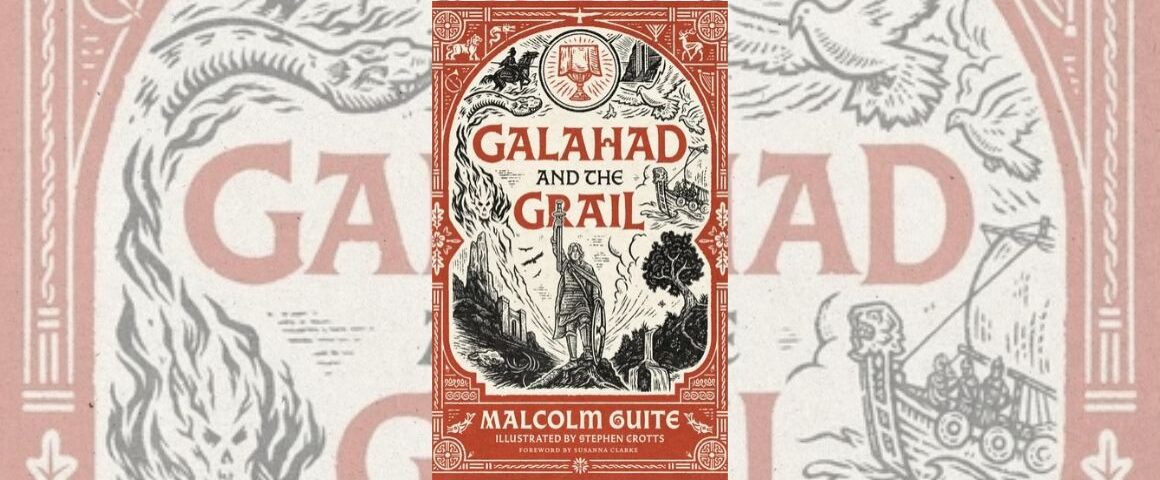
Galahad and the Grail. By Malcolm Guite. Nashville, TN: Rabbit Room Press, 2026. 357 pp. $34.99 (hardcover).
Malcolm Guite’s most recent book attempts two naïve ambitions for literature. The first is the naked audacity to add his voice to the long tradition of the Arthurian legendarium. Since Geoffrey of Monmouth and Chretien de Troyes, such has been the aspiration of great writers. Yet as the West became disillusioned with its own ideals and turned against its own beliefs, subsequent iterations of Camelot have tended less toward medieval narratives of moralistic self-examination like the Cistercian Queste de Sangraal (c.1225), the Nordic Saga of the Mantle (14th century) and the English Le Morte D’arthur (1485), and instead to the Jungian despair of Excalibur (John Boorman, 1971), the feminist revisionism of The Mists of Avalon (Marion Zimmer Bradley, 1981), and the surrealistic nihilism of The Green Knight (David Lowry, 2021). The further removed from faith, the more we have become enamored with tales not of flawed heroes but weak and decaying antiheroes, revealing not merely a stale vision of the past but a reflection of our own corrupt character. And Arthurian tales, if nothing else, are a reflection of culture. Why anyone would want to join his voice to such a chorus must be, to many, a baffling question.
Secondly, that Guite chooses to write his legend in narrative verse—and in a ballad stanzaic form, no less—reveals a writer entirely out of touch with his own time. Indeed, one feels as if he is reading a student of Chaucer or Tennyson rather than the proselike obscurantism in many contemporary poetry journals. This may give us some insight into his intended audience, who may be unfamiliar with poetry entirely, even if they admire its artistic sophistication at a distance. For at the same time as the West discarded faith, it also rejected the poetic forms that held together a literary culture. Yet it is through the grammar of verse that diction, rhythm, syllable, and sense recreate an auditory incantation and lead us toward transcendence. Guite explains in his several appendices to this text that his hope is “to make a poem that restores the spiritual elements that have been shorn away and renews their deepest meaning” beyond the “immanent frame,” what he calls “lifting the veil.”
Lifting the veil is one of the musical motifs dancing throughout Guite’s work, and it serves as the theme of his many appearances on his worldwide book tour. This is not just a clever phrase for storytelling; his purpose is to remove the obscuring veils of secular ideologies, cynical literary theory, and free verse poetry to help us remember our aesthetic and cultural heritage. His materials are magic, “as though some lovely long-lost spell / has made all new again” (Prologue ll.4-5), in a quiet echo of Christ’s words in Rev. 22:5. He sings in such an unusual but familiar strain, allowing us to breathe in the revivifying salt air of Logres’ ancient shores, spy spirits in the mist, and believe in something true beyond the flesh. Guite self-consciously lifts the veil of reality and guides us into the metaphysical world.
His subject, as the title suggests, is the Grail Quest. It is an unusual subject matter, not only because it is out of chronological order in the legendarium—the Grail Quest takes place soon before the disintegration of Camelot—but because it is the most explicitly religious iteration in an era where religious poetry, where it exists, is often more spiritualist than orthodox. The Grail Quest blends elements of Cistercian theology, Celtic mythology, and Gospel lore to continue the story of Christ’s kingdom made manifest on earth. Here, Guite follows the essential plot of the Queste de Sangraal and Malory’s Le Morte. Arthur and his knights are celebrating the Pentecostal Feast when a vision of the Grail appears. Against his better judgment, Arthur reluctantly approves his knights to find the cup of Christ, knowing that this act may save the Wasteland but will eviscerate Camelot. Each knight ventures forth, but only the Grail knights—those who are clean from lust—are permitted to see it. And only Galahad, untainted by the imperfections of the kingdom, is himself able to hold it and participate in the Eucharistic celebration. Many of the elements readers have come to expect are present—the Dolorous Stroke, Lancelot’s sin, the ship of Solomon—but Guite’s genius lies in recombining his source material, sharpening the blurry edges, and weaving a cohesive narrative that is accessible to the modern reader and still distinctly Christian. One of the challenges of interpreting the medieval texts is how they often describe murky events that even they do not seem to understand. How does the Dolorous Stroke occur exactly, and how does it create the Wasteland? By what means does Solomon’s ship arrive? Guite retells the ancient stories with new vivacity, adding heroines like Dindraine and developing paramours like Blanchefleur. He paints detail and color to the Grail knights’ individual adventures, where each story tells a self-contained myth with a moral message yet overlaps with each of the others. And whereas the Grail is a mysterious dish among many mystic objects in its first appearance in de Troyes’ Perceval (1190), Guite’s Grail is the cup of Christ that bodies forth the glorified Savior.
Much may feel foreign to the modern reader for whom industrialized Britain exists as a nation full of arcane traditions divorced from their Christian meaning. Yet even for the uninitiated, a familiar, and even comforting atmosphere evocative of Tolkien lays upon this book, with descriptions of moonlit, starry nights, with white light illuminating the sky. Nature is alive in Logres: the Naiad is the Spirit of the Stream (2.3.43-48), possessing “the wisdom of the woods” (2.2.141); the Grail knights respectively hold trees of Oak and Ash and Thorn, binding the wood and the characters together in common purpose; and the voice of Coleridge’s Ancient Mariner can be heard in axioms like, “He who cares for beasts / will care for men as well” (3.2.686-7).
The poetry is saturated in Christian chivalry, and its tone is theologically hopeful, illustrating a heartfelt trust that the Good will triumph because of the will of frail but honest men and women. For instance, when the Naiad fears she cannot find the iron key, Galahad admonishes her: “Draw deep from deep within yourself / the hidden flow and force—/ the wellspring of your inner life, / the Source behind the source” (2.4.225-28). His words lay bare the many layers of worlds conjoining in this polyvalent vision—the Logres behind Britain, the spiritual behind the physical, the divine behind the magic. Readers will recall the inspirational ethos of the knightly ideals they once believed in their youth. As Lancelot knights Galahad, the young boy confesses he heard a voice say, “Ride on for justice, Galahad, / through this dark world and wide. / Ride on for pity, Galahad, ride on to set things right, / and take your spurs at Pentecost / from Arthur’s bravest knight” (1.2.94-99). But, much as artists imagine a false past today, this is not some pseudo-civilizing exercise using religion as a feint for power. This Camelot is, much like its medieval forebears, a sacred place, eager to become the more sacred through the mystical presence of Christ.
Guite’s is a sacramental vision, one not only immersed in the medieval tradition of mystic relics but also one in which all things may become sacralized should an image of the Christ become present in the imagination. When Nacien shrives Lancelot, for instance, we see glimpses of grace available to all who would seek the will of God: “The very sin you most regret / may turn to good, if you will let / His Spirit work” (2.6.464-6). God may take human evil and make it good, which is the thesis of the book of Genesis (50:20), and even that of the entire Bible. The work of Christ is to free us to work and worship and achieve our own telos. As Bors says in the Epilogue, “The Holy Grail may come to us / on any Sabbath Day” (ll.117-18). Blending Catholic and Protestant traditions, Guite marries past to present and myth to modern life. He urges us to seek out the Grail like knights on a future-oriented quest, knowing the real presence in communion is available to us in the here and now.
Guite’s supposed naivete reveals, in truth, a visionary artist eager to reclaim the best of the past with hopes of restoring an imaginative future to the West. If we already know the tune, we know also that the story will lead toward its preordained end in the accomplishment of the quest and the translation of Galahad. This means, also, that we feel the impending sorrow of Camelot’s fall, and Guite, whose aspirations include three more volumes to the Merlin’s Isle saga, is composing a story to which we already know the conclusion. But it is the language that fills the story with new life and causes us to believe again. The problem is not that poetry no longer speaks to a post-Enlightenment world, but that we have lost the capacity to listen. Yet as he lifts the veil, we learn to enjoy the melody of verse again. To listen closely to this work of beauty is to give meaning again to those rituals that bind humanity to the earth, to remove us from our self-imposed mechanistic identities, and remind us of our mutual inheritance. To this, then, we may perhaps add a third ambition to Guite’s Galahad and the Grail: not only the revival of Arthur or of national poetry, but the re-enchantment of the cosmos.