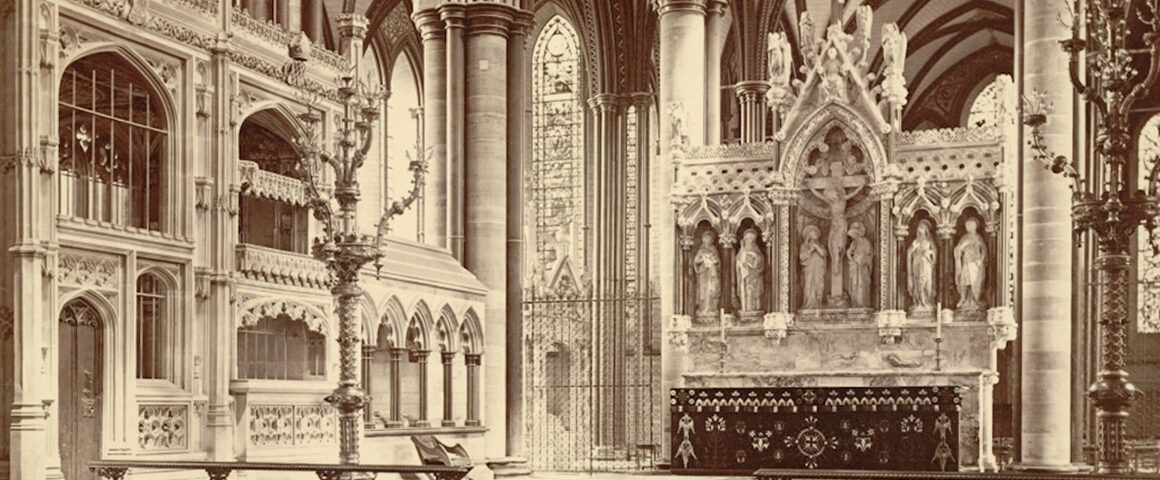
Before any law was given, before any liturgy was written, the light of nature taught man that God is to be worshipped, and that such worship requires a holy place. This instinct, grounded in natural religion, is one of the pillars upon which the Catholic tradition builds its sacramental and liturgical theology.
Natural religion, as affirmed by classical philosophers from Cicero to the Scholastics, is the knowledge of God and synderesis which arises from the light of reason, conscience, and creation. It does not depend on supernatural revelation but flows from what is accessible to all rational beings. It tells us that God exists, that He is worthy of reverence, and that man, by nature, must offer worship; not merely in spirit, but with concrete, visible acts.
In the 1630s, the Very Reverend Jeremy Taylor, later to become Bishop of Down and Connor, wrote a letter later published as On the Reverence Due to the Altar. Addressed to a colleague with Puritan and anti-Laudian convictions, this short but genius work was instrumental in my own Christian intellectual development. In it, I found a gateway to classical metaphysics, Thomistic hylomorphism, natural theology, Old Testament typology, and a rich Anglican sacramental theology.
One of the central themes of Taylor’s letter is natural religion. He reflects on how men, even without explicit command, have always erected altars and consecrated places for divine worship. In the Old Testament, we see the Patriarchs doing just this. After the flood, Noah builds an altar and offers sacrifice. Abraham, in various places and at various times, builds altars to God without being expressly commanded. Why did they do this? Because through the light of nature, man knows that God must be worshipped, and that true worship demands sacrifice. And where there is sacrifice, there must be an altar.
Bishop Anthony Sparrow, writing in his Rationale Upon the Book of Common Prayer (1684), echoes this very thought:
The Light of Nature taught Heathens thus much ; and they obeyed that Light of Nature, and dedicated and set apart to the worship of their God’s, Priests and Temples. The Patriarchs, by the same Light of Nature, and the guidance of God’s holy Spirit, when they could not set apart houses, being themselves in a flitting condition, dedicated Altars for God’s service, Genesis 22.9. 28.22. &c. Under the Law, God call’d for a Tabernacle, Exodus 25. within which was to be an Altar, upon which was to be offered the daily Sacrifice, Morning and Evening, Exod. 29.38. David by the same Light of Nature, and the guidance of the holy Spirit, without any express direction from God, (as appears 2 Sam. 7.7. and also by this, that God did not suffer him to build it) intended and designed an House for God’s service and worship…
Sparrow makes clear that even the heathen, following the light of reason, knew to set apart altars, temples and priests. The Patriarchs, inspired by the same light and guided by the Spirit, erected altars in a wandering and nomadic world. The altar was not an invention of Levitical law, but is a universal reality seen as a human response to the majesty of God, grounded in the order of nature.
Taylor, too, sees altars not merely as ecclesiastical ornamentation, but as expressions of a deeper sacramental reality. While materially made of wood or stone, altars, when consecrated, receive a new form. Here Taylor implicitly appeals to Thomistic hylomorphism, the view that all created objects are composed of matter and form. A table of wood or stone, once consecrated, takes on a new form: it becomes an altar. Its matter remains, but its purpose, orientation, and telos are transformed.
This is sacramental theology proper. Just as when the priest prays over the water at the font, the water receives a new form and becomes baptismal water; and when the words of institution are spoken over the bread and wine, they become the Body and Blood of Christ sacramentally. So too, when a table of wood or stone is set apart and consecrated for divine worship, it becomes something different in kind—a holy altar. The act of consecration reorients the object’s end to God. The formal cause of the object is changed, elevating the material to a divine and sacred function.
In Bp. Taylor’s letter, he explores the fact that both Scripture and nature teach that certain places are holier than others. Though God is the efficient cause of all things—upholding the universe by the Word of His power—He manifests His presence more clearly in particular places. Consider the Angel of the Lord appearing to Moses in the burning bush: “Draw not nigh hither: put off thy shoes from off thy feet, for the place whereon thou standest is holy ground” (Exodus 3:5). Or Solomon when he tells the Israelites that if they pray facing towards the temple, God will hear their prayers “If they pray toward this place, then hear thou in heaven” (1 Kings 8:35–36). Lastly, Jesus teaches us when we pray, to pray to the Father, “who art in heaven” (Matthew 6:9); a recognition of God’s special presence in a localized place.
Because altars and churches are consecrated to spiritual and divine ends, Taylor concludes they are holy and deserve our reverence. Therefore, bowing or genuflecting before the altar is not idolatry or superstition, but the proper bodily expression of an inward spiritual reality. Here, Thomistic anthropology aids us again. Man is a composite unity of body and soul. Worship, then, must be both interior and exterior. The soul informs the body, and the body gives visible expression to the soul’s devotion. Our gestures and movements in sacred space are not by mere fiat; they are the necessary outworking of our nature as embodied worshippers.
In bowing or genuflecting before the altar, we do not act out of empty ritual, but fulfill what our very nature demands; that worship necessitates the whole man, body and soul. If reason teaches that God is to be worshipped, then reason also teaches that the place of worship is to be reverenced by virtue of God’s special presence. Jeremy Taylor’s On the Reverence Due to the Altar is not simply a defense of ceremony. It is an explication of human nature, rightly ordered toward God.
“O worship the LORD in the beauty of holiness; *
let the whole earth stand in awe of him.”
—Psalm 96:9
Image Credit: Cornell University Library