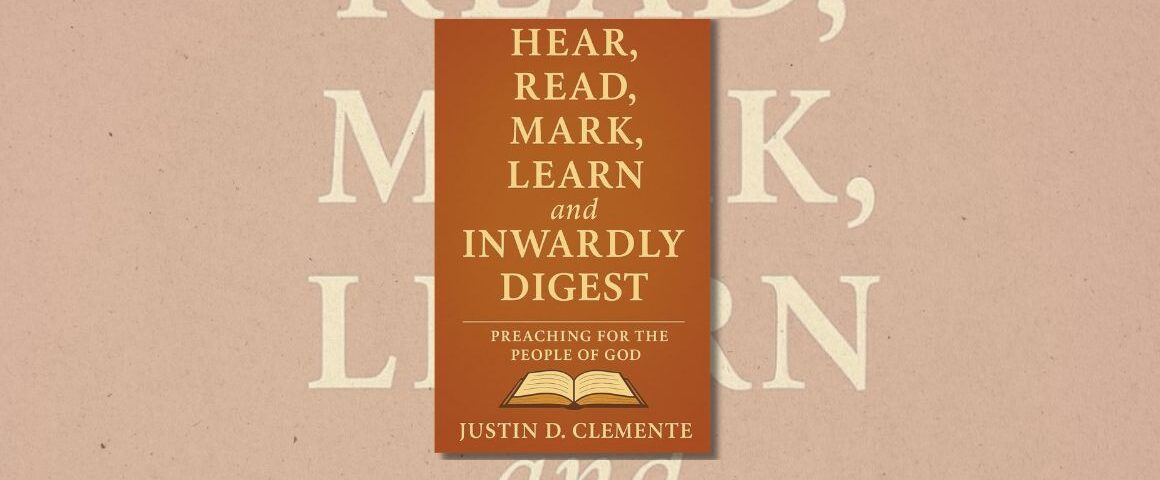
Hear, Read, Mark, Learn and Inwardly Digest: Preaching for the People of God. By Justin D. Clemente. Self-Published, 2025. 89 pp. $9.99 (paper).
No one can doubt that the sermon or homily is an important part of Sunday worship. Some traditions emphasize it more, and some emphasize it less. In our own Anglican tradition, we even have an official set of sermons in the Two Books of Homilies from the time of Edward VI and Elizabeth I, enshrined in Article 35 of our Thirty-Nine Articles of Religion. Those who are clergy almost certainly took at least one class on preaching and likely have at least one volume in their libraries with tips on how to preach, such as the venerable Steps to the Sermon by Brown, Clinard, Northcuff, and Fasol. Beyond our official Books of Homilies, it has long been a common devotional practice to read published homilies, whether historic homilies, such as those of Augustine, Chrysostom, John Donne, or Charles Spurgeon, or those from a favorite modern pastor such as Timothy Keller.
Much rarer are books aimed at the laity on how to receive preaching. The Rev. Justin D. Clemente, associate pastor of Holy Cross Cathedral in Loganville, GA, has stepped in to fill that gap with his new book, Hear, Read, Mark, Learn, and Inwardly Digest: Preaching for the People of God. Regular readers of The North American Anglican or Anglican Compass may be familiar with Clemente’s writing; he is a regular contributor to both online journals and has published an earlier book, At the Cross: Reflections on the Stations of the Cross, through Anglican Compass.
Hear, Read, Mark, Learn, and Inwardly Digest gets its title from the Prayer Book’s collect for the second Sunday in Advent, composed by Archbishop Cranmer. The collect has led to Advent 2 often receiving the nickname “Bible Sunday.” In using this collect as the inspiration for his book title, Clemente shows that he sees the primary purpose of the sermon to be an aid in knowing the Bible better. That is, he sees the sermon as primarily about exposition of the Scriptures. To that end, the goal of Hear, Read, Mark, Learn, and Inwardly Digest is to help the hearer of a sermon know the Bible better through active and effective listening to the sermon.
The book is framed as a case study on five sermons from the Bible itself. Through these case studies, Clemente points out an aspect of effective preaching for which the hearer of a sermon can be on the lookout. Two of the case study sermons are from the Old Testament, and three are from the New Testament.
The first case study is from the prophet Ezekiel’s preaching to the valley of dry bones in Ezekiel 37. In this chapter, the focus is on the spiritual power of the preached word. The second case study is based on Moses’ address to the Israelites prior to entering the Promised Land from Deuteronomy 4. In this he focuses on the primacy and importance of the preached word. The third case study is on Jesus’ teaching to the two companions on the Road to Emmaus in Luke 24 and focuses on the Christocentric story of the Scriptures and preaching. The fourth case study us on Jesus’ lesson to Nicodemus in John 3 and focuses on the Trinitarian nature of the Scriptures’ story and preaching. Together, the two case studies from Jesus’ teachings are combined into a theme of the Story of Scripture. The final case study is on Paul’s sermon to the Athenians in Acts 17 and discusses the countercultural nature of preaching the word.
In each of these case studies, Clemente points out various aspects of preaching that he sees as essential to a proper biblical sermon. Since the book is aimed at the laity who are hearing the sermon, the focus is less on creating a sermon with these aspects than listening for these aspects as one hears the sermon. By tuning the ear towards these biblical themes, the one who hears the sermon will be more apt to hear God’s voice speaking through the preached word. Nevertheless, for those of us who are regular preachers, keeping these aspects in mind will help us write better homilies.
As a longtime preacher who has also helped coach new clergy in preaching, I probably would not choose Clemente’s fourfold focus of “power, primacy, story, and strangeness” as the preacher’s rubric. Nor is it a rubric for what to listen for when receiving a sermon. However, it is a helpful rubric for understanding the nature of preaching.
For example, when considering the power of preaching, we must realize that our default position is spiritual deadness, and we need life from God to hear from him. As Clemente writes, “And here is the thing we can’t miss: every sermon from God’s Word meets this same spiritual deadness” as we see in the dry bones of Ezekiel’s vision (18). One implication of this that a sermon that didn’t “speak to me” may be more about my heart’s unreadiness to hear from God than about the sermon itself!
Or perhaps reading the Bible and hearing biblical preaching may seem boring or overly familiar because we forget that God usually works through those ordinary means of grace rather than in dramatic spiritual experiences. “At the center mark of every ordinary, faithful, Christ seeking life is the Bible” (34). Perhaps we need to humble ourselves and remember that willingly being “under godly preaching is an effective antidote to the greatest god of our age: oneself” (36).
These are just some of the gems that are to be found in Hear, Read, Mark, Learn, and Inwardly Digest.” The only criticism I found was that there were a number of typographical errors in the text; Clemente could have used at least one more set of eyes in editing the book. Nonetheless, these errors were not distracting from Clemente’s points or his pastoral tone. It was indeed a joy to read this love letter to biblical preaching. I highly recommend Hear, Read, Mark, Learn, and Inwardly Digest.