A Defense of Sacred Images and Their Veneration
When I first began this “trilogy” of articles on images I was sitting in my local coffee shop. I now find myself beginning to write this final installment in a local brewery which was converted from an old church. While there aren’t as many logos surrounding me as there were in that coffee shop two years ago, there are some stained-glass windows here—so I suppose all is well and remains fitting to the theme. In my first article, I argued for the metaphysical “logic” behind images and why they are what they are, and how they direct our minds toward contemplation of the divine. I hinted in the conclusion of that piece that another article would be needed to tackle the objections raised against images and their veneration. My second installment was not that, but instead took a different (albeit tangentially related) direction by applying the same metaphysical foundation laid in the first article to subject of biblical interpretation. I argued that, much like how images direct us to things outside of themselves, the text of Scripture likewise invites us to look beyond and deeper (but never at the denigration of) its literal meaning. Now, after two years, it is my hope and aim to be able to tie all of these pieces together and tackle common objections raised against sacred images and their veneration. I would strongly encourage reading both previous articles because although I will explain some of what I have previously put forth below, much of it will be assumed in order to save space.
Common objections usually fall into two categories. The first is objections against sacred images wholesale. Here we can find a division of arguments, principally against sacred images of our Lord, which fall under prohibitions against depicting the divine nature and the alleged necessity to represent in a photo-realistic sense the person being depicted. The second category of objections focuses on the veneration of images. For many, including some critics of the Second Council of Nicaea, images themselves are fine but they have difficulty in finding warrant for venerating sacred images of our Lord or of His Saints, often resorting to passages condemning the worship of idolatry. For some of these objectors, the distinction made between veneration and worship (or, dulia and latria respectively in the Greek) is fine, and for others they see no real difference between the two which would warrant a distinction. It is my aim to consider each of these objections, and those subcategories which fall under the main headings, and provide a substantive answer in defense of the doctrine put forth by the Second Council of Nicaea.
The Second Commandment: Defining Worship
We are told by our Lord through Moses that “Thou shalt not make thee any graven image, or any likeness of anything that is in heaven above, or that is in the earth beneath, or that is in the waters beneath the earth. Thou shalt not bow down thyself unto them, nor serve them: for I the Lord thy God am a jealous God, visiting the iniquity of the fathers upon the children unto the third and fourth generation of them that hate me, and shewing mercy unto thousands of them that love me and keep my commandments.”[1] This is often the go to passage for those who would oppose both the making and veneration of images. For many, this passage settles the entire debate. I will confess, I too once thought that was the case. However, I don’t believe the apostolic traditions which have upheld the Nicene doctrine of images were ignorant of this commandment. I would like to examine this passage further, and consider how it applies to the Church’s teaching on this matter.
First, we see an interdiction which forbids the making of images that bear the likeness of anything which is in heaven, on earth, or in the waters below. This would presumably leave us with permission to depict something that is immaterial and outside of our visible sense—so perhaps something abstract and without a visible form, like love or wisdom. But, how could we circumscribe (draw a line around) and make present to our visible sense that which is understood only by the intellect? We cannot—at least not without the use of visible forms, which, by this understanding of the commandment, would be prohibited. So, unless we should fall into absurdity, we recognize that the command itself is not an absolute prohibition against the making of any image, but only in a qualified sense.[2] We read further that the distinction between lawful and unlawful images is whether or not one was to “bow down” to worship the image. In the English language there is a range of meaning behind the term “worship,” and context is vital to understanding the difference. This is similar to the word “prayer” as well. To pray may mean simply to ask something of someone; or it may mean to direct a form of religious adoration and dependence toward God, seeking some action that could only be accomplished through His own power, pleading upon His supreme goodness and love. But we cannot equivocate here, lest we accuse lawyers across the country of idolatry for “praying” to judges and courts. Similarly, with the word “worship” we mean quite simply an ascription of honor. We distinguish between differing degrees of honor stipulated upon the inherent worth of the subject this act is being directed to. At the highest end of this spectrum is the worship due to God alone, of which it is unfitting, blasphemous, and idolatrous to give to any creature. Below this are varying degrees of honor given both to God and creatures for a multitude of reasons. We ascribe honor to our mothers and fathers more than we would to a random stranger on the street, yet we ascribe more honor to that stranger than we would to a stray dog on the side of the road. Even further than that, we ascribe a certain kind of honor that is greater, in a particular sense, than that which we show our parents toward judges and high ranking officials in our country. In our own Prayerbook, the Husband vows to “worship” his bride. None of these lesser forms of “worship” are what is in view here in the second commandment. This much is obvious for one reason. In the commandment itself we are informed what kind of “worship” is in view: “for I the Lord thy God am a jealous God…” What else could be in view but the worship that is due to God alone? Why would divine jealousy be invoked if not because God is being deprived of what is rightfully His alone? Some may claim that the act of “bowing down” denotes this kind of worship. I will grant that, in this passage of Deuteronomy and others, the term used for “bow down” does refer specifically to this highest form of worship. However, I do not think this alone suffices to demonstrate that every act of bowing is therefore connected with this highest form of worship. This act is shown to be accepted, and rejected by angels and men depending on the context. I am aware there are arguments based on the specific words used in each example; however just as there is ambiguity with the English words employed, there likewise is a degree of flexibility with words used in Scripture which do not always fit our dogmatic and systematic theological definitions as tightly as we would prefer. So I am not worried that one word may be accepted in one instance, and rejected in another; rather I think the context surrounding the word better aids us in understanding what is in view. This is echoed by Scottish Presbyterian Edward Mason in his work “An Apology for the Greek Church,” who notes that these terms exist in a range of degrees and that context must determine the meaning of any given use.[3] Therefore, the invocation of divine jealousy coupled with the act of bowing down suffices to demonstrate what kind of worship is in view here in this commandment. Clearly then we see that the commandment given here by our Lord through His servant and friend Moses is against the creation of images for the purpose of worshiping them as, or in the place of, God—and not against the making of images in an absolute sense.
Another objection that might arise is the addition of “nor serve them” after the prohibition to worship such images. Some might grant that we are not to worship images and agree with what I have put forth above, but would nevertheless argue that this commandment also prohibits showing honor or veneration toward images as well. I do not think this is the case, but first let us grant their argument and consider whether or not it would preclude venerating sacred images. Under this argument, we recognize that the context forces us to say the images in view are not sacred images, but profane idols. With that context in mind, I think the answer is quite obvious why the Lord would prohibit us from showing honor to idols. An image points us to the one it depicts, and the referent of an idol is a false god, or demonic spirit. There is nothing worthy within a demonic spirit that would warrant our veneration and since veneration is an act of civil or relational piety, it would necessarily mean that we are having some kind of fellowship with the demonic. We are the children of light, and are to have no fellowship with the darkness of the demons. In giving them honor, we would be saying that they are honorable. The contradiction is stark. To show honor to one whose entire existence is that of vice and malice is to promote and declare that what is evil, false, and ugly is actually good, true, and beautiful. This is absurd. Further, since we are instructed by the good example of David in Psalm 138:2 to “bow down toward thy holy temple,”[4] which is a kind of sacred image, we can see that even under this argument that showing honor and veneration toward sacred images are not prohibited in the Second Commandment.
Now, as I noted at the start, I do not think that the inclusion of “nor serve them” is a prohibition against showing honor toward images. Rather, I think that “Thou shalt not bow down thyself unto them nor serve them” has in view not two separate things, but only one—namely, that we are to give only to God that highest kind of worship. One example is when our Lord cites Deuteronomy 6:13 in Luke 4:8, saying “Thou shalt worship the Lord thy God, and him only shalt thou serve.” The context in Deuteronomy is clearly about not giving divine worship to idols (v.14), lest the Lord spew the Israelites out from the promised land. In the Gospel, our Lord is battling the father of all idols and lies, Satan himself, who tried to tempt our Lord into giving him divine worship. That “and him only shalt thou serve” is a further emphasis on not worshipping idols rather than a separate prohibition on venerating images is clear from the numerous places in Scripture where we are commanded to honor one another, and the examples where honor is shown toward sacred images such as the temple.
But one may still object and argue that images of God are likewise condemned when Moses prohibits images of “anything that is in heaven above” since God is in heaven. Further this rebuttal is seemingly strengthened when considering our Lord’s warning: “Take ye therefore good heed unto yourselves (for ye saw no manner of similitude on the day that the Lord spoke unto you in Horeb out of the midst of the fire), lest ye corrupt yourselves, and make you a graven image…”[5] Here an additional reason is given for the Israelites not to create an image: on the day they were visited by the Lord on Horeb, they saw no form or manner of similitude wherewith they could depict God. Our Lord is after all, as St. Paul says, “the image of the invisible God,” and that Jesus is “the express image of his person.”[6] The divine nature is itself invisible, and therefore the manner in which the Son images the Father is not in a fashion that we can sense with our eyes.[7] Further, St. John tells us that “God is a spirit,”[8] and spirits are immaterial and thus not present to our visible sense unless they take upon themselves a certain visible form (as the Angels are accustomed to do, and as our Lord did when visiting Abraham.[9] To return to the objection set forth above, we must grant that under the old law God did prohibit images of the Godhead particularly because there was no visible form or similitude by which we could represent Him. He, according to the divine nature, is uncircumscribable. I will address this particular objection in more detail below.
What then would it mean for the Israelites then to “corrupt [themselves]” in making an image? As we noted previously, this is not all images per se, because they did not act corruptly in making images of pomegranates or cherubim for use in the temple. Therefore, it specifically relates to images seeking to depict the Godhead.[10] To do so through the use of a visible form, at this point in history, would be to falsely ascribe something to God, and would therefore not be a “true” image. Our answer is further informed in verse 19 of the passage cited above: “and beware lest you raise your eyes to heaven, and when you see the sun and the moon and the stars, all the host of heaven, you be drawn away and bow down to them and serve them…” Once more we see that what makes images corrupt someone is when they turn to give that image (whether made by hands or a creature made by God—for both are “images”) the worship due only to God, especially when that image speaks something false about God. This is clear because simply to honor someone does not corrupt a person, but only when one perverts the creature by giving that which is due to God alone to something other than God.
Finally, we must consider the objection that an image of Christ must depict Him with photographic realism in order to be a true image. Inasmuch as an image depicts the likeness of it’s archetype, it shares the form and name therewith and can be identified with the archetype. The way in which we understand names is of special importance here. We need not have a photo of our spouse to recall them to our mind—their name alone suffices to inform our memory of them. In order for an image to be a “true” image, it must communicate this identification with our memory of the archetype which bears that name and likeness. An image of Christ, then, in order to be a “true” image need only to communicate information to us about His person. It is also important to note that, even from the Iconoclast side, the name of Christ does not denote any specific physical traits, but only the truths revealed about His person. Since the name “Christ” denotes the two natures of Our Lord, His likeness or form need only depict our Savior under the form of Man in order to be a “true” image.
The Circumscribable God: Christological Heresies
As I discussed in the first article, the entire “logic” behind images is rooted in the Son’s eternal imaging of the Father. This imaging is principally an invisible one—namely, it is not one that is immediately present to our visible sense. However, in the incarnation this imaging has indeed taken upon itself a real and sensible manifestation. We are told in St. John’s Gospel that “No man hath seen God at any time: the only begotten Son, which is in the bosom of the Father, he hath declared him.”[11] Further, Our Lord tells St. Phillip that “he that hath seen me hath seen the Father.”[12] As noted above, the old law forbade images intended to depict the Godhead and gave the reason for this as when he appeared at Horeb, the people of God saw no form or similitude by which the He could be represented. It seems then that after the incarnation, God is now circumscribable. But how is this? Is this not a contradiction? This is where I believe St. John of Damascus’ defense of sacred images comes to the forefront. As the Damascene argues, this prohibition is no longer the case (at least for the hypostasis of the Son of God) because of the incarnation. For it is in the incarnation that the uncircumscribable God has put on our mortal flesh and has taken upon Himself the form of humanity. He who is invisible now has been “seen with our eyes, which we have looked upon, and our hands have handled…”[13] We will now consider this defense against the accusations of alleged Christological heresy as it pertains to images of Christ.
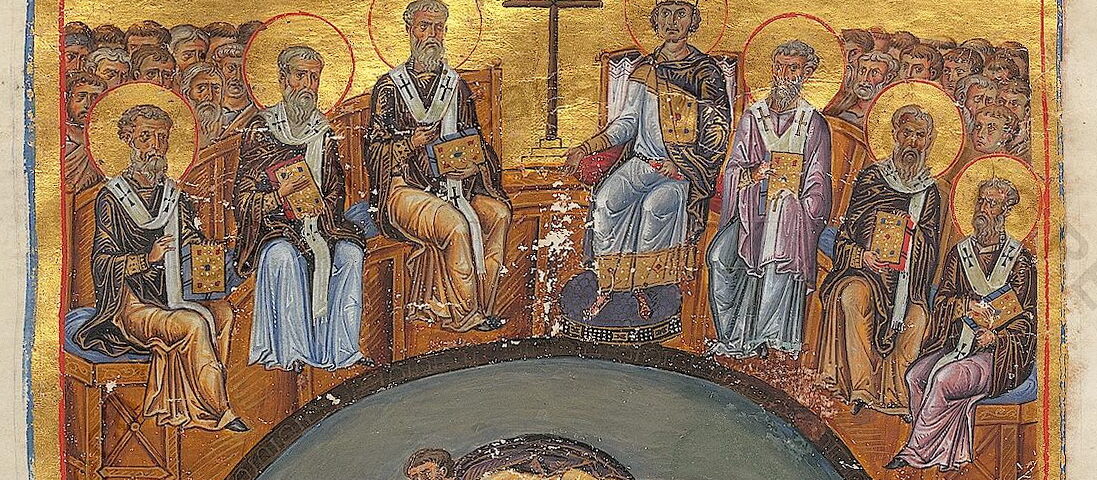
As the Iconoclasts argued in their conciliabulum (convened in 754 AD), to depict Christ in His humanity was to err into one of the Christological heresies condemned by the earlier ecumenical councils.[14] In response to this, the Second Council of Nicaea argued that to deny the lawfulness of images of Christ was to deny the reality of the incarnation. Here are the words of the decree made by the Second Council of Nicaea: “To make our confession short, we keep unchanged all the ecclesiastical traditions handed down to us, whether in writing or verbally, one of which is the making of pictorial representations, agreeable to the history of the preaching of the Gospel, a tradition useful in many respects, but especially in this, that so the incarnation of the Word of God is shewn forth as real and not merely phantastic, for these have mutual indications and without doubt have also mutual significations.”[15]
In what way then does the making of images set forth the incarnation as real? In opposition to docetististic implications, Christ did not merely appear to be a man but really and truly became man. We just previously considered and conceded that under the old law, God had prohibited depictions of the divinity because no form or manner of similitude had been seen by the Israelites. One may object and recall the previously referenced instance where our Lord appeared to Abraham and state that because our Lord appeared as a man, that therefore we could depict Him under such a form. However, at that time this was just an appearance and it would still be false to say that God had the form of a man. In the incarnation, however, this is no longer the case. He who is unable to be circumscribed has assumed the form of a man, really and truly and not merely in appearance. It is now a true statement to say that God has become man, and therefore depictions of Christ are lawful because no misrepresentations or falsities are being ascribed to him. We are now able to attribute circumscription to God in a manner similar to how we can attribute hunger, thirst, and even death to God in light of the incarnation. Yet the iconoclasts did not seem to have any disagreement with granting circumscription to our Lord. After all, the Gospels are filled with examples where Christ is in one location and not another, where he hungers and thirsts, where he is touched and heard. All of these are in some way limiting God. So then it seems that perhaps the real area of disagreement has to do with the way in which we attribute this to God, and how images relate to the person of Christ.
It is important to consider further what merit these accusations of Christological heresy may have, since many of these same arguments are raised today, and because I think the Iconoclast position has to assume a heretical notion of the hypostatic union. The Iconoclasts said that to depict Christ in an image was to fall into the errors of “Arius, Dioscorus, and Euthyches”[16] amongst others, because the divine nature is invisible, without limit, and therefore unable to be depicted. First, we should note that the fathers at the Second Council of Nicaea rightly recognized the ignorance of equating these heresies. Arius and Euthyches do not agree in their error, and therefore cannot equally apply to whatever alleged error images may have. The error of Arius was to deny the divine nature of our Lord, and the error of Euthyches was to posit a fusion or mixture between our Lord’s two natures.
Here, it is important to distinguish between “nature” and “person.” We do not depict natures—for all natures are invisible just as the soul of a man is invisible to our eyes. Rather, we depict the person of the eternal Logos who really and truly became man. The form of man is visible and therefore able to be depicted. It is no more a failure to depict the divinity of Christ than it is a failure to depict the soul of a man when he is painted. If we recognize in the latter example that the person is represented without fault, then so too in the former. The Iconoclasts further argued that if one takes recourse to say that only the flesh of Christ is depicted, they fall into the error of Nestorius.[17] The assumption here is the same: If you can only depict the flesh of Christ then you are separating His flesh from the Godhead. This accusation, however, is faulty because only that which is visible can be depicted, and the divinity qua divinity is always invisible, without limit, and uncircumscribed. Taking the above example of a portrait of a man, no one in their right mind would look at the painting and say “this is only the body of the man, and not his whole person.” Rather, we rightly discern the unity of the person. We can distinguish in concept between what is visible and invisible without necessarily separating the two in reality.
This is where the Christology of the Second Council of Nicaea comes to bear forcefully upon the objections of the Iconoclasts. According to the Iconoclasts, to depict Christ at all is to fall into heresy—either in dividing the natures, giving the humanity of Christ it’s own hypostasis, or admitting some kind of mixture or change within both natures. However, as noted above, these objections fall flat because we are not depicting the natures but the person, or hypostasis, of Christ. St. Theodore the Studite (759 AD) is helpful here. In arguing against Iconoclast objections, he replies to this objection as follows: “In the same manner therefore, you should know that it [the Godhead] also had remained uncircumscribed in being circumscribed.”[18] Torstein Tollefsen, professor of Philosophy at the University of Oslo, unpacks the Studite’s argument in this way: “Theodore clearly states that there is an aspect of the Son of God that is uncircumscribed even in the incarnate condition, viz. the Godhead as such. There is no confusion of natures as a tertium quid that reduces the divinity into something changed into a creature.”[19] The Iconoclasts want to maintain the uncircumscribability of the Godhead, and the Iconophiles want to uphold that Christ, in the incarnation, really was circumscribed. The Studite’s answer satisfies both sides, and provides a Christologically sound solution to the objections.
Further, as I alluded to at the start of this section, I believe that the Iconoclast arguments are reliant upon a heretical Christology. Each of their arguments seem to depend upon some presumed mixture between the two natures, resulting in a form of Monophysitism wherein it is assumed that an image of Christ must necessarily depict the divine nature. Yet, the Iconoclast appeals are contradictory. Either you must depict the divine nature lest you separate the two, or you cannot depict the divine nature and therefore cannot depict Christ according to His humanity. On the one hand we have a divine nature which is so mixed with the human that it now can be depicted, such that to fail to do so is to separate the natures. This assumed that the divine nature has now taken on the attribute of circumscription. On the other hand, we have a human nature that is so mixed with the divine that Christ’s humanity has ceased to possess circumscription, and now is infinite. Both sides are obviously wrong, and implicitly deny the incarnation of our Lord as professed by the councils of the Church.
In upholding the reality of the incarnation, the Second Council of Nicaea upheld the Apostolic faith handed down throughout the ages. Some may object and say that there are no records in the New Testament writings that show images being made or appointed a place of privilege in the Church, but this objection is irrelevant.[20] If the lawfulness of images is an implication of the incarnation, then only the reality of the incarnation needs to be proved, since the implication is derived from the premise. If the lawfulness of images is implied by the Incarnation, we do not need to demonstrate that the Apostles made images or had them commissioned in order for the teaching to be Apostolic—We need only to demonstrate the implication is valid. For Christ to be incarnate necessitates that He is circumscribable. Therefore, images are lawful because, though they were prohibited under the Old Law due to the absence of a form by which God could be circumscribed, after the Incarnation, we now have such a form. To prove the contrary one would need to disprove the premise that in the incarnation Christ was circumscribed, but in doing so they would unravel the faith of the Apostles.
We see then that to argue from the old law that images of Christ are prohibited would be a return to the yoke of the law, and a denial of the incarnation since it denies a necessary consequence (that He who is uncircumscribable is now also circumscribable). In short, to prohibit images as the Iconoclasts would have us do is nothing short of Judaizing the Christian faith—seeking to return to the letter of the law, burdened with it’s unwavering strictures, neglecting that there are genuine components of the law that have been changed in the advent of our Lord. I will conclude this section with St. John of Damascus’ vivid warning: “If, because of the law, you prohibit images, watch that you keep the sabbath and are circumcised; for these the law unyieldingly commands. But know that if you keep the law, ‘Christ is no use to you; you who would be justified by the law, have fallen from grace.’ Israel of old did not see God, ‘but we, with unveiled face, behold the glory of God.’ ”[21]
To Venerate or To Worship?
Now that it has been established that images are lawful, we now must turn our attention to the equally contested point of veneration. As I noted above, there is ambiguity in the English words “pray” and “worship,” which have caused confusion for many today. Henry Percival notes this confusion in his introductory notes on the Seventh Ecumenical Council, and I will quote him at length: “The Greek language has in this respect a great advantage over the Hebrew, the Latin, and the English; it has a word which is a general word and is properly used of the affectionate regard and veneration shown to any person or thing, whether to the divine Creator or to any of his creatures, this word is προσκύνησις ; it has also another word which can properly be used to denote only the worship due to the most high God, this word is λατρεία. . . . But unfortunately, as I have said, we have neither in Hebrew, Latin, nor English any word with this restricted meaning, and therefore when it became necessary to translate the Greek acts and the decree, great difficulty was experienced, and by the use of ‘adoro’ as the equivalent of προσκυνέω many were scandalized, thinking that it was divine adoration which they were to give to the sacred images, which they knew would be idolatry. The same trouble is found in rendering into English the acts and decrees; for while indeed properly speaking ‘worship’ no more means necessarily divine worship in English than ‘adoratio’ does in Latin . . . yet to the popular mind ‘the worship of images’ is the equivalent of idolatry.”[22]
In seeking to maintain clarity, in this section I will only use “worship” to denote that which is due to God alone, and “reverence,” “venerate,” and “honor” as those lesser forms due both to God and to his creatures. E.L. Mascall, preeminent Anglo-Catholic theologian, beautifully highlights the key distinction in this way: “It is not simply that his creatures owe him gratitude for his love in creating them, though this is, of course, perfectly true, but his own nature, what he is quite apart from what he does, is supremely worthy and so supremely worshipful.”[23] The worship we owe to God is not fundamentally rooted in anything he has done for us—neither our creation nor our salvation are what demand our worship—but rather the very being of God, that supreme and sublime holiness of who He is, requires it. These acts of God give us further reason, but they are not the why behind our worship. There is no creature made by God which can compel us to such an act of worship in and of their own inherent worth and splendor. Not even the angels above have such beauty that is worthy of the adoration and worship due to God. In contrast, however, I have already made mention of the varying degrees of reverence and honor which we owe to various creatures. Parents are owed a degree of honor and veneration from their children; kings and judges from their subjects, etc… This is why the Second Council of Nicaea at various points, both throughout the acts of its sessions and in its decree, painstakingly distinguish between the honor given to God and creatures, and that worship which is due to God alone. In session three, we read from Constantine, bishop of Constantia saying “I consent and become of one mind, receiving and saluting with honour the holy and venerable images. But the worship of adoration I reserve alone to the supersubstantial and life-giving Trinity.”[24]
I do not wish to belabor this point too much, but it is important to stress that the fathers of the Second Council of Nicaea repeatedly emphasized this distinction and complained that their critics conflated these categories. One more quote will suffice, and I will quote at length from the Council’s sixth session: “Next they (the Iconoclast’s of Hieria) assimilated the relational veneration of honour to the divine worship and veneration that Christians preserve in a true and pure faith. They distort these two realities, which is why they are called, and are, accusers of Christians. For they say that Christians offer the veneration and worship due to God to the sacred images and that they [thereby] subject to limitation the incomprehensible divine nature. For reason has no scope here, but their words are full of slander and calumny. … Knowing that ‘God is Spirit and those who venerate him must venerate him in spirit and truth’, they offer the veneration and worship of faith only to the one who is God over all in the hymned Trinity. As for the divine figure of the cross and sacred images, we kiss them and pay them the veneration of honour out of desire and longing to ascend to their archetypes.”[25] We honor the Saints principally because they are the friends of God who, through their faithful endurance in this life, have obtained a greater share in Christ’s holiness and grace. Their holy lives serve as an example and pattern for us to follow, and in imitating them we imitate Christ within them.[26] While it may be uncontroverted that we are to honor the Saints, the argument for why we honor and venerate their images still needs to be made.
The “Logic” of Veneration
In the fourth session of the Second Council of Nicaea we are given one of the most practical reasons for why we venerate images of the Saints; it is “So that through their representations we may be able to be led back in memory and recollection to the prototype, and have a share in the holiness of some one of them.”[27] There are a few things of importance to note here. First is the relation between the image and the one depicted. It is common to hear sacred images viewed as “windows” through which we come into contact with the one depicted. Some may take issue with this, and perhaps some of the language employed in talking about this may sound magical; but it does not need to be so. This is where I find St. Maximus the Confessor’s use of the relation between the logoi and the Logos most instructive. Because the logoi “link” back to the eternal Logos, there is a relationship between the two: “Moreover, the many (logoi) are directed toward the One (Logos) and are providentially guided in that direction. It is as though they were drawn to an all-powerful center that had built into it the beginnings of the lines that go out from it and that gathers them all together.”[28] I think we can follow the same lines here as it pertains to the image and its prototype since these underlying logoi serve to establish the forms of each creature. If we were to begin with an image of St. Maximus, we could follow the underlying logoi of that image back to St. Maximus himself, and from him back to Christ, the eternal Logos. Inasmuch as that image of St. Maximus represents him, there is a unity between the two (the image and archetype). To provide further evidence for this, the fathers at the Second Council of Nicaea argued, from St. Athanasius, from the nature of reality that there is a unity between the archetype and it’s image through a shared form. From the fourth session of the Second Council of Nicaea, quoting St. Athanasius we read, “For in the image is the form and figure of the empower, and in the emperor is the form in the image.”[29] Thus, from this underlying unity, the fathers commonly argued that the honor or veneration paid to the image passes over to the archetype.
We see this idea put forth when our Lord tells us that the honor and good deeds we show, or withhold, to others is done, or withheld, from Him.[30] Therefore, if the honor or reverence shown to the image (living or painted) passes on to the prototype (the person depicted), then we can see why such reverence is owed to the images of the Saints—it is the same as reverencing their person.[31] In ascribing honor to the Saint for his particular holiness and good works wrought in faith, we are honoring Christ from whom such honorifics have come. To demonstrate this point further, we can consider how parents receive honor when their child is honored for a particular trait that has been instilled in them by their parents. Since the Saint is an image of Christ, and their image is a real point of relation between the viewer and the Saint depicted, in venerating their image we are giving honor to both the Saint and to Christ. This naturally leads to the next note of importance for this reason given by the Council, which is that we venerate the image (and therefore the Saint) in order that we may receive a share in their holiness.
It is important to note, however, that the material of the image itself is not venerated. We do not ascribe honor to the mere materials themselves. Rather, it is through the use of the medium that our minds are taken up in contemplation. Properly speaking, then, we do not venerate the image inasmuch as we are venerating the one depicted. The base matter itself is exalted, or lifted up, through our contemplation as our mind rises above from the creature to God. St. Theodore the Studite, in Antirrheticus, explains it in this manner: “So whether in an image, or in the Gospel, or in the cross, or in any other consecrated object, God is evidently worshipped ‘in spirit and in truth’, as the materials are exalted by the raising of the mind toward God. The mind does not remain with the materials, because it does not trust in them: that is the error of the idolaters. Through the materials, rather, the mind ascends toward the prototypes: this is the faith of the orthodox.”[32]
One further point of importance to note is that the Second Council of Nicaea had a very specific understanding of “image.” The best way to highlight this is by considering their condemnation of the Iconoclast position that the Eucharist is an image of Christ. We are accustomed to using “image” and “symbol” somewhat synonymously, but when we do so we are actually departing from the way the early fathers understood these terms. An image, properly speaking, only conveys the form of the one depicted, whereas a symbol can be understood as participating in the reality signified. One of the assumptions made by the Iconoclasts, which fueled much of their invectives against sacred images, was that an image shares in the nature of the one depicted. The Second Council of Nicaea utterly repudiates this understanding of images. “But we, born as legitimate children in the Catholic Church, as we accept the dispensation of our Lord Jesus Christ and abhor Arius and Nestorius, and Apollinarius and his disciples Euthyches and Dioscorus, so we accept the sacred images, knowing them to be images and nothing else, since they bear only the name of the archetype and not the essence.”[33] And shortly after, “But these fine fellows, wishing to abolish the sight of the sacred images, have introduced another image, which is not an image but body and blood; possessed by wickedness and criminality, deceiving themselves by fraudulent sophistry, they have used the term ‘by designation’ to describe this divine offering. Just as saying this is indubitable madness, so too saying that the body and blood of the Lord is an image is equally insane, and shows impiety even more than stupidity. Then, leaving the lie, they touch, to a small extent, on the truth, saying that it becomes a divine body. But if it is an image of the body, it cannot itself be a divine body.”[34] For these fathers, “image” carries with it a nominal relation between the image and it’s archetype. They share only the form and name, but do not participate in one another in the same manner in which the Eucharist participates in the Body and Blood of our Lord Jesus Christ, nor in how we participate in Christ by the power of the Spirit, working through the sacraments.
Throughout the acts and the decree of the Second Council of Nicaea we find many mentions of seeking intercession from the Saints and the angels. I will not seek to make a robust case for this practice here, but will note that the practice is, in the eyes of the Council, intricately tied to the veneration of the sacred images. We are told that these images serve to lead us to remember and recollect the one depicted—namely, their holiness and good deeds are brought to our memory so that we may imitate them. We honor them as the friends of God, seeking through their prayers that we too may cooperate with the grace of God given to us as they did, and may thereby share in their holiness (which is none other than the holiness of Christ). Therefore the practice of having and venerating images, in the eyes of the Council, is an important, and arguably a vital, aspect of the Christian life.
We see then that the Second Council of Nicaea staunchly distinguishes between the worship due to God alone, and the honor or reverence due to sacred images. We honor and venerate the Saints, and our Lord, through their images as they call to mind the powerful way in which Christ worked in and through their lives; subsequently, these images are a vivid call to holiness as they provide us with a real point of relation to the one depicted. The sacred images are not the persons depicted themselves, but that they nevertheless, through the logoi possess an underlying unity with the archetypes depicted, and provide us with a real point of contact with them and their holiness.
The Trinitarian Logic of Images
I have made references to Our Lord being the image of the Father, and in my first article I wrote at length describing this divine imaging. I will not belabor this much further, but there is an important point to emphasize before we move on. Some will object and say that honor paid to an image of a human person may very well pass on to its archetype, but that this is not so with an image of a divine person. This objection reveals a gap in logic. Our entire notion of images is rooted in this divine imaging between the Father and the Son, since it is prior. Further, it assumes that there is something inherently deficient in images such that honor cannot pass to a divine person through an image. Yet, St. Basil’s entire argument is purposed to prove just that very point![35] St. Basil’s argument was designed to show the unity, and not disunity, between the Father and the Son. He argues that since the Son is the image of the Father, the honor paid to the Son is not distinct and separate from the honor given to the Father, but that they are unified. Therefore, if an image of Christ is deficient to convey the honor given to Christ, a divine person, then we must maintain that the eternal divine imaging itself is insufficient to convey this honor, and must hold that the honor given to the Son is distinct from that given to the Father. But we confess one honor, and not two.[36] St. Basil distinguishes between the two kinds of images in his argument, where the image of the emperor is by imitation and the Son as the image of the Father is by nature. What is important to note, however, is that the commonality between the two types is that honor passes from one to the other. This, in the mind of St. Basil, would seem to be a feature of images and not unique to only one type of image (by imitation or by nature). Therefore, it seems to me that one would have to argue for some substantial difference between a created image of Christ and the divine imaging which constitutes a disparity where honor ceases to pass through the image. However, I do not see a way to do such without creating disunity between the Father and the Son.
Living and Dead Images
The Second Council of Nicaea often criticized the Iconoclasts for failing to distinguish between the profane and the sacred.[37] This was in reference to the Iconoclast claim that sacred images were nothing short of idols, and that their veneration was a backslide into idolatry. The council argued that idols were images of false gods, or the demonic, who were not real; whereas the Christians venerated images of those who were real—Christ, and His Saints.[38] Yet, we know that the demonic is real. Hopefully St. Paul’s words about idols having no real existence and that to partake at the altar of demons is to have a real fellowship with them comes to mind.[39] So how do we make sense of this? St. Paul is clear that the demonic is real: “I imply that what the pagans sacrifice they offer to demons and not to God.”[40] With an idol it was presumed that the god being worshipped would come and reside within the idol itself (such that the two became identical) and that with its presence it would bring about the desired blessings when accompanied or satiated with sacrifices. This sounds like a knock-off incarnation, which may shed light on why the Council repeatedly affirmed that Christ has delivered us from the error of idols through His incarnation.[41] So then, if demons are real, what about all of this makes an idol not real? First, while an idol may be a focal point for demonic activity, there was no god (in the true sense) which inhabited this image. Secondly, the “god” worshipped had no power to bless or save, which is why the Prophets repeatedly castigated the Israelites for worshipping wood and stone images who possessed no sense of sight, hearing, and lacked mobility. In other words, the idols were powerless to save themselves from any danger, let alone their worshippers. Furthermore, since, as noted earlier, a demon’s entire existence is that of vice and malice, there is no power to bless or save, whose actions always tend toward death and destruction. They are impotent, and corruptive. Idols, therefore, are dead images with no real existence. This is in contrast with Christ who, in His incarnation, came and dwelled within a human body, which is the highest created image of God, and brings blessing and salvation upon all who place their faith in Him. The former is a polluted and cracked cistern, while the latter has become a fountain of living and cleansing water.[42]
How then do we make sense of the sacred images enjoyed by Christians? The Second Nicene Council rejected any similarity between the idols of the pagans with the sacred images in the Church: “For they (The Iconoclasts) did not distinguish the images of the Lord and his saints from the image of demons, calling them idols equally and bringing false accusations against the Church that Christ our God acquired with his own blood.”[43] Two main critiques were raised by the Council which supported their distinction between idols and sacred images. We have already discussed the former (that idols are images of non-existent gods or demonic spirits) and now turn to the latter. The second critique raised by the Council is that Christians do not view the saints depicted and venerated as gods, and in support of this they claim that no sacrifices are offered to the saints. In criticizing the Arians for their idolatry in worshipping a created being, the council states: “But Christians did not call the sacred images gods, nor worship them as gods, nor place their hopes of salvation in them, nor await the coming judgement from them. It was simply in remembrance and commemoration and moved by love of their archetypes that they kissed them and gave them the veneration of honour…”[44] Elsewhere, the Council cited a marginal annotation placed in the Old Testament at the second commandment stating: “If we make likenesses of religious men, it is not to venerate them as gods but so that by beholding them we may come to emulate them…But the pagans in error think the likenesses to be gods, and sacrifice to them.”[45] From these quotes we can gather that, in the mind of the Council, sacred images were distinct from idols in that they depicted really existent people, and viewed them as fellow inheritors of the eternal salvation wrought by Christ. Rather than offering up sacrifices to these saints, as if they were themselves gods, their images served to help us offer our own lives up as living sacrifices as we seek to emulate their example.
With all this talk of sacred images, one is left to wonder how man being made after the image of God plays into all of this. Some are quick to castigate those who venerate sacred images as downplaying the unique honor that humans have as the image of God in this world. Two things are important to note here. First, our entire notion of being made in the image of God is rooted in the Son’s divine imaging of the Father. Since it is eternal, it is always prior to any subsequent “imaging” that occurs in creation and follows a similar pattern. Christ, then, both in His Divinity and His Humanity, stands as the penultimate and truest image of God. Secondly, rather than minimizing the unique honor humanity has, sacred images actually recognize this honor. In contrast to the pagan idols, sacred images represent actual human beings made in the image of God. In venerating their image, we are venerating their person both for their natural dignity, as well as for their supernatural elevation in grace. There is nothing about an image which denigrates or replaces its archetype, otherwise we are left to posit a disunity between the Father and the Son.
The Second Nicene Council and The Council of Frankfurt
Whenever the Second Council of Nicaea is discussed it inevitably comes to pass that the Council of Frankfurt gets mentioned. The Council of Frankfurt convened after the Second Council of Nicaea, and sought to deal with the Adoptionist movement as well as various other matters. It appears as if Frankfurt’s consideration of the Second Council of Nicaea was not a primary matter, and relegated to more of a side affair. Thomas F.X. Noble notes in his work “Images, Iconoclasm, and the Carolingians” that “The prime annalistic source for the Council of Frankfurt says only that it was held to condemn, for the third time, the heresy of Felix. The text then moves on directly to the death and burial of Charlemagne’s wife Fastrada. A later hand then interpolated into the entry for 794, at its end, ‘The pseudosynod of the Greeks, which they held for the adoration of images and which they falsely call the seventh, was rejected by the bishops.[46]’ ” It is well known that the Franks worked with a bad Latin translation of the Greek acts of the council, and for many this is sufficient enough to discredit the council of Frankfurt’s rejection of the Second Council of Nicaea. One notable blunder is Frankfurt’s belief that Bishop Constantine (quoted above) was quoted as saying that the sacred images were to receive the same worship that was due to God alone. Scholars like Thomas F.X. Noble agree that this translation was “poorly and hastily done,”[47] yet nevertheless contends that the Franks had a well developed understanding of the distinction between veneration and worship that the Second Council of Nicaea made. In particular he notes that Theodulf, Bishop of Orleans who would later become Archbishop of Lyon, “[understood] the distinction. He simply felt that the Byzantines failed to observe it.”[48]
At this point we must ask how much the Frank’s view of the Second Nicene Council was colored by the bad translation they worked with. If they understood the distinction, and felt it was valid, but understood the Second Nicene Council to have erred in observing that distinction due to bad translations like the one noted above, then we must reevaluate how valid their rejection really is, especially since in the following generations, the West has received the Second Council of Nicaea as a valid and binding ecumenical council. Continuing Anglicans, such as the Anglican Province of America, have also accepted the Second Council of Nicaea as ecumenically binding through the Affirmation of St. Louis.
Noble provides a lengthy summary of Theodulf’s criticism of the Second Council of Nicaea in his work, and upon closer examination with the actual words of the Council’s acts, we can see that there is considerable overlap between the two, which lends credence to the view that Frankfurt’s rejection of the Second Nicene Council was squarely upon a misunderstanding of the Council. Noble himself argues alongside more recent scholarship which would contend that Theodulf was well aware of the Greek’s distinctions. I’ll grant that he did, but I do not believe his criticisms hit their mark when comparing the two sources. First, as has already been noted, Theodulf and Frankfurt condemn the adoration of images. Adoration here is taken for that worship which is due to God alone. That adoration is in the place of divine worship is clear, since the above referenced misquote of Bishop Constantine of Constantia is what is criticized by Theodulf. This misunderstanding of the Second Nicene Council colors much of Theodulf’s criticisms. Secondly, Theodulf argues against the veneration of images by noting the superiority of man as the image of God: “That is, the ‘worship’ of one person for another is a mark of respect or honor and has absolutely nothing to do with worship paid to things that lack movement, voice, or sense.”[49] Here Theodulf is rightly recognizing the spectrum of “worship,” speaking here of what we distinguish as veneration. What is important to note here is that The Second Nicene Council would agree with the superiority of man as the image of God, and that the “worship” given to another man is that of respect.
Further, the Council makes clear that the object of such honor is not the image qua image, but the person depicted. So while Theodulf may object to venerating images upon the grounds that they are far inferior to man, it does not necessarily follow that the use of images to honor Saints is inappropriate, especially when the principal object of our veneration is the Saint, and not their image as an image. Third, it is clear that Theodulf thinks that The Second Nicene Council has a poor understanding of images, wherein it would seem that the image has a share in the essence of the one depicted. This is evident when Theodulf raises an objection, contrasting images with the Eucharist: “First he asserts the difference between the Eucharist and images. Then he says that the bread and wine are transformed by the consecration of the priest whereas images receive no consecration. Then he starts his combat of comparisons: … the eucharist possesses the Spirit of God, an image only the skill of the painter.”[50] Here we see a stark agreement between Theodulf and The Second Nicene Council. We have already considered the way in which the Council defines images when it condemns the notion that the Eucharist is an image. Both Theodulf and Nicaea agree that an image does not share in the essence of the one depicted. Theodulf’s rhetoric seems prove too much, if he thinks that a sacred image bears only the skill of the painter, and not the likeness or form of the one depicted, which may constitute a disagreement between the two; but this disagreement does not outweigh their agreement with regards to images and the Eucharist. These comparisons between Theodulf and The Second Nicene Council are not to assert that Theodulf was actually in complete alignment with the Council—there are real areas of disagreement, especially with regards to the use of material things in recollecting ourselves in the presence of God—but are to show there are areas of real agreement between the two, especially where Theodulf had a wrong conception of what the Council actually believed.
Anglican theologian C.B. Moss concludes the historical disposition of the English church prior to the reformation as follows: “Relying on Palmer, I wrote in my book The Christian Faith that the Church of England had never accepted the Seventh Council either before or after the Reformation. I have every wish to believe Palmer (one of whose daughters was my godmother). His Treatise on the Church (1838), now undeservedly neglected, is the only large Anglican work on the subject since Richard Field’s, written in 1606, and in my opinion it is far superior to Field’s book, which is marred by its controversial tone. Palmer (who was an Irishman) had strong prejudices against even the devotional use of the crucifix,11 and when I had examined the matter more closely, I saw that the position I had stated was untenable. The Council of Frankfort did not condemn the teaching of the Second Council of Nicæa, but what was wrongly supposed to be its teaching, and therefore the English provinces rejected that Council, if at all, under a misapprehension. The Second Council of Nicæa had been accepted as General by the Council of Constance, at which the English provinces were represented. We cannot therefore say that it was not accepted by the Church of England before the Reformation.”[51]
Conclusion
Thus far I have considered objections from various parts of Scripture, as well as the philosophical arguments raised by the Iconoclasts against the making and veneration of sacred images. I have demonstrated how appeals to the second commandment ultimately fail in light of both the incarnation, and how such appeals typically fail to distinguish between veneration and worship. I have shown how, contrary to the claims of the Iconoclasts, the making of an image of Christ does not fall into christological heresy; but, rather, to reject that Christ is in some sense circumscribed is to deny the reality of the incarnation and often carries with it heretical notions of the hypostatic union. We do not profess faith in a Christ whose humanity was merely a phantom; but we profess faith, with St. Theodore the Studite, in the God who remained uncircumscribed in being circumscribed.
So why is all of this important, and why would I devote this much time in writing over 10,000 words about this? I think a defense of sacred images is important for us today because they stand as monuments beckoning us both to our heritage and to our inheritance. Sacred images call us back to the faith of our fathers, commemorating their triumphs in grace and serving as examples for us to follow. They point us forward to our inheritance because where our fathers are now, we will be too by God’s grace. Further, in a time where we are inundated with secular iconography and pornography which is designed to attract and ensnare our attention, sacred images provide a respite where we can cast our minds toward heavenly things and escape the mire of earthly mindedness. Sacred images aid in recollection, an important spiritual discipline made even more difficult with the constant stream of secular iconography. As we stop to look at a sacred image, our mind is elevated into heavenly contemplation. In venerating the images of our spiritual fathers, we commune with them by the Holy Spirit who has knit us together into one body, seeking a share in their holiness as we continue the same path they trod.
Some may still object to the veneration of sacred images by appealing to the manner in which images are honored. This is a prudential argument, and not a substantive one. There is a case to be made that while the Second Nicene Council decreed that images are to be made and honored, there is not a definitive form in which they are to be honored. While incense and candles were historically put before such images, we need not think this is the only proper manner that is to be done today. As times change, so too do cultural norms and practices. While it is common in the Eastern tradition to kiss holy images, I do not think it necessarily must be done as if such an act were the only way to honor and revere such images. For the more reserved person, simply having these images prominently displayed in Churches and in the home may suffice. By affixing these images in prominent places, they are afforded a place of honor in the space they occupy. Gestures such as bowing or nodding toward the image are also suitable forms. The decree is that honor is to be paid to sacred images—this is the objective proscription; the subjective is the particular manner in which one shows honor to them, and as such will differ from culture and personal temperament.
Further, one may object that making and venerating images tends toward idolatry and therefore is not a prudential practice. While there may be some merit to this, it should be up to the Bishop of a particular area to discern the spiritual state of his flock. If there is a tendency toward the laity to give worship to these images, then the Bishop is to care for his flock with prudential measures with the aim to restore the laity to the apostolic practice. We would never amputate the whole arm for a small infection which some minor medication could resolve. Likewise, with proper and intentional instruction, those laity who are confused and would give worship to images are to be corrected and restored to the practice of the Church. We should not, on account of occasional abuse in ignorance, depart from the practice of the Church. Therefore, appeals to lesser councils which placed prohibition upon images should be viewed in this light, and not constitutive of the dogmatic practice of the Catholic Church.
Finally, we are to consider the anathemas pronounced by the Second Nicene Council. Those who object to the veneration of images ask whether or not we are really to consider them to be cut off from Christ, damned to an eternity in Hell simply because they, in good conscience, do not buy the arguments put forth by the council. There is room to nuance an answer on this, as we are several centuries from the anathemas pronounced, and those who object to sacred images largely do so mostly with ignorance as to what the Church actually puts forth, as well as an unclear understanding of the Christology involved. As in all things, we are to proceed with charity as far as we are able. For those who find themselves at odds with the apostolic practice out of ignorance, I do not believe we are to presume them to be destitute of grace. It requires a willful rejection of what the Church teaches to warrant the anathemas. Further, one may recognize that this is what the Second Nicene Council teaches, but may object to this being an accurate expression of the mind of Christ on the matter. There is room for debate and dialogue while one works through these matters. But if one is fully convinced that The Second Council of Nicaea is what the Church teaches, and willfully rejects a sound understanding of the doctrine set forth, then they are to be considered in opposition to the Christ’s Church, and at odds with the catholic faith for the reasons set forth above. All of that said, the Anathemas are not part of the definition and are not equally binding. Additionally, the application of these Anathemas have also been handled in diverse and prudential ways. So there is grace to navigate these matters with prudence and in a case-by-case situation.
There is much more that can be said, but this article is already longer than both previous entries combined. It is my hope and aim in writing this that the conversation on this subject can be furthered; that clarity could be brought where confusion existed; and ultimately that unity of mind and practice could be had amongst brothers who disagree on this subject so that God may fully be glorified. I do not presume to have masterfully exhausted all objections that could be raised against sacred images, but I do hope to have been able to provide a helpful word in this debate.
[1] Deuteronomy 5:8-10, King James Version (KJV) All other portions of Scripture cited hereafter will be from the KJV, unless otherwise stated.
[2] For further evidence, we see Israel employ the use of images in the making of the bronze serpent (Numbers 21:4-9), as well as images of pomegranates and angels in the construction of the temple (2 Chronicles 3:16 and Exodus 25:18-20 respectively). Clearly a qualified sense is in view.
[3] As quoted in William Palmer’s work “A Harmony of Anglican Doctrine with the Doctrine of the Catholic and Apostolic Church of the East,” pages 143 and 144.
[4] Revised Standard Version – Catholic Edition
[5] Deuteronomy 4:15-19
[6] Colossians 1:15, Hebrews 1:3
[7] See the first article, Imago et Cogitatio for more details. In short, the manner in which the Son of God from all eternity “images” the Father is through His eternal generation from the Father. This is not a physical resemblance, but an immaterial and spiritual likeness wherein the Son bears in Himself all that the Father is without any deviation.
[8] St. John 4:24
[9] St. Mark 16:5, Tobit 5:4, Hebrews 13:2 (angelic appearance), and Genesis 18:1-2
[10] It is important to note that this passage is specifically prohibiting the Israelites from worshipping God in the manner which the surrounding pagan nations did, namely depicting God in the form of any creature since the Godhead is without form and is uncircumscribable. Following the example given, to depict God as the sun or the moon would inherently tend toward encouraging the Israelites to worship these creatures.
[11] John 1:18
[12] John 14:9
[13] 1 John 1:1a
[14] Philip Schaff, Nicene and Post-Nicene Fathers: Seven Ecumenical Councils. (1956). (n.p.): William B. Eerdmans Publishing Company. pg. 543-544
[15] Schaff, Seven Ecumenical Councils, 550
[16] Schaff, Seven Ecumenical Councils, 544
[17] Schaff, Seven Ecumenical Councils, 544
[18] Tollefsen, T. (2018). St Theodore the Studite’s Defense of the Icons: Theology and Philosophy in Ninth-century Byzantium. United Kingdom: Oxford University Press, 71
[19] Tollefsen, St. Theodore, 71
[20] This objection also ignores a long standing tradition that Saint Luke was the first iconographer, depicting the crucifixion and providing a vivid image of Christ crucified before the eyes of those hearing the preaching of the gospel (See Galatians 3:1)
[21] Saint John of Damascus, Three Treatises on the Divine Images. (2003). United States: St. Vladimir’s Seminary Press, 31
[22] Schaff, Seven Ecumenical Councils, 526-527 I should note that this precision in the Greek does not contradict my earlier remark about context determining which act is in view. In the former I am speaking principally of exegeting biblical examples, whereas here we are speaking about theological distinctions and definitions, which can carry more precision than common parlance usually affords.
[23] E.L. Mascall, “Christ, the Christian, and the Church: A Study of the Incarnation and its Consequences” (Massachusetts: Hendrickson Publishers Marketing LLC, 2017) 159.
[24] Schaff, Seven Ecumenical Councils, 539
[25] Richard Price, “The Acts of the Second Council of Nicaea (787)”. London: Liverpool University Press, 2020. Pg. 490
[26] 1 Corinthians 11:1
[27] Schaff, Seven Ecumenical Councils, 541
[28] On the Cosmic Mystery of Jesus Christ: Selected Writings from St. Maximus the Confessor. United States: St. Vladimir’s Seminary Press, 2003. pg. 57
[29] Price, Acts of the Second Council of Nicaea, 312
[30] St. Matthew’s Gospel 25:31-46
[31] It is vital to note that while the image of the Saint is a real point of contact with the person depicted, the image itself is not equivalent to the person. If this were the case, images of Christ would be owed the worship that is due to God alone—this is something rejected by the Second Council of Nicaea.
[32] As cited in Tollefsen, St. Theodore, 130
[33] Price, Acts of the Second Council of Nicaea, 476
[34] Price, Acts of the Second Council of Nicaea, 479
[35] Philip Schaff, Nicene and Post-Nicene Fathers: St. Basil: Letters and Select Works. (1956). (n.p.): William B. Eerdmans Publishing Company. pg. 28
[36] In the Athanasian Creed we confess: “But the Godhead of the Father, and of the Son, and of the Holy Ghost is all One, the Glory equal, the majesty Co-Eternal.”
[37] Price, Acts of the Second Council of Nicaea, 442
[38] Price, Acts of the Second Council of Nicaea, 331, 343-344
[39] 1 Corinthians 8:4, 1 Corinthians 10:21
[40] 1 Corinthians 10:20
[41] Price, Acts of the Second Council of Nicaea, 343,539, 561
[42] Jeremiah 2:13, Zechariah 13:1
[43] Price, Acts of the Second Council of Nicaea, 456; Also: “There is no accord between the church of Christ and idols.”, ibid. 331
[44] Price, Acts of the Second Council of Nicaea, 452
[45] Price, Acts of the Second Council of Nicaea, 412
[46] Thomas F. X. Noble, Images, Iconoclasm, and the Carolingians (Philadelphia: University of Pennsylvania Press, 2009), 170.
[47] Noble, Images, 160.
[48] Noble, Images, 182.
[49] As referenced in Noble, Images, 188.
[50] As referenced in Noble, Images, 194.
[51] C.B. Moss, The Church of England and the Seventh Council (Project Canterbury Edition, 2003), 19.