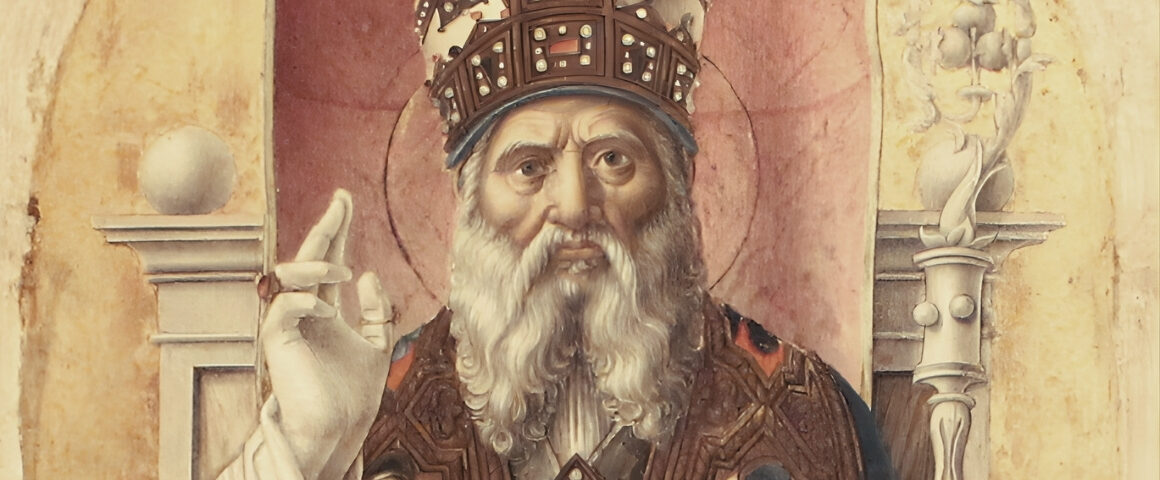
Editor’s Note: This article appears as part of a symposium responding to a recent essay by Joe Colletti (“The Young Anglican”), in which he announced his departure from the ACNA to join The Episcopal Church as part of what he describes as an Anglican “reconquista.” Please check back in the coming weeks as we continue this important conversation.
Joe Colletti, known to his followers on YouTube as ‘Young Anglican,’ has discovered that the Episcopal Church of the United States is the sole valid jurisdiction of Christ’s Church in our land. Setting aside the deeply depressing implications of that fact (were it true), this is one case in which it is profitable to be a slightly less young Anglican for no other reason than that one has had the opportunity to hear it all before.
By this, I do not mean to claim any intellectual superiority. In most other particulars, I am not so different from Colletti: a convert to Anglican tradition, brought up in the ACNA with a (sort of kind of) moderately successful online outlet promoting orthodox Anglicanism to whomever wants to listen, and while I am in possession of a (sort of kind of) advanced degree in Historical Theology, very little of what follows was gleaned from it. I am also a priest in the ACNA, which perhaps makes me somewhat more of a partisan in these matters, but the reader can be the judge of whether a 10,000 follower YouTube audience or a salaried rector position over 130 or so souls, an ACNA sponsored retirement plan, and a far less listened to podcast constitutes more skin in the game (personally I can’t decide).
I have not heard of the two points that frame Coletti’s argument: that there is a distinction between a ‘positive’ or ‘negative’ separation, in which (to borrow the Methodist terminology) the ‘leaver’ departing from a given ‘jurisdiction’ is always the schismatic while the ‘remainer’ is the compromised, heretical, apostate, abusive, but nevertheless rightful and juridical retainer of the substance of the One Holy Catholic and Apostolic Church in a given area. The second, that schism is only justified insofar as salvation is impossible in a given communion, and this is determined by the “public doctrine” of that Church, is an even more novel thesis by my lights, and probably deserves a separate treatment (or not, depending on one’s opinion of its coherence). What is familiar about Coletti’s Reformed case against reformation is his claim that examining the lives and writings of the early Fathers of the Church sets one against the sort of “positive” schism that could result in the ACNA, GAFCON, or the Global Anglican Communion.
Failure of the Windsor Report
Patristic-sounding cases against encroachment by orthodox jurisdictions are at least as old as the Windsor Report of 2004, which set out to give one of those good old lukewarm Church of England scoldings to both the hot and the cold: equal moratoria on the consecration of practicing homosexual bishops and also conservative missions into liberals’ ecclesial territory. Of course, neither side listened, and the Archbishop in question would go on to bless transgenderism as a ‘sacred journey of becoming whole.’ So much for Canterbury’s tough talk for sexual progressives. Meanwhile, N.T. Wright, then England’s “house conservative,” was left to defend the report’s injunctions against orthodox provinces planting churches in progressive ones, citing the Nicene canons against the border-crossing Novatians.
At the time, Dr. William Tighe at Touchstone ably handled the inapplicability of those canons to the Anglican situation (that they had nothing to do with false teaching), and then went on to correctly summarize the way in which the orthodox Fathers’ conduct at the time of the Arian crisis does turn out to be relevant to the modern Anglican situation.
Athanasius was willing, as the conflict intensified—in his case, as early as the mid-340s—to intervene unilaterally in dioceses whose bishops were Arians or compromisers… he ordained men in dioceses whose bishops were tainted with Arianism to serve the orthodox upholders of Nicea, and that he did so without seeking or obtaining the permission of those bishops.
While it cannot be verified whether any of Athanasius’s ordinands were Bishops, other orthodox adventurers certainly were: Eusebius of Samosata, disguised as a soldier, slipped into Arian territory to ordain anyone needed to support the struggling parishes, including bishops. Same story for the lesser-known Lucifer of Cagliari and Epiphanius of Salamis. This and more led Tighe to conclude “that any attempt to construct a theory of the inviolability of diocesan boundaries cannot find any support in the theory and practice of the early Church.” So, the picture we get of patristic action during the Arian crisis is not a stolid respect for “jurisdiction” as an inviolable sacral category. Rather, the orthodox party was more than willing to cross borders, ordain bishops, and cause trouble by doing everything the Church does under the nose of a heretical Bishop.
Getting the Fathers Wrong
The same is demonstrable in the patristic examples Colletti breezily cites. None of them adds up to any sort of patristic consensus against the possibility of “positive” separation.
Ignatius of Antioch’s entire theology of the Church’s unity hinges on the Bishop as Christ’s representative. But this is exactly what is compromised in false teaching, as opposed to mere separation. To become a formal heretic is to cease to act as Christ’s representative. It is not just that a Bishop fails, but that he ceases to do his job. Even though he may “ontologically” remain a bishop, his metaphysical status does not give him a claim over the faithful in his region in the same way that one rightfully denies a violently abusive father his parental rights over his children. Such a situation was not in Ignatius’s view, and in any case, the schismatics addressed do not involve false teachers.
Irenaeus of Lyons’ mention of schismatics alongside heretics (Against Heresies XXXIII.7) is also hard to marshal against the cause of the ACNA when the full quote is recalled:
He shall also judge those who give rise to schisms, who are destitute of the love of God, and who look to their own special advantage rather than to the unity of the Church; and who for trifling reasons, or any kind of reason which occurs to them, cut in pieces and divide the great and glorious body of Christ[1]
In other words, schismatics are those who divide churches for their own advantage or for ‘trifling’ reasons, self-dealing, or on the basis of private judgment. This is not why the ACNA was formed. The ACNA coalesced around very grave matters of doctrine, moral theology, and biblical authority, the very matters Irenaeus contends for against the heretics named in the foregoing passages. His meaning of ‘reformation,’ that Colletti makes so much of, is hard to determine and would probably need to be considered in the Greek by a superior scholar to us both. Taken together with his reference to Matt. 23:24, my judgment is that Irenaeus is referring to concerns of church improvement, which, though valid, do not rise to the level of threatening what he goes on to say is “true knowledge” of “the doctrine of the apostles” which is in “harmony with the scriptures.” The message is that the former sorts of changes these separations seek to effect are of no great importance. It is the latter which most concerns him, and those who threaten these are the true schismatics. It strains credulity to think that Irenaeus would find the question of whether men may “marry” other men in the Church to be a minor one, a ‘gnat’ not worth straining out. As in many places, Colletti’s citations consistently beg the question of what it means to be ‘schismatic’ even when the definition stares him in the face.
Ambrose of Milan’s controversy with the interloper Auxentius’ attempted takeover of a basilica is indeed an example of heretical encroachment on Catholic territory, and yet its context of imperial politics and the quasi-political role the Bishop played is so far removed from our situation today that drawing parallels in any direction is meaningless. But the episode does echo the bitter fights many orthodox Anglican parishes had with the Episcopal Church when they announced their departure for the care of African primates. As a result, some congregations lost their buildings, and some, like Ambrose’s congregation, successfully defended themselves (the Bishop was not, as Colletti claims, dragged from the building), but Ambrose’s letters reveal no comment on what to do when the conquest is successful. Not to take anything away from Ambrose–one of the bravest men the Church ever produced–but things would have gone the other way if the local police had not been so chummy with the Catholics that they were unwilling to enforce the order. What the Bishop would have done or how he would have advised his flock in the wake of such a disaster is impossible to say, except that Ambrose does not even recognize “Auxentius” as a bishop at all (see Letters XX.8 and XI.15), so it is hard to imagine him turning around and advising the saints to stick around and tough it out with the guy.
An aside: it is not usually my way to be histrionic, but this particular citation merits a brief lapse. To preach the episode of Ambrose and the Milanese Catholics defending their basilicas from the Emperor’s Arian puppet at the many U.S. Anglican congregations who valiantly though unsuccessfully fought protracted and expensive battles for the exact same reason, only to cast them unfavorably as “leavers” for the ACNA or the Continuum, is temerity bordering on cruelty. If the implication is that holding a lock-in until you’re arrested is the test of orthodoxy, then this is abusing both the memory of the Fathers and our contemporary brothers.
A disinterested reading of the Fathers reveals that while schismatics are not always heretics, heretics are always schismatics, since they separate themselves from the deposit of faith. The temporal components of “jurisdictions” (sees, dioceses, basilicas) are not treated as the substance of the visible Church, but as her rightful inheritance, and worth a fight, but not worth dissolving or stratifying the Body’s members in order to keep within its temporal bounds. To put a finer point on it, the Bishop himself is the sign of the Church’s unity, not his see. Anglicanism has always maintained that the Church is visible, but it is the Spirit who gives form to the body, not the other way around.
The Doctrine of The Episcopal Church
I will leave the rest of Coletti’s attempt at a Reformed case against reformation to those more interested in the 16th and 17th Centuries than I am, save for a few parting thoughts.
One thing that strikes me is that Colletti does not appear to count the public statements of Episcopal Bishops as forming part of the “formal doctrine” of that church. But this is an inorganic and frankly unpatristic way of understanding the role of the Episcopate. The statements of Bishops, especially in concert, form an important part of the public doctrine of their church. The documentary foundations of a church are not divorced from that church’s public teaching. The Bishop’s job is to synthesize and interpret its doctrine to the faithful, and The Episcopal Church has decided that means preaching full LGBTQ acceptance and codifying gay marriage rites into its canons. How this does not rise to the level of her “formal doctrine” needs to be explained. In an oddly Roman Catholic way, Colletti seems to treat Bishops as witting or unwitting conduits for the grace of the sacraments, while their teaching office does not contribute to their Church’s substantial form.
Just as Colletti misreads the Fathers, he also mistakes the situation in the ACNA and GAFCON. The ACNA is not a ‘new’ jurisdiction, but the product of already existing provinces and primates providing for the faithful in our land; i.e., doing exactly what the orthodox Fathers above did to provide for the faithful. So we do not have the creation of a new body (unless we decide that constitutions, bylaws, and 501c3s are the real sacral documents that disclose the substance of the Church), but rather the intervention of other members of the body bringing health and life into a part of it that had grown gangrenous. ACNA and GAFCON have always enjoyed the continuity of the Communion, only ever acting in concert with the blessing of its most concerned primates for the faith once delivered to the saints.
I find the whole notion of “positive” and “negative” separation confused and, it must be said, pastoral malpractice. Colletti’s counsel, if taken seriously by his online followers, would bind the consciences of the faithful to an individual duty of “negative separation” (i.e. you really ought to be careful whom you take communion from!) without offering them the possibility of availing themselves of the haven of the orthodox churches that were planted for the very purpose of providing the faithful and their children clear water to drink.
Free to be Faithful
Sacramental theology did not grow up to define polity, and it never binds us to false teachers nor does it prohibit true teachers, validly ordained and in line of succession, from challenging, succeeding, and planting if it is necessitated by false teaching. This situation inside the ACNA, I grant, is a different matter, but what to do about apostate bishops is actually pretty easy to summarize: 1. Dad is abusive, 2. he’s still your dad, but 3. it’s time to get out of the house, at least until he gets better. (The ACNA has never rescinded its invitation for Episcopal Bishops to repent.) The point is that bishops who apostatize no longer act as bishops, and so may be opposed and challenged in whatever way benefits the faithful and fits the circumstance. Colletti’s idea, on the other hand, saddles believers with a condition worse than slaves, who were at least allowed by Paul to avail themselves of their freedom if they had the opportunity. Sacramental theology and its metaphysical implications (ex opere operato, in persona Christi) were defined to explain how God nurtures the faithful even through infirmities of heresy and immorality, not to bind them to diseased limbs when they have the opportunity to form healthy ones.
Image Credit: Wikimedia Commons.
Notes
- Irenaeus of Lyons, “Irenæus against Heresies,” in The Apostolic Fathers with Justin Martyr and Irenaeus, ed. Alexander Roberts, James Donaldson, and A. Cleveland Coxe, vol. 1, The Ante-Nicene Fathers (Buffalo, NY: Christian Literature Company, 1885), 508. ↑