- Book Review: Sing Unto the Lord (Part 1)
- Book Review: Sing Unto the Lord (Part 2)
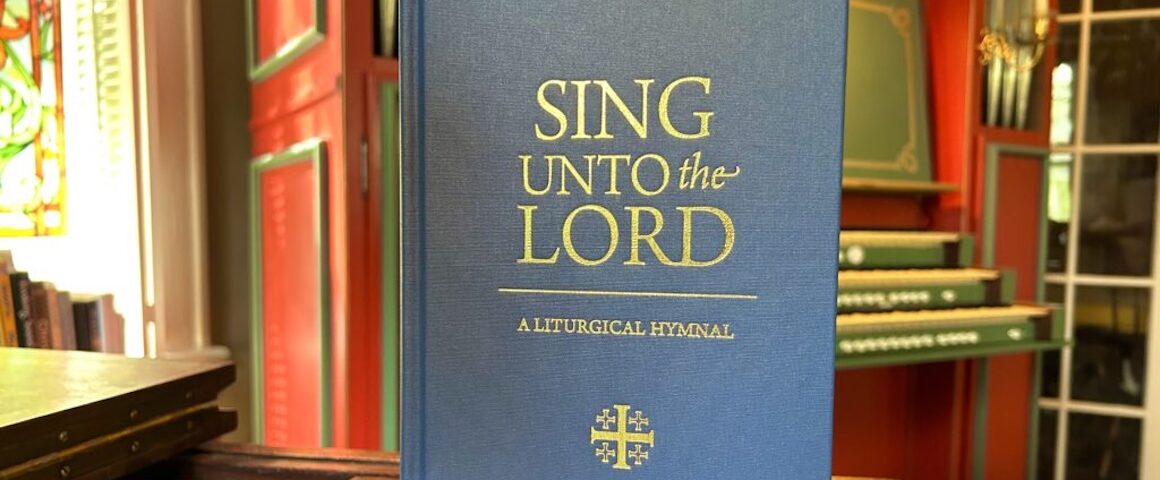
Sing Unto the Lord: A Liturgical Hymnal. Anglican Music Publishing, 2023. 942 pp. $29.95 (hardcover).
In my previous article, I reviewed the service music of Sing Unto the Lord, the 2023 hymnal intended for contemporary language ACNA worship.[1]
At the end of 6900 words about the 159 pages of service music, I asked the question: how often does service music matter in a hymnal adoption decision? In response, I posited “the main factor in choosing a new hymnal will be its portfolio of hymns for the entire church year.” So here is that part of the hymnal story.
I’m not going to write about all 741 hymns in the new hymnal, but instead focus on the changes since two earlier ECUSA hymnals: The Hymnal 1982 (the most popular hymnal used by North American Anglicans) and The Hymnal (1940) (still used by some). I will also discuss similarities and differences with Magnify the Lord (Book of Common Praise 2017), a more traditional language ACNA hymnal that some may be considering.[2] At the same time, my hunch is that the target audiences for SUL are the H82 parishes — and thus for most readers, the key question is “how is it similar to or different from Hymnal 1982?”
Overall, these changes can be classified as
- What texts were added and deleted?
- What tunes were added and deleted for existing texts, and used for new texts?
- Were any of the harmonizations changed?
- How well does this line up with the hymns a parish will want to sing?
Some choices are going to be unremarkable: like its three predecessors, this hymnal includes Joy To The World,[3] For All The Saints, and Hail Thee Festival Day (all three seasons), along with many other obvious choices. So instead I’ll emphasize the portfolio — not only what’s added and what’s missing, but also how it covers the less familiar liturgical dates and services of the Christian year.
Stated Goals
Many hymnals — particularly those produced by an ecclesial committee — have a long statement of principles or goals. Those for Sing Unto the Lord are much briefer, with most of the opening pages devoted to providing ideas (or even ammunition) for helping a music director strengthen the use of sung music in his or her parish.
However, one paragraph in SUL’s Forward by editor Mark K. Williams comes closest to articulating its goals:
[O]ur Lord has spoken through the creative efforts of poets and musicians for millennia. The music in this hymnal brings honor to this by collecting in one place many of the best of both ancient and modern poetic and musical expressions of God’s story, His relationship with His people, and their enduring worship of Him. Given this, we have gathered together the very best of The Hymnal 1940, The Hymnal 1982, and Hymns Ancient and Modern, as well as many fine hymns composed and used since their publication. As editor, it was my goal for every page of this hymnbook to contain highly singable, well-crafted melodies married to excellent texts.
The emphasis between modern vs. traditional choices is explicitly different from that of the other 21st-century ACNA hymnal.[4] As SUL’s Forward continues
I love the saying, “Tradition is a good thing; it is traditionalism that is bad; for traditionalism is the dead faith of living people. Tradition, however, is the living faith of dead people.” May we honor and keep alive the faith of saints past, present, and future in our singing about and our singing to our great and loving Lord.
The Preface to Magnify the Lord places greater emphasis on preserving the best music of the past. For any hymnal buyer, it provides a helpful list of five criteria that would apply to any hymnal’s compilation of hymns: true theology, good poetry, good music, good match of music and text, and variety.[5]
As I noted in an earlier article, teaching accurate theology was why Martin Luther created congregational hymns in the first place.[6] Doctrine — as well as fit to a specific service or liturgical season — are determined by the text. For the 1892, 1916 and 1940 ECUSA hymnals, General Convention approval was required for the texts but (apparently) not for the tunes.[7]
Some editing of texts over the years has been to change the meaning, whether to make a theological point or to achieve a social goal. In recent decades, textual modifications have often reflected the social justice goals of many Episcopal and Anglican parishes, typically on gender inclusivity or gender neutrality.
However, both the selection and editing of the text can impact the poetry of the text, for better or worse. Textual changes (for whatever reason) can also reduce the continuity within and between generations, a goal explicitly mentioned by MTL but not SUL.
The choice of a tune or harmony is more subjective. Martin Luther himself noted how the choice of a tune might comfort, encourage, calm, or otherwise impact the emotions of a Christian congregation.[8] But the music is more than just the tune — it is also the entire piece, with rhythm and harmony.
While the fit of music to text is potentially a problem, this challenge seems generally to have been taken seriously by the editors of SUL and most earlier hymnals. The most familiar counter-example is probably I Am The Bread Of Life, which combines an accurate paraphrase of John 6 and 11 with legendarily awkward speech rhythms and voice leading. This 1966 Catholic folk hymn is included in H82 but neither MTL nor SUL.
Finally, the variety (or portfolio effect) might cause an otherwise weak hymn to be included to fill a gap, or an otherwise strong one to be omitted. For texts that will include coverage of specific liturgical seasons or services that might be under-represented in earlier hymnals.
In terms of musical styles, in selecting a new hymnal, some parishes are consciously seeking more recent styles not represented in earlier hymnals. For the 21st-century hymnals, that notably applies to contemporary Christian music popularized since the 1990s.
Overview
First, I want to call out the typography. For decades, H82 singers suffered with unreadable tiny fonts for words and music. SUL — consistent with MTL and most modern Protestant hymnals — has big, readable notes and text, which is particularly important in borrowed/improvised worship spaces where the parish can do little to improve the lighting quality.
But my main focus in this review is comparing the hymns published in SUL to other hymnals. While H40 numbers hymns by texts, SUL (like H82 and MTL) numbers hymns as the pairing of a specific text to a specific tune. For the purpose of this review, I cross-referenced the four hymnals and made a database of 1216 unique hymn texts — and 1630 hymn-text pairings (aka “hymns”) — that occur in one of the four hymnals.
The new hymnal has 741 hymns with 676 distinct texts (although a few texts are related). Of these 741 hymns, 196 are common across all four hymnals. In SUL, five hymn-text pairings (and three texts) are found only in H40. Meanwhile, 57 hymns are found only in H82, 138 found only in MTL, and 40 are found in the three newest hymnals.
Overall, 228 of the 741 hymns are new to U.S Anglican hymnals. Of these, 144 are texts not found in one of the three most recent US Anglican hymnals (H40, H82, MTL), and four of these 144 have two tunes with the new text. Meanwhile, 80 are new tunes for texts already in earlier hymnals. Most of the latter are new pairings of the tune with the text, but some of these pairings have been published by other denominations.
Major Seasons
As with the 1940 and 2017 American hymnals — and the 1906, 1986, and 2023 English hymnals — the new hymnal begins with music for Advent, the beginning of the church year.[9]
Since the first comprehensive Anglican hymnal 160 years ago, the major seasons of the liturgical year have been well represented by Christmas carols and other popular hymns. Nevertheless, each successive hymnal has added more Christmas hymns: 17 (H40), 24 (H82), 26 (MTL), and 27 (SUL). SUL has more Advent hymns (27) than its three predecessors: MTL (26), H82 (24), and H40 (17). [10]
SUL shares with MTL three Advent hymns and 15 Christmas hymns not found in the 20th-century ECUSA hymnals; eight are translated from older texts: three Latin, two French, two German, and one Polish. Of the 15, seven are familiar Christmas carols: Ding Dong Merrily On High, Go Tell It On The Mountain, Good Christians All Rejoice And Sing, I Wonder As I Wander, On Christmas Night All Christians Sing (Sussex Carol), Still Still Still, and The Snow Lay On The Ground (Venite Adoremus). SUL also includes Blest Be The King Whose Coming, found in H82 but not MTL.[11]
Many of these 20 seem like congregation-pleasers, but I wonder when, during the twelve days of Christmas, there is enough time to sing the existing hymns, let alone these new ones. Perhaps an Advent 4 or Christmas Eve Lessons & Carols service could include them. Most likely to be used is the delightful Advent carol rediscovered by MTL and continued with SUL: People Look East, first published in the 1928 Oxford Book of Carols but ignored by American hymnals until the Catholic Worship III (1986).
SUL is above average on Easter hymns (38) vs. 26,40,24 for its predecessors. It includes Easter hymns only found in H82 (Awake My Heart With Gladness, Christ Is Alive Let Christians Sing, Come Away To The Skies, Love’s Redeeming Work Is Done). Christ The Lord Is Ris’n Today is among the Easter hymns found both in SUL and MTL, while the three newer hymnals include Christ The Lord Is Risen Again and This Joyful Eastertide.
SUL introduces five Holy Week texts and six Easter texts not found in three earlier hymnals — both newer and centuries-old hymns. Meanwhile, the Easter hymn Sing Choirs Of New Jerusalem is a modified version of Ye Choirs Of New Jerusalem, an 1850 translation of St. Fulbert’s 11th-century text popularized by Hymns Ancient & Modern (1861), not published in the US before MTL. However, both MTL and SUL assumed that since the text was unfamiliar, they had the liberty to abandon the tune (St. Fulbert) used by most hymnals, including the 1861, 1906, 1986, and 2023 English hymnals. SUL pairs it with the second most popular tune, the 19th century (Lyngham), as well as the 21st century (Hedegaard) tune first used with the modified text,[12] while MTL uses the 18th century Glasgow with the original text. While musical taste can be very subjective, I unexpectedly found that I preferred the newly-selected tunes — Hedegaard and Glasgow — to the earlier ones. This anecdote is consistent with Williams’ view that unknown (or underused) texts can be revived with better tunes.
Of six hymns for Pentecost, two are found in H40, H82, and MTL. Like MT,L it restores the 9th century O Come Creator Spirit Come dropped by H82, while keeping Hail This Joyful Day’s Return found only in H82. Of the two not published in the earlier hymnals, one is Blow Thou Cleansing Wind from Heaven, a 1989 anthem (set to Hyfrydol by Thomas McLelland-Young) popularized by Scottish Episcopal cathedral choirs in their YouTube video (but without the latter’s descant).[13] The other is the 1817 Holy Spirit Light Divine, the most popular hymn by 19th-century Congregationalist minister Andrew Reed, using the same modified text and Orlando Gibbons tune (Song 13) found in the Lutheran Service Book (2006).
A major flaw of H40 is its paucity of hymns for lesser feast days: H82 more than doubled the total, from 29 to 63, while MTL (45) and SUL (42) are somewhere in between. SUL more closely follows MTL in this regard, but includes some texts (When Stephen Full of Power And Grace) and tune pairings found only in H82. As discussed below, it also includes both the MTL and H82 texts of For All Thy Saints in Warfare. More music for these mid-tier feasts is important in principle, but in practice, with the general absence of midweek sung services, most parishes will only use these hymns one year out of seven, when the holy day lands on Sunday.
Other Services
For the Daily Offices, if you ignore the large number of noonday hymns in H82 (12), the four hymnals are roughly similar in their number of hymns, with one exception: SUL has many more hymns for Morning Prayer.
For morning, the new hymns include Surely It Is God That Saves Me, O God We Praise You And Confess, Be Joyful In The Lord (two tunes), Now From The Altar Of My Heart, and New Every Morning Is The Love. Like H82, it includes Morning Has Broken (largely similar to the 1971 folk song).
SUL selects a new tune for O Splendor Of God’s Glory Bright. For two hymns — Awake My Soul And With the Sun and All Praise To Thee Who Safe Hast Kept—unlike H40 (which uses Morning Hymn), it uses Tallis’ Canon as the tune (MTL and H82 have both).
All four hymnals overlap on key office hymns. For morning, these include Awake My Soul Stretch Every Nerve and Christ Whose Glory Fills The Skies, while for evening they include All Praise To Thee My God This Night, Abide With Me, The Day Thou Gavest Lord Is Ended and Now The Day Is Over.
Probably of greater interest for most parishes is the collection of communion hymns: 41 compared to H40 (32), H82 (47), and MTL (37). All of what I would consider to be the standard communion hymns are present in all four hymnals. Ten texts (one with two tunes) are new since the earlier hymnals, including contemporary offerings from GIA and Hope Publishing. Two are also found in H82, including Let Us Break Bread Together On Our Knees. A number of tunes are changed.
What about the other sacraments? There are changes in the hymns for Baptism, Confirmation, Matrimony, and Burial — but I’m not sure how much people care about these four.[14] I asked Anglican friends what hymns they’ve heard at baptism or confirmation, and none could think of any. At my current parish, these rites of initiation occur either at the Easter Vigil (when those hymns take precedence) or during a regular Sunday service.[15]
This year, our family is going to a lot of weddings. To nominate potential hymns for weddings (as opposed to those printed under “Matrimony”), I identified 12 hymns from liturgy PDFs that I have for four Texas ACNA weddings, either in the REC or the Diocese of Ft. Worth. Nine hymns are in all four hymnals: At The Lamb’s High Feast We Sing, The Church’s One Foundation, Come Down O Love Divine, Deck Thyself, Let All Mortal Flesh, Love Divine, Praise To The Lord The Almighty, The King Of Love My Shepherd Is, and Wake Awake For Night Is Flying.
Two are only in the three newer hymnals: All Creatures Of Our God And King and My Shepherd Will Supply My Need. The final one (Though Angel Tongues Adorn My Human Voice) is only in the two ACNA hymnals, but SUL and MTL use different tunes.
As for funerals, in a 2020 article, I reported on 39 ecumenical hymns suitable for a Lutheran funeral, necessarily selected from those in the Lutheran Service Book.[16] Based on this earlier research — as well as various funerals I’ve attended — seven of the 39 hymns seem commonly used at Anglican funerals: Abide With Me, Amazing Grace, Eternal Father Strong To Save (Navy Hymn), For All The Saints, Jerusalem My Happy Home, O God Our Help In Ages Past, and Rock of Ages.[17] SUL and the other two recent hymnals have all seven. However, H40 notably omitted Amazing Grace, which has consistently ranked as the most popular funeral hymn today.[18]
Beyond the LSB, all four Anglican hymnals listed Faith Of Our Fathers, the opening hymn at my mother’s funeral, which my family knew from regularly playing the quadruple platinum “White Christmas,” Bing Crosby’s best-selling LP of his entire career.[19] Written by the Tractarian (later Roman Catholic) priest Frederick W. Faber, FOOF is listed in more than 850 hymnals. However, it is omitted from many Lutheran hymnals [20] because, as the Hymnal 1982 Hymnal Companion notes, it was written as “a specifically pro-Catholic hymn.”[21]
Not So New Hymns
Overall, SUL shares with MTL 111 texts not found in earlier hymnals. Beyond the 18 for Advent and Christmas, SUL classifies another 15 for other seasons or Holy Days, three for Daily Offices, 10 for Holy Communion, 13 for other sacraments and leaving 52 for general occasions. Of those before 1960, the best-known general hymn additions in SUL/MTL are Jesus Loves Me (1860) and It Is Well With My Soul (1876).
Of the 144 texts unique to SUL, one is 17th century, nine are 18th century, 26 are 19th century, 88 are 20th century and 21 are 21st century. Put another way, 45 of the texts were published from 1650 to 1935, and 101 were published from 1962 to 2020. There is no dramatic pattern as with MTL, which added a number of Wesley texts and tunes from Southern Harmony.
SUL does add one Charles Wesley text, the 1749 O How Happy Are They. With a total of 32 hymns in SUL, Wesley nudges out John Mason Neale (31) and easily bests Isaac Watts (20) and the translations of Catherine Winkworth (26). Other new evangelical hymns include My Soul With Joy Attend (1755) by English Congregationalist minister Philip Doddridge,[22] and Blessed Assurance (1873), the best-known hymn by American Fanny Crosby.[23]
Also new are two versions of “I know that my redeemer lives, what comfort this sweet sentence gives,” a 1775 text by English Baptist Samuel Medley. The hymn was very popular in English evangelical hymnals of the early 19th century English, but has more recently fallen out of favor. One version is to the tune Duke Street, the one also used with this text by the recent Missouri and Wisconsin Lutheran hymnals, the 3rd edition of the Catholic Gather (low church) and Worship (high church) hymnals, as well as the 1938 (but not the current 1998) hymnal of the Anglican Church in Canada.
A second version of the text can be traced to the 19th-century Sacred Harp hymnals, to the tune Antioch (here termed Shout On). As in the original and later versions (such as the 1975 Baptist Hymnal), it includes a “glory, hallelujah” after each phrase and a refrain of “Shout on, pray on” after each verse.
More Anglican is the addition of a hymn by Scottish-born, Irish-educated poet and CofE priest Henry Francis Lyte. To his better-known hymns found in the three previous hymnals — Abide With Me and Praise My Soul The King Of Heaven — SUL adds the lesser-known Praise The Lord His Glories Show (1834), paired with the Welsh tune Lllanfair as found in recent Presbyterian hymnals.
More unusual is the addition of two hymns from the 1839 Psalms of David by Oxford Tractarian John Keble: God You Rule With Royal Bearing, and God Our Lord A King Remaining. Both are often paired with the familiar Regent Square, but SUL instead follows the 1990 and 2013 Presbyterian hymnals by using Bryn Calfaria from 19th-century Welsh composer William Owen.
But the most surprising is the inclusion of Firmly I Believe And Truly, a text by the (already-Catholic) John Henry Newman, not previously printed in an American hymnal. Rather than the English tunes used or recommended by the 1906, 1986 and 2023 English hymnals (Shipston and Halton Holgate aka Sharon), it uses Nashotah House, a 1992 tune by Joseph Kucharski, the music professor at Nashotah House from 1991-2016, best known as the editor of the 1993 Nashotah House Plainsong Psalter.[24]
Finally, two additions match SUL’s intended role as a modern hymnal also for Canadian Anglicans: the 18th-century “God Save the King” and the 1908 English lyrics to “O Canada!”
Newer Hymns
As noted, SUL includes 101 new texts since 1961 not published in one of the three earlier hymnals, of which 80 were published in the first 40 years.
From the 1980s, it has two additions from Roman Catholic Liturgical Renewal Hymnody: Dan Schutte’s best-known hymn Here I Am Lord, and Marty’s Haugen’s Here In This Place. At the complete opposite end of the spectrum, the final hymn of the 20th century is adaptation of John Rutter’s 1999 anthem Eternal God We Give You Thanks for Music.
Of these 101, 21 hymns are texts from the 21st century, 11 after 2009. These are too many to list here. Frankly, I don’t recognize any of them — I don’t listen to CCM or go to evangelical churches — and they are too new to use Hymnary.org as an objective measure of their impact.
I will say that one of the 21 stood out because of the provenance of its author: Presbyterian theologian R.C. Sproul (1939-2017), founder of Ligonier Ministries. “The Secret Place” is one of 13 hymns by Sproul and film composer Jeff Lippencott from Ligonier’s 2014 CD and song book. Listening to the Spotify playlist, this (and the other) hymns sounded more like traditional congregational hymns, but performed using the orchestration of the Robert Shaw Chorale, a Hallmark Christmas CD or a film score; their YouTube video of a 2015 symphony performance shows the hymn to greater advantage. [25] Here is the first verse
Who dwells within His most secret place
Is never far from His blessed grace
’Neath His great shadow all will be well;
No better place now for us to dwell
While the theology is not as deep as Luther — nor the poetry as eloquent as Keble or Chesterton — it compares favorably to many 19th and early 20th-century hymns. And when performed by a piano and small church choir — rather than studio orchestra — it would fit right in with such hymns.
However, SUL certainly includes other hymns in a more modern musical style. These are what Michael Hawn termed “Protestant Contemporary Classical Hymnody”[26] — essentially the traditional strophic hymn, but adapted to more recent popular music norms. These are somewhere between traditional hymns and the latest CCM (Christian Contemporary Music) hit performed on the radio or by a megachurch praise band.
Nothing represents such contemporary hymnody in the ACNA more than Keith and Kristin Getty, once the quasi-official praise musicians of the ACNA. In 2017, the ACNA website promoted a live simulcast of the Gettys’ annual Sing! Conference, with 4000 attendees gathered in Nashville. In 2018, its email blast promoted their annual “Irish Christmas” tour, which featured a guest appearance by then Abp. Foley Beach at the Atlanta conference. Finally, during the darkest days of Covidtide in 2020, the ACNA promoted an online-only version of the Sing! Conference hosted by “Keith and Kristyn Getty — friends of the Province,” it featured an online panel discussion between Keith Getty, Abp. Beach and former Abp. Bob Duncan.[27]
MTL included one song with both Gettys and Stuart Townend, as well as five songs by Keith and Stuart, including In Christ Alone and Speak O Lord — as well as one by Townend alone (How Deep The Father’s Love). To these seven, SUL adds two more Townend collaborations, one with both Gettys (Behold The Lamb) and one with Keith alone (The Power Of The Cross).
New Tunes and Harmonizations
SUL has 78 new tune-text pairings for texts found in a previous hymnal: 20 are additional tunes while keeping the earlier tune(s), while 58 are newly paired tunes that replace the previous pairing(s). It is difficult to characterize all 78, but some patterns can be illustrated by examples.
First, it appears the editor had more than a dozen favorite tunes. Of tunes used either in the 146 new texts or the 78 new pairings, seven were used three times. Beach Spring, Bryn Calfaria, Hymn to Joy, Llanfair, Llangloffan, St. Anne and St. Peter; as the names suggest, three of these are Welsh. One tune was used four times: O Waly Waly, named for an 18th century Somerset folk song that Hymnary says is used for a wide assortment of texts in various hymnals, including recent American Catholic and Lutheran hymnals and the New English Hymnal.
Three tunes were used twice for new hymn texts: Nettleton, Regent Square, and Sine Nomine. Meanwhile, six were used twice for new pairings of existing texts: Canonbury, Chester, Ebenezer, Genevan 36, Prospect, and Wie Lieblich Ist Der Maien.
The additional tunes for existing text are less controversial and, in at least a few cases, to be applauded. For the latter, my daughter celebrates SUL being the first American Anglican hymnal to include the tune Darke for In The Bleak Midwinter. That pairing has been made famous when sung by the King’s College Choir on Christmas Eve — 13 times from 1997 to 2022[28] — at their iconic Lessons & Carols service. The tune was named for and written by Harold Darke, KCC’s interim music director during WWII while Boris Ord was working for the R.A.F.
As with MTL, the editor of SUL felt the liberty to change harmonizations for familiar tunes. But unlike MTL, these reharmonizations were by other composers rather than the hymnal committee. I was surprised to find that SUL includes many of the 14 (re)harmonizations from the MTL — two by MTL editor Chris Hoyt, and 12 by committee member Andrew Dittman.
In American hymnals, one of the most frequently changed harmonizations was for John Newton’s 18th-century hymn Amazing Grace.[29] Because it was not in H40, there was not a harmonization known to Episcopalians until later hymnals. H82 included a new (1950) harmonization by Austin C. Lovelace, while MTL and the 2023 Revised English Hymnal had different new harmonizations. SUL uses the 1918 Edwin Excell harmony that appeared in many Baptist, Lutheran, and Methodist hymnals since then: it is less familiar for former Episcopalians but more familiar for former Evangelicals.[30]
Beyond such famous hymns, there is a real question as to who will notice a change in harmonization? This might include a professional choir member, the organist (if the 4 parts are used as accompaniment), or the occasional part-singer in the pews — but not the average congregation member.
When looking at the most frequent musical contributors (tune, harmony, descant) to the hymnal — as measured by the hymnal index —two names were a surprise: Alice Parker (1925-2023) and Betty Pulkingham (1928-2019). Parker (with 23 contributions) honed her craft by working with the Robert Shaw Chorale, and also had ties to the Mennonite Church and was active in her United Church of Christ congregation. Pulkingham (with 11 hymn contributions) was a well-known TEC composer, having served on its Standing Commission on Church Music from 1988-1994; as noted in Part 1, she also contributed four pieces of service music.
Not surprisingly, the most frequent musical contributor was Ralph Vaughan Williams (52), who transformed Anglican hymnody in 1906 with folk tunes and other adaptations for The English Hymnal. Second was Parker (23), while tied for third at 20 are J.S. Bach and W.H. Monk, music editor of Hymns A&M. In terms of hymns, MTL harmonizer Andrew Dittman (12) was fifth, and Pulkingham (11) sixth.
H82 was notable for taking away harmonizations from hymns published in H40. As a crude measure, I looked at the first 40 hymns in SUL common to all four hymnals, which conveniently matched the Advent, Christmas, and Epiphany seasons. SUL (and MTL) had two unison hymns, while H82 had eight. I think this comparison understates H82’s use of unison, which (flipping pages) seems more common in general hymns — and also with new hymns not previously published. One example of the latter is the Isaac Watts Come Let Us Join Our Cheerful Songs, which was new to H82 with a unison Johann Crüger tune; meanwhile, SUL incorporated Crüger’s harmonization of that tune.
Taking Hymns to a Higher Level
Like many Anglican pew-sitters, I have a soft spot in my heart for an appropriate use of the choral descant. The 20th-century descant has its origins in the 14th-century faux bourdon, which usually (but not always) put the melody in the tenor and then soprano (or multiple parts) in harmony above the tenor.
The modem descant dates to the publications of English composer Athelstan Riley (1915-1916) and Alan Gray (1920); the latter is represented in H82 with his descant for Hark A Thrilling Voice Is Sounding. The first Anglican hymnal with descants was the English Songs of Praise (1925) and its successor, Songs of Praise Enlarged Edition (1931), with descants both by Gray and music editor Ralph Vaughan Williams.[31]
In this century, Methodist music theologian Don Sailers wrote:
[T]he addition of a well-written descant enhances and makes some hymns all the more memorable. Need I mention the descants of Sir David Willcocks? Some of our most beloved Christian carols and hymns are indelibly etched in our souls as a result. As one person said to me recently of the descanted final stanza of “O come, all ye faithful,” “it was splendid, as though the entire congregation was singing a transcendent anthem.”[32]
While SOPEE (like SOP) is a niche hymnal, descants are a central part of its mainstream English successors: New English Hymnal (1986) and Revised English Hymnal (2023). Led by Willcocks (1957-73), Philip Ledger (1974-82), and Stephen Cleobury (1982-2019), the soaring voices of the young choirboys of King’s College Cambridge, popularized descants around the world, first through their live annual Lessons & Carols broadcast, and then with their recordings of Christmas music.[33] Many American Anglican congregations have sought to imitate that sound, whether in a special December service or on an ordinary Sunday during the season.
As it turns out, both Sing Unto the Lord and Revised English Hymnal heed Sailers’ advice by using famous Willcocks descants for O Come All Ye Faithful (also in the NEH), and Hark The Herald Angels Sing — but not Once in Royal David’s City (only in REH). Oddly, neither SUL nor REH has the famous Willcocks descant to The First Nowell from 100 Carols for Choirs, nor the Healy Willan and Philip Ledger alternatives for the same tune.[34] SUL includes two other Willcocks descants: Jesus Christ Is Risen Today for Easter and the general hymn Christ Is Alive.
SUL and REH share the John Rutter descant to the Advent hymn Lo He Comes With Clouds Descending, found in the Oxford Book of Descants (2012). SUL also includes Rutter’s descant for Now Thank We All Our God.
SUL (like H82) sources its descants from a mix of American and English sources, while NEH and REH limit their descants to elite English sources: they omit New Zealand-born Craig S. Lang (1891-1971), who spent his entire career in England.[35] H82 includes six Lang descants, and SUL retains three: Holy Father Great Creator, Praise To The Lord The Almighty, and Praise My Soul The King Of Heaven.
Overall, SUL has fewer descants (23) than H82 (31), but infinitely more than H40 or MTL (0). It keeps seven of H82’s descants, changing one (the Willcocks Easter Hymn) and dropping the other 23.
The most frequent descant composer in SUL is American Betty Pulkingham, with six descants, including one (Alleluia Alleluia Give Thanks) retained from H82. Five are new: Angels We Have Heard On High, Glory Be To Jesus, Alleluia Sing To Jesus, Jesus Shall Reign, and Peace Perfect Peace.
Other descants by TEC composers include How Firm A Foundation (Lois Fyfe) and Oh Love of God How Strong and True (Calvin Hampton). Two more descants come from Richard Proulx (1937-2010), an American Catholic composer who was part of the H82 committee and contributed to late 20th-century Catholic, Episcopal, Methodist, and Presbyterian hymnals: those for Crown Him With Many Crowns (also in H82) and Lift High The Cross.
Two descants come from composers born in the U.K. who spent their careers in the U.S. Alec Wyton provides a descant for Sine Nomine included with the 1987 hymn God’s Paschal Lamb, although the tune is better known with For All The Saints. David McKinley Williams, a member of the H40 hymnal committee, provides a descant for Holy Holy Holy.
Two unfamiliar hymns have unfamiliar descants. The descant for Tell Out My Soul is by Methodist composer Charles H. Webb, credited with more than 100 descants on Hymnary.[36] Finally, editor Mark Williams himself contributes a descant for a unison version of Rutter’s 1999 SATB anthem Eternal God We Give You Thanks.
Inclusive and Inoffensive Hymnody
As analyzed in Part 1, the SUL service music makes some provision for traditional language, but emphasizes the ACNA’s contemporary language liturgy. As with the earlier Rite II, service music for these texts drops the “thee” and “thou” in favor of “you.”
Beyond liturgical changes, over the past 50 years, various Protestant hymnals have sought to “modernize” the language of familiar hymns. Hymnary.org has an option to find “Non-Archaic” hymn texts, although no corresponding option for “Traditional” or “Historic” hymn texts.
When it comes to modernizing text, Sing Unto the Lord more closely follows H82 than MTL. MTL matches the original 19th/20th century texts of The Hymnal (1940) and earlier American and English hymnals, while SUL includes various Hymnal 1982 modernizations.
Christmas carols are the easiest place to spot the difference, starting with Good Christian Men Rejoice, published in English language hymnals from 1853-1977, renamed Good Christian Friends Rejoice by the ECLA Lutheran Book of Worship (1978), Hymnal 1982, and now Sing Unto the Lord. SUL follows H82 in banishing the dreaded “m” word from verse 2 of Joy To The World, verse 3 of Hark The Herald Angels Sing[37] — but (as in H82) retains it in verse 2 of O Little Town Of Bethlehem.
Also unacceptable for some hymnals is text related to warrior metaphors: here, SUL seems to split the difference. H40 includes the Isaac Watts hymn Am I A Soldier Of the Cross, in which later verses proclaim “I must fight”, “this glorious war,” and “all thy armies shine.” While MTL triples down with two additional tunes, both H82 and SUL drop the problematic text altogether.
A more complex case is a hymn written by Horatio Nelson, nephew of the famous English naval hero. His hymn From All Thy Saints in Warfare, first published in a U.S. Episcopal hymnal in 1883,[38] offers specific stanzas for the major prayer book saints’ days. H82 reintroduced it with (demilitarized) contemporary versions of Nelson’s saints’ verses as By All Your Saints Still Striving, with two tunes: King’s Lynn and Nyland. MTL has the traditional name and verse language with the first tune and all 20 verses, while SUL includes the traditional name and tune but drops the “thee,” “thine,” and “thy.” However, for partial continuity with H82, SUL also includes a simple three-verse hymn By All Your Saints Still Striving using the second tune.
Other Textual Changes
Other textual changes are not so clearly aligned to ideology.
First, there is the curious case of the communion hymn Here O My Lord I See Thee Face To Face. H40, H82, and MTL agree on the text of this hymn, and MTL copies the H40 tune, while H82 has a new tune. SUL both has a third tune, but also revises the text to Here O Our Lord We See You Face to Face.[39]
Second, for Philip Nicolai’s Wake Awake For Night Is Falling, SUL uses the same adaptation of the Catherine Winkworth translation as H40 and MTL; H82 calls the same hymn Sleepers Wake A Voice Astounds Us. The major English hymnals (1906, 1986, 2023) consistently use Wake O Wake With Tidings Thrilling.
Meanwhile, H40 and H82 are at opposite extremes when it comes to the use of the “Amen”: H40 almost always has one, and H82 almost never does so. Chris Hoyt (editor of MTL) said he reduced the use of “Amen” from H40 to those cases where it fit as an affirmation of a petition; still, MTL retained more Amens than either H82 or SUL. As a way to quantify this, I looked at the Advent hymn texts in H40 (#1-11). All 11 have Amens in H40; MTL keeps all 11 texts, and 9 have Amens. Meanwhile, H82 and SUL keep 10 of the 11 texts (dropping O Word That Goest Forth On High): for these 10, SUL has only one Amen (Creator of the Stars of Night) while H82 has none.[40]
Conclusions
In the end, Sing Unto the Lord succeeds at what it sets out to do: creating a hymnal for ACNA contemporary language worship.
H82 users would find 320 familiar hymns and 421 new ones, although many of the latter reflect familiar texts with new tunes. For mass settings, it retails two traditional language settings (Merbecke, Willan) and two contemporary language settings (Proulx, Powell) while adding five new contemporary language settings; all of the contemporary settings are updated for the ACNA rather than the BCP 1979 Rite II language. However, for the Daily Office, only three earlier pieces are retained.
If an ACNA parish is looking to replace an existing hymnal — and not every church should be looking to change — Sing Unto the Lord is the best replacement for Hymnal 1982, offering updated ACNA mass texts, dropping some of the more questionable H82 hymns, while adding a large assortment of new (and older, unfamiliar) hymns. For traditional language parishes, Magnify the Lord is more consistent with The Hymnal (1940) and its attitude towards modernization of hymn texts.[41]
For those more generally interested in hymnals as evidence of evolving hymn practice, SUL offers a slightly newer perspective on modern Anglican hymnody than MTL, but from an American perspective rather than the very English Revised English Hymnal also released in 2023.
Overall, Sing Unto the Lord seems like it should be the default choice for a new contemporary language Anglican parish, both for the new hymns and for the better fit to worship from the 2019 edition of the ACNA prayer book.
Notes
- See Joel W. West, “Book Review: Sing Unto the Lord (Part 1),” North American Anglican, January 29, 2025, https://northamanglican.com/book-review-sing-unto-the-lord-part-1/ As noted earlier, SUL (and the earlier MTL) are provided by ACNA musicians for the ACNA, but are not officially endorsed by the ACNA hierarchy. ↑
- Joel W. West, “Hymnal Choices for North American Anglicans,” North American Anglican, June 15, 2020. https://northamanglican.com/hymnal-choices-for-north-american-anglicans/ . Because the content of Book of Common Praise 2017 and Magnify the Lord are identical, for simplicity’s sake here I refer to this compilation as “MTL”. ↑
- For brevity’s sake, here I list each hymn without quotation marks, with all words capitalized, and deleting any punctuation within the title. ↑
- Since the ACNA was formed in 2009, one could argue that “21st century ACNA hymnal” is redundant. ↑
- Ray R. Sutton, “Preface,” Magnify the Lord (Newport Beach, Calif.: Anglican Liturgy Press), p. vi-vii. ↑
- Joel W. West, “Anglican Hymnals in the 21st Century,” North American Anglican, July 19, 2024, https://northamanglican.com/anglican-hymnals-in-the-21st-century/ ↑
- The Hymnal (1892) approved by General Convention contained only texts, not tunes. H40 published second and third editions with new tunes for previously approved texts. For H82, Volume 1 of the 1985 “Accompaniment Edition” includes both harmonizations for the service music published in H82, as well as 160 new tunes for this music. ↑
- See the quote from Luther in Joel W. West, “Anglican Hymnals in the 21st Century,” North American Anglican, July 19, 2024, https://northamanglican.com/anglican-hymnals-in-the-21st-century/ ↑
- The renumbering of hymns by H82 seemed like a deliberate attempt to avoid comparison with H40. Even the latest English hymnal, the Revised English Hymnal, begins with Advent. ↑
- For comparability, this and later counts of hymns for H40 are the number of text-tune pairings (as numbered by the other hymnals) and not the number of unique hymn texts (as numbered by H40). Also, the count for H40 includes two hymns found elsewhere for Advent (Hark The Voice Eternal, Lift Up Your Heads Ye Mighty Gates), and Christmas (One In Royal David’s City, Joy To The World). ↑
- These classifications differ between hymnals: for example, H40 includes Lift Up Your Heads Ye Mighty Gates and Joy To The World as general hymns, but classified as Advent and Christmas hymns by the three later hymnals. ↑
- The modified text and new tune were written by Pennsylvania composer and Lutheran cantor Kile Smith (b. 1956). ↑
- “Blow Thou cleansing wind from Heaven – Hyfrydol,” Oct 21, 2013, https://youtu.be/6ZjFTDiOod4 ↑
- I am hard pressed to come up with a potential use case for a hymn or other music specific to Unction/Anointing or Confession/Reconciliation. ↑
- By special permission from our ECUSA rector, for our daughter’s baptism during the slow summer season, my wife and I requested two of our childhood favorites from H40 — All Things Bright And Beautiful and I Sing A Song Of The Saints Of God — with All Hail The Power Of Jesus Name (Coronation) as the communion hymn. SUL, MTL and even H82 could provide all three for baptizing any future grandchildren. MTL and SUL also provide Jesus Loves Me with the same familiar tune, their harmonizations have slight differences. ↑
- Joel W. West, “Through Death to Life: Selecting Ecumenical Hymns for a Lutheran Funeral,” Logia: A Journal of Lutheran Theology 29, 2 (April 2020), 19-27. ↑
- For Rock of Ages, all four hymnals have the most popular Episcopalian tune (Toplady), while SUL, MTL and H40 also have the most popular Church of England tune (Petra). Four other tunes are also in common use; see J.W. West, “Water from a stone,” Anglican Music weblog, February 24, 2008, https://anglicanmusic.blogspot.com/2008/02/water-from-stone.html. ↑
- For example, see Susan Kearney, “What are the Most Popular Hymns at Funerals,” March 7, 2024, https://christian.net/arts-and-culture/what-are-the-most-popular-hymns-at-funerals/ . Amazing Grace is not without controversy. In 2018, when I asked experienced church musicians what song they would ban from worship, Amazing Grace ranked 10th with 1.8% of the more than 500 votes — in a three-way tie with the aforementioned Bread Of Life by Suzanne Toolan and In Christ Alone by Townend and Getty; it was the only pre-1900 hymn on the entire list of 21 nominees. See J.W. West, “Church musicians have thousands of reasons to shine,” Anglican Music weblog, September 13, 2018, http://anglicanmusic.blogspot.com/2018/09/church-musicians-have-thousands-of.html ↑
- See “Bing Crosby discography,” https://en.wikipedia.org/wiki/Bing_Crosby_discography ↑
- Written in 1849, Faith Of Our Fathers is Farber’s second most popular hymn, after There’s a Wideness in God’s Mercy. The hymn is found in the 1958, 1978 and 2006 hymnals of the Evangelical Lutheran Church in America, but not the 1941, 1982 and 2006 hymnals of the Lutheran Church-Missouri Synod and the 1993 hymnal of the Wisconsin Evangelical Lutheran Synod. It was first published in The Catholic Hymn Book of 1852 and has been a staple of Catholic hymnals ever since. ↑
- David Farr, “Protestant Hymn-Singing in the United States, 1916-1943: Affirming an Ecumenical Heritage,” in 1982 Hymnal Companion, Vol. 1, ed. Raymond F. Glover (New York: Church Hymnal Corporation, 1990): 505-554 at 512. ↑
- Doddridge is perhaps best known to Anglicans for Awake My Soul Stretch Ev’ry Nerve, Hark The Glad Sound The Saviour Comes and My God Thy Table Now Is Spread. In his initial 1907 Dictionary of Hymnology, John Julian wrote: “Doddridge’s hymns are largely used by Unitarians both in Great Britain and America. As might be expected, the Congregationalists also draw freely from his stores. The Baptists come next. In the hymnals of the Church of England the choicest, only are in use.” See “Philip Doddridge,” Hymnary.org, https://hymnary.org/person/Doddridge_Philip ↑
- Both SUL and MTL include I Am Thine O Lord, ranked by Hymnary.org as Crosby’s 4th most reprinted hymn. At the beginning of the 20th century, her most popular hymn was Safe In The Arms Of Jesus, which is now listed 7th overall. See “Fanny Crosby” Hymnary.org, https://hymnary.org/person/Crosby_Fanny ↑
- The hymn can be heard performed by the Nashotah House choirs, October 20, 2022 at https://youtu.be/s2HJxAa4v1U ↑
- “Glory to the Holy One,” Ligonier Ministries, https://store.ligonier.org/glory-to-the-holy-one-download. See also “Glory to the Holy One Premiere Concert,” Feb. 18, 2015, Ligonier Ministries, https://youtu.be/iLS-LVf550I?t=2879 ↑
- C. Michael Hawn, “Streams of song: An overview of congregational song in the twenty-first century.” The Hymn 61, no. 1 (2010): 16-26. ↑
- “Live Stream Sing! Conference September 18-20,” Anglican Church of North America, September 14, 2017, https://anglicanchurch.net/live-stream-sing-conference-september-18-20/ ; J.W. West, “ACNA co-sponsors CCM-bluegrass Xmas concert tour,” Anglican Music weblog, November 19, 2018, http://anglicanmusic.blogspot.com/2018/11/acna-co-sponsors-ccm-bluegrass-xmas.html ; J.W. West, “A CCM superstar and two archbishops go into a videoconference,” Anglican Music weblog, August 28, 2020, http://anglicanmusic.blogspot.com/2020/08/a-ccm-superstar-and-two-archbishops-go.html ↑
- As for any KCC performance from 1997-present, the hymn tallies are s reported by David Sindon, “Carol Service Spreadsheets,” accessed June 27, 2025, https://www.sinden.org/carols/ ↑
- Hymnary.org reports the first version of the current tune as Salon in 1874, and first paired with Amazing Grace as Harmony Grove in 1883. For Amazing Grace, Excell called this tune New Brittain with his initial harmonization in Make His Praise Glorious (1900), a revised harmony closer to the current form in Coronation Hymns (1910), and in its current form in Hymns and Sacred Songs (1918). Excell is credited with the harmony of 150+ hymnals vs. 7 for Lovelace. ↑
- Full disclosure: After inspecting a May 2023 draft of SUL, I notified the publisher of the difference between the H82, MTL and Excell harmonizations, implicitly recommending the latter one as more ecumenical. ↑
- Kimberling Clark, “Hymn Tune Descants Part 1: 1915-1934.” The Hymn 54, no. 3 (2003): 20-27; Kimberling Clark, “Hymn Tune Descants Part 2: 1935-2001.” The Hymn 55, no. 1 (2004): 17-22. ↑
- Don E. Saliers, “Interanimations of Words and Music.” The Hymn 71, no. 1 (2020): 33-34 at 33, ↑
- For a comprehensive history of the KCC choir, see Timothy Day, I Saw Eternity the Other Night: King’s College, Cambridge, and an English Singing Style. (London: Penguin, 2018). ↑
- See David Willcocks and John Rutter, eds. 100 Carols for Choirs, Oxford, 1987, and also J.W. West, “Shopping for a Christmas descant,” Anglican Music weblog, December 25, 2009, https://anglicanmusic.blogspot.com/2009/12/shopping-for-christmas-descant.html ↑
- Despite Lang’s considerable descant output, the Oxford Book of Descant excludes any mention of his works. This may be because Lang’s career was spent outside the high status Church of England postings, which would include major cathedrals, the Oxbridge college chapels, and various Royal school and chapel choirs. ↑
- The former dean of Indiana’s music school, Webb’s manual for descant writing is published as Charles H. Webb, The Art of Descant and Free Harmonization, Bloomington: Indiana University Jacobs School of Music, 2013. ↑
- Respectively, see J.W. West, “Not my favorite hymnal,” Anglican Music weblog, December 29, 2007, http://anglicanmusic.blogspot.com/2007/12/not-my-favorite-hymnal.html and J.W. West, “What Isaac Watts says to “us”,” December 20, 2009 https://anglicanmusic.blogspot.com/2009/12/what-isaac-watts-says-to-us.html ↑
- See “For all thy saints in warfare,” in A.B. Goodrich & Walter B. Gilbert, eds., Hymnal and Canticles of the Protestant Episcopal Church with Music (New York: E.F. Dutton, 1883), p. 175a, https://hymnary.org/hymn/HPEC1890/175a ↑
- This has a rough parallel to both the 2019 and 2022 editions of the ACNA prayer book, which (unlike the TEC’s 1979 BCP) requires all contemporary and traditional recitations of the Nicene Creed to begin “We believe.” ↑
- These 11 texts accounted for 15 hymn-text pairs in H40, 13 in MTL, 13 in H82 and 13 in SUL. When multiple hymns used the same text, all hymns either included or excluded the Amen. ↑
- A Hymnal of the Heart: One Hundred Hymns (2nd ed., Nashotah House Press, 2024) provides a novel take on simplifying Anglican hymnody. However, the complete lack of parts (whether for accompaniment or choral singing) leads me hard-pressed to find an application for parish worship, even if the approach could work well for experienced singers at a retreat or seminary. ↑