The Anglican Tradition, St. Mary the Virgin, and the prudential divide between pious opinion and requisite belief
A recent article at the North American Anglican regarding St. Mary the Virgin’s place in the Anglican tradition blessed the reader with a palpable love of the Book of Common Prayer and a rarely seen expertise in the Anglican hymnody tradition. The Reformed Episcopal Church boasts a long history and frankly miraculous ability to pass the faith down to subsequent generations: the author of this article and the one in question are second generation Anglicans, and there are many similar cases in the REC, including the new bishop coadjutor of the Diocese of the Central States. Thus, the Rev. Jenkins and I have much in common, and he was even kind enough to clarify some details from the article for me in advance of writing this piece, for which I am deeply grateful. What follows below would be impossible without the work done already by the Rev. Jenkins and is offered in brotherhood and love.
My gratefulness continues in the article’s stated desire, “…to see if latent within Anglican authorities could be discovered a cohesive body of [Marian] doctrine and piety that did not require external referent for comparison.” The three works deemed “fundamental to our identity” are “the Book of Common Prayer and the hymnals approved for use in worship; the Hymnal 1940 and the Book of Common Praise 2017.” Regrettably, this selection of documents cuts the reader off from some of the most important works of theological precision in our Anglican formularies. The Book of Common Prayer certainly belongs in this conversation, but privileging two hymnals over The Articles of Religion and The Books of Homilies seems a curious hierarchy. After all, a great deal of poetic license and hyperbole is to be expected in a large hymnal. Many familiar with the late 20th century struggles of The Episcopal Church know Percy Dearmer’s hymn in the Hymnal 1940, “Sing Praise to God,” was used as a buttress for Universalism. Others could tell stories of how similar actors mined the “Social Responsibility” section to unearth all sorts of novel doctrines bringing great controversy and strife. As a Reformed Episcopalian, I am incredibly grateful for the Anglican hymnody tradition; I have sung from either the Hymnal 1940 or The Book of Common Praise since I could speak, but the Anglican hymnody tradition, particularly in America, is not cemented until the 20th century, with all of the good and ill which sprang from that century of change and revision, and much is lost in prioritizing that century over those which came before.
Mary’s Example in the Books of Homilies
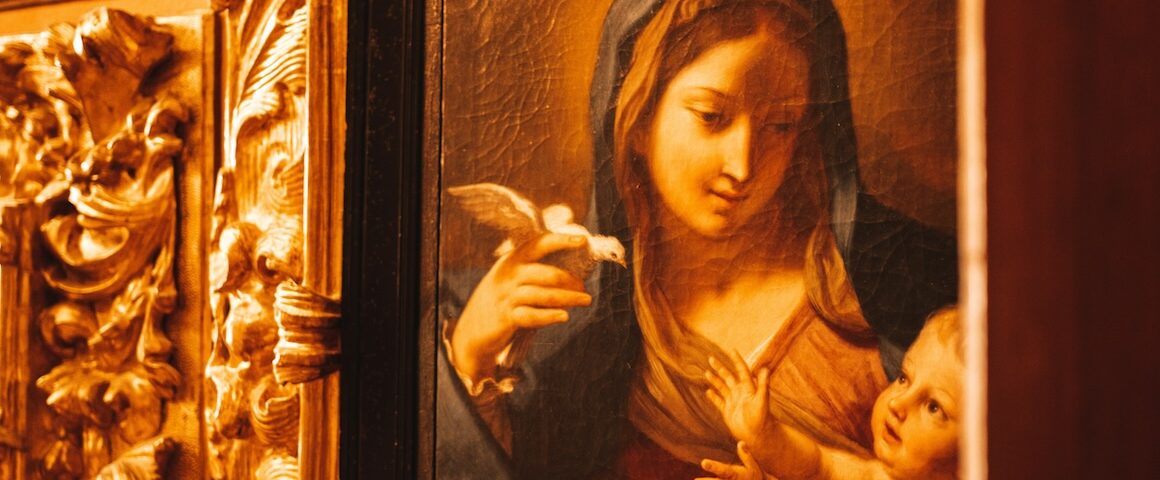
The Books of Homilies, for example, give sound guidance on the Marian piety expected to be found in Anglican sermons and services. In “The Second Part of the Homily Against Disobedience and Wilful Rebellion,” one of the Anglican Way’s official sermons “to be read in churches by the ministers diligently”[1] holds up “the blessed Virgin Mary” as an exemplar in refusing to disobey a lawful sovereign’s commands: “neither did the blessed Virgin—though both highly in God’s favour, and also being of the royal blood of the ancient natural kings of Jewry—disdain to obey the commandment of an heathen and foreign prince, when God had placed such a one over them…but all excuses set apart, she obeyed. This obedience of this most noble and virtuous lady, to a foreign and pagan prince, doth well teach us, who in comparison to her are most base and vile, what ready obedience we do owe, to our natural and gracious Sovereign.”[2] The most noble and virtuous lady to whom, in comparison, we are most base and vile: here we see the great humility to be expressed by preacher and people coupled with the high praise and esteem with which St. Mary the Virgin should be held. The same collection of official sermons, and most likely the same author, balances this high praise with stern warnings against the peril of polluting the pure worship of Almighty God through the popular idolatry sadly connected, then and now, to our most noble and virtuous lady.[3]
This balance fits the Scriptural record quite well, wherein we read in the Gospel of John, “When Jesus therefore saw his mother, and the disciple standing by, whom he loved, he saith unto his mother, Woman, behold thy son! Then saith he to the disciple, Behold thy mother! And from that hour that disciple took her unto his own home” (St. John 19:26-27). Here, we see that Christians should follow in the footsteps of the Beloved Disciple in cherishing and honoring the mother of our Lord, and of course, in cherishing and honoring our own earthly mothers in humble imitation of Christ. We do all of that without ignoring our Lord’s words found in St. Luke’s Gospel, “And it came to pass, as he spake these things, a certain woman of the company lifted up her voice, and said unto him, Blessed is the womb that bare thee, and the paps which thou hast sucked. But he said, Yea rather, blessed are they that hear the word of God, and keep it” (St. Luke 11:27-28).
The Meaning of Mary’s Purity in the Christmas Collect
We should not see it as a surprise that the official sermons written and promulgated when our Book of Common Prayer was adopted and regularized are in continuity and provide context for that same Book of Common Prayer. This continuity can also be found when we examine the treatment of the Christmas Collect[4] in relation to the Articles of Religion. Of particular interest in the recent NAA piece is the phrase, “of a pure virgin,” with the word “pure” being set-aside for particular scrutiny. Massey Shepherd, whose mid-20th century commentary on the 1928 Book of Common Prayer has a unique status as the only long-form commentary on the 1928 Book of Common Prayer, is brought to bear on the question of what “pure” means, and Shepherd rather cryptically writes this, “Specifically, the Collect is woven into three themes: (1) the birth of the Only-begotten Son of God in the substance of our human nature is linked with the idea of rebirth in Baptism by ‘pure’ water (cf. 273) and the Holy Spirit…”[5] The rubric on page 273 of the 1928 Book of Common Prayer reads, “The Minister, having come to the Font, which is then to be filled with pure Water…” Shepherd leaves it there, but the conclusion the Rev. Jenkins comes to is, “…the status we are given by Baptism and its pure waters is the status Mary has without it.” That conclusion could very well be what Shepherd is reaching for (anyone who reads Shepherd with regularity knows he can be fairly accused of shooting from the hip from time to time), but, in this case, Shepherd does not state this position explicitly in the text of his commentary.
The problem with such a conclusion is that it would be a direct contradiction of the other formularies (some of them written by the same author of the Christmas Collect). Article 9 (Of Original or Birth Sin)[6] describes “the fault and corruption of the nature of every man that is naturally engendered of the offspring of Adam,” and then Article 15 (Of Christ Alone without Sin)[7] gives the one exception to this reality. The authors of Article 15, who included the author of the Christmas Collect, were not suffering from a systemic ink shortage which prevented them from adding our most noble and virtuous lady to the list of sinless humanity, and so we should be quite careful in pitting one possible meaning of a word in the collect against the helpful clarity found in our more precise theological documents.
The General Necessity of Baptism
Further, regarding the necessity of baptism, the catechism in The Book of Common Prayer is clear: “How many sacraments hath Christ ordained in his church? A. Two only, as generally necessary to salvation – that is to say, baptism and the supper of the Lord.” A common misunderstanding of the word “generally” used here has led to many believing that these two dominical sacraments are only necessary in most cases, but the term delineates the sacraments from those other sacramental activities which mankind may or may not pursue (holy orders, marriage, etc.). In our own age, where baptism is held in such low regard among so many people, I see no utility in teaching that the greatest woman who ever lived did not need to be baptized, and more importantly, the evidence in the Bible, and the formularies which reflect the truth of that sacred text, do not support such a teaching either.
Now, in the above-mentioned conversation with the Rev. Jenkins, he clarified to me that “I’m not even arguing that this is theologically correct. I certainly would not be comfortable preaching Mary’s sinlessness. The goal was just to see what the witness of the BCP and the approved hymnals was.” Fair enough, but I would humbly caution against us clergy publicly arguing that the Book of Common Prayer might teach a doctrine in contradiction of Articles 9 and 15, but then say we don’t have to believe that doctrine even if it is (maybe?) found in an important collect. Either the Christmas Collect is breaking Article 6[8] in demanding churchmen believe a doctrine that cannot be proved by Scripture (that Mary was sinless or saved in a way not mentioned in Scripture), or alternatively, perhaps the collect is in agreement with those articles and Thomas Cranmer, archbishop and martyr, was utilizing one of the other meanings of “pure” (absolute, genuine), or engaging in his common practice of using extra words with the same meaning to enhance the rhythm of the text and to help the prayer stick in the memory of the hearer. I lean heavily towards the latter two explanations.
With the merits of the case to one side, it is important to remember that the pious opinions of Anglican theologians (from any century) and the work of speculative theology are fascinating and quite important, but that is not the same thing as claiming the formularies teach, and thus require loyal churchmen to believe, doctrines which are speculative and unnecessary. This distinction can be made to some extent by clergy, but a layman will struggle mightily to understand what is expected of him unless a firm line of demarcation is made between speculative theology and the ordered life of a Christian jurisdiction found in her formularies. This line of demarcation is incredibly important as it protects a congregation from the pious and often evolving opinions of their priest (the present author being the chief of sinners). For example, a clergyman might have very strong opinions about the exact contours of reprobation and double predestination, but he is held in check by the boundaries of Article 17 in his public preaching, teaching, and work as an officer in the church. In that humble acknowledgment of authority, guiding us in and through countless other controversies, the common life of the church can flourish while still allowing plenty of room for the brilliant theological minds of each generation to write and work to better understand and worship God with our whole hearts, souls, and minds.
Beyond Pious Opinion
Finally, a brief note on the final paragraph of the article: “What of it? While some Anglicans join Roman Catholics and Orthodox Christians in a robust Marian piety, this is not the norm. In its absence, is there anything that can be made of these truths? Yes! Especially in light of traditional Anglicanism’s insistence on a male only priesthood, it is important to focus on the role of women.” The priesthood of the Anglican Church as specified in the traditional ordinal flows from the natural order of a household—a reality evident from the qualifications St. Paul provides for St. Timothy and St. Titus. The Anglican Way is the tradition from which the great expositor of the natural law, Richard Hooker, sprang forth, and so we should be on the forefront of using that deep well in defense of a priesthood filled, not just with men, but with men who bring peace and order to their homes and to the houses of God. Men do not get their value from being placed in positions of leadership, just as women do not get their value from a church more often mentioning St. Mary the Virgin. Our value as people who were dead and are now alive flows from the God/Man who died for the sins of the whole world. The attitude we bring to church should not be: “How does the theology and worship of my church help me feel valued as a member of my sex?” Nor should it be: “Well, if the church doesn’t value me and my sex I will go someplace else.” Who do we think we are talking to? We worship the Almighty God, not a teenager taking our order at Burger King. The rule of faith found in the traditional Book of Common Prayer is the place where we learn to take up our cross and assassinate the old man of sin calling us back to the slave houses from which we were freed. We are not negotiating; we are being rescued. There is no special Christianity for men and no special Christianity for women: no christened chauvinism or baptized feminism. There is only Word and Sacrament, heaven and hell, death and life, and each of these is as true for a woman as for a man.
Let us then honor and cherish St. Mary the Virgin, respect and defend the line between speculation and common prayer, and seek to be shaped and formed into the image of Christ through the Anglican Way.
Image credit: Unsplash.
Notes
- Article 35: The Second Book of Homilies, the several titles whereof we have joined under this Article, doth contain a godly and wholesome Doctrine, and necessary for these times, as doth the former Book of Homilies, which were set forth in the time of Edward the Sixth; and therefore we judge them to be read in Churches by the Ministers, diligently and distinctly, that they may be understanded of the people… ↑
- The Homilies: Appointed To Be Read in Churches, ed. John Griffiths (Herefordshire: Brynmill/Preservation Press, 2006), 412-413 Books of Homilies page 412-413 ↑
- Ibid., 140, 177. (See “Against Peril of Idolatry) ↑
- Almighty God, who hast given us thy only-begotten Son to take our nature upon him, and as at this time to be born of a pure virgin: Grant that we, being regenerate and made thy children by adoption and grace, may daily be renewed by thy Holy Spirit, through the same our Lord Jesus Christ, who liveth and reigneth with thee and the same Spirit, ever one God, world without end. Amen. ↑
- Shepherd, Massey Hamilton, Jr., The Oxford American Prayer Book Commentary (New York: Oxford University Press, 1950), 96-97. ↑
- Article 9: Of Original or Birth-Sin. Original sin standeth not in the following of Adam, (as the Pelagians do vainly talk;) but it is the fault and corruption of the Nature of every man, that naturally is engendered of the offspring of Adam; whereby man is very far gone from original righteousness, and is of his own nature inclined to evil, so that the flesh lusteth always contrary to the Spirit; and therefore in every person born into this world, it deserveth God’s wrath and damnation. And this infection of nature doth remain, yea in them that are regenerated; whereby the lust of the flesh, called in Greek, ,(which some do expound the wisdom, some sensuality, some the affection, some the desire, of the flesh), is not subject to the Law of God. And although there is no condemnation for them that believe and are baptized; yet the Apostle doth confess, that concupiscence and lust hath of itself the nature of sin. ↑
- Article 15: Of Christ alone without Sin. Christ in the truth of our nature was made like unto us in all things, sin only except, from which he was clearly void, both in his flesh, and in his spirit. He came to be the Lamb without spot, who, by sacrifice of himself once made, should take away the sins of the world; and sin (as Saint John saith) was not in him. But all we the rest, although baptized and horn again in Christ, yet offend in many things; and if we say we have no sin, we deceive ourselves, and the truth is not in us. ↑
- Article 6: Of the Sufficiency of the Holy Scriptures for Salvation. Holy Scripture containeth all things necessary to salvation: so that whatsoever is not read therein, nor may be proved thereby, is not to be required of any man, that it should be believed as an article of the Faith, or be thought requisite or necessary to salvation… ↑